Provenance
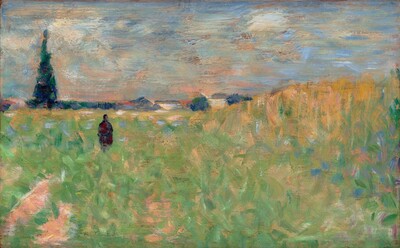
Georges Renand [1879-1968], at least in 1965.[1] Paul Mellon [1907-1999], Upperville, Virginia; bequest 1999 to NGA, with life interest to his wife, Rachel Lambert Mellon [1910-2014].
[1] Renand, a director of the French department store La Samaritaine, lent the painting to a 1965 exhibition in Chartres. The painting did not appear in any of the four sales of Renand's collection (Hôtel Drouot, Paris: 20 November 1987, and 15 March, 31 May, and 13 December, all 1988).
Accession Number
2014.18.54
Medium
oil on wood
Dimensions
N/A
Classification
Painting
Credit Line
Collection of Mr. and Mrs. Paul Mellon
Tags
Painting Impressionist & Modern (1851–1900) Oil Painting French
Background & Context
Background Story
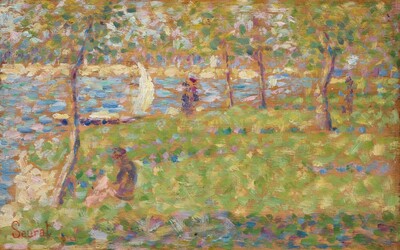
This study for Seurat's first major painting, Bathers at Asnieres (1884, National Gallery London), captures the riverside scene with an immediacy that would be calibrated out of the final version. The bathers are seen along the Seine at the industrial suburb of Asnieres, their relaxed postures contrasting with the factory chimneys visible across the river. This juxtaposition of leisure and industry, nature and modernity, was Seurat's great subject from the beginning — and it distinguished him from the Impressionists, who preferred to ignore industrial modernity in favor of rural or suburban idylls.
Cultural Impact
The study format allows Seurat to work rapidly and empirically, testing color relationships and tonal values before committing to the large canvas. The brushwork here is still essentially Impressionist — small, varied strokes that record optical sensations. What is already distinctive is Seurat's compositional discipline: the figures are placed with geometric precision in relation to each other and the landscape, achieving a stability that Impressionist compositions typically lack.
Why It Matters
This study is the laboratory where Seurat's revolution began. The combination of Impressionist color and pre-classical compositional rigor was unprecedented, and it would reshape European painting within a decade.