Provenance
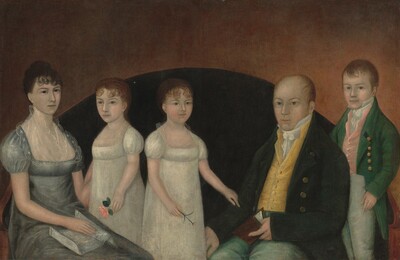
The sitter, Grace Allison McCurdy [1775-1822, Mrs. Hugh McCurdy, later Mrs. Edward N. Clopper]; by inheritance to her daughter, the sitter Letitia Grace McCurdy Douglass [1797-1875, Mrs. Richard Henry Douglass], Baltimore; by inheritance to her daughter, Grace Douglass; by descent to her daughter, Mrs. Joseph Earl Moore, Baltimore; by inheritance by 1958 to her son, Allen F. Voshell, Jr., Baltimore; (sale, Phillips, New York, 17 May 1982, no. 394); (Hirschl & Adler Galleries, New York); purchased 1983 by the Corcoran Gallery of Art, Washington; acquired 2014 by the National Gallery of Art.
Grace Allison McCurdy (Mrs. Hugh McCurdy) and Her Daughters, Mary Jane and Letitia Grace
c. 1806
Accession Number
2014.136.146
Medium
oil on canvas
Dimensions
overall: 110.8 × 98.8 cm (43 5/8 × 38 7/8 in.) | framed: 125.57 × 113.51 × 8.1 cm (49 7/16 × 44 11/16 × 3 3/16 in.)
Classification
Painting
Credit Line
Corcoran Collection (Museum Purchase through the gifts of William Wilson Corcoran, Elizabeth Donner Norment, Francis Biddle, Erich Cohn, Hardinge Scholle and the William A. Clark Fund)
Tags
Painting Neoclassical & Romantic (1751–1850) Oil Painting Canvas American
Background & Context
Background Story
Pilgrimage to Cythera, painted in 1717, is the founding work of the fete galante - a new category of painting that Watteau invented and that the French Academy officially recognized in 1717. The painting depicts a group of elegantly dressed couples gradually making their way toward a boat that will carry them to Cythera, the mythical birthplace of Venus.
The painting's mood is one of wistful melancholy. The couples move toward the boat in a slow, reluctant procession, as though reluctant to leave the beautiful garden where they stand. Their poses suggest not eager anticipation but a mixture of desire and regret. Even the statue of Venus in the glade seems to mourn rather than celebrate.
Watteau invented the fete galante to solve a professional problem: the French Academy's rigid hierarchy of genres left no place for his particular talent - the painting of beautiful young people in beautiful landscapes. By creating a new category, Watteau made room for his own art and changed the Academy's system from within.
Cultural Impact
Watteau's fete galante created a new genre and a new sensibility in European art: the melancholy awareness that beauty and pleasure are fleeting. His influence on French painting was immeasurable: Fragonard, Boucher, Ingres, and even Manet all worked in his shadow.
Why It Matters
Pilgrimage to Cythera is the most beautiful statement of Watteau's central theme: the bittersweet knowledge that the most exquisite moments are the most transient. The painting's couples, moving reluctantly toward a boat that will carry them to the island of love, embody the Rococo's deepest truth - that paradise is imaginary, and that the journey toward it is more beautiful than the arrival.