Provenance
Given by Corot to his god-daughter, Mme. Renaut, at the time of her first communion;[1] purchased by (Georges Petit, Paris) by 1898;[2] sold to Albert, vicomte de Curel [1827-1928], Paris;[3] his heirs; (his estate sale, Galerie Georges Petit, 25 November 1918 [originally scheduled for 3 May 1918], no. 1, as _Le Lac de Terni_); purchased jointly by (Arnold & Tripp, Paris) and (M. Knoedler & Co., New York);[4] purchased April 1919 by William Andrews Clark [1839-1925], New York, as _Le Lac de Terni_;[5] bequest 1926 to the Corcoran Gallery of Art, Washington; acquired 2015 by the National Gallery of Art.
[1] See M. Knoedler & Co. Records, accession number 2012.M.54, Research Library, Getty Research Institute, Los Angeles: Sales book 11, p. 253.
[2] See Alfred Robaut, _L'Oeuvre de Corot_, Paris, 1905: 224, no. 1943.
[3] The vicomte de Curel has been identified by François Auffret, Président of La Société des Amis de Jongkind in Paris (founded 1970), with confirmation from the collector's descendants. With M. Auffret's kind permission, his research was shared with the Corcoran Gallery of Art by Dr. Diana Kostyrko (see her e-mail from 11 November 2008 in NGA curatorial files).
[4] See M. Knoedler & Co. Records, accession number 2012.M.54, Research Library, Getty Research Institute, Los Angeles: Stock book 6, no. 14539, p. 181, row 47.
[5] See M. Knoedler & Co. Records, accession number 2012.M.54, Research Library, Getty Research Institute, Los Angeles: Stock book 6, no. 14539, p. 181, row 47.
Accession Number
2015.19.25
Medium
oil on canvas
Dimensions
overall: 60.96 × 90.17 cm (24 × 35 1/2 in.) | framed: 83.82 × 114.3 × 11.43 cm (33 × 45 × 4 1/2 in.)
Classification
Painting
Credit Line
Corcoran Collection (William A. Clark Collection)
Tags
Painting Impressionist & Modern (1851–1900) Oil Painting Canvas French
Background & Context
Background Story
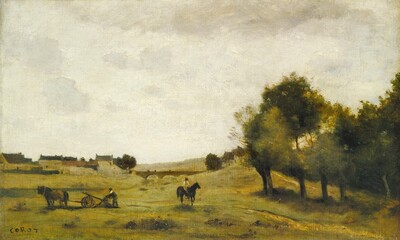
The Moored Boatman: Souvenir of an Italian Lake (1861) combines two of Corot's signature elements—the Italian souvenir subject and the boatman figure that appeared in his lake landscapes throughout his career. The word souvenir in the title indicates that this is not a painting made on location in Italy but a studio composition based on memory of Italian lake landscapes, filtered through Corot's mature aesthetic sensibility. The boatman—moored at the edge of a lake, his boat tied to a landing—provides the human element that animates the landscape without overwhelming it, a compositional strategy that Corot perfected and that influenced later landscape painters. The year 1861 places this during Corot's most productive late period, when his Italian souvenir subjects had achieved the synthesis of memory and imagination that distinguished them from the more topographical Italian views of his early career. The moored boat itself—a flat-bottomed vessel typical of Italian lakes—provides a compositional anchor that organizes the lake surface and creates the reflective depth that was Corot's greatest technical achievement. The boatman, rendered with Corot's characteristic economy—a few carefully placed strokes suggesting figure, posture, and activity without detailed description—demonstrates the late Corot's ability to suggest more than he described, a quality that the Impressionists would develop into a fundamental artistic principle.
Cultural Impact
Corot's Italian lake souvenirs influenced how memory-based landscape was practiced in French art, establishing the compositional approach that distinguished studio work from plein-air painting. The boatman figure influenced how human presence was represented in landscape, establishing the small, economically rendered figure that became standard in Corot-influenced painting. The souvenir subject influenced how Italian landscapes were understood in French art, contributing to the idealized vision of Italy that was central to French artistic culture.
Why It Matters
This painting matters because it represents the Corot method at its most characteristic: memory, imagination, and artistic sensibility combining to produce landscape compositions that were simultaneously Italian and Corot's own, and that argued for the artist's right to transform remembered experience into poetic vision rather than to merely record observed reality.