
Provenance
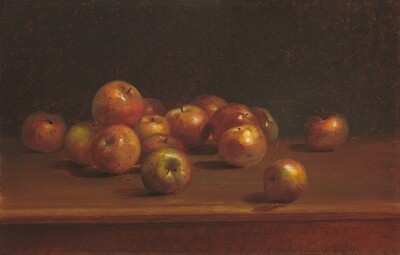
(The Cooley Gallery, Old Lyme, Connecticut); purchased 2004 by William H. [1929-2020] and Abigail Booth Gerdts, New York;[1] gift 2018 to NGA.
[1] Per documention from Abigail Booth Gerdts provided with the gift, in NGA curatorial files.
Accession Number
2018.44.124
Medium
oil on canvas
Dimensions
overall: 45.72 × 40.64 cm (18 × 16 in.) | framed: 61.6 × 56.52 × 4.45 cm (24 1/4 × 22 1/4 × 1 3/4 in.)
Classification
Painting
Credit Line
Gift of William and Abigail Gerdts
Tags
Painting Impressionist & Modern (1851–1900) Oil Painting Canvas American
Background & Context
Background Story
Charles Ethan Porter's "Peonies in a Vase" (c. 1885) is a sumptuous still life depicting a generous arrangement of full-blown peonies in a glass vase, their ruffled petals and lush foliage rendered with the meticulous precision and vibrant color that made Porter the most accomplished African American still-life painter of the nineteenth century. The peonies cascade over the edges of the vase in a lavish display of natural abundance, their colors ranging from deep crimson through blush pink to creamy white, creating a chromatic symphony that fills the canvas.
Porter (1847–1923) was born in Hartford, Connecticut, and spent most of his career in the Rockville neighborhood of Vernon, Connecticut, painting the flowers, fruits, and vegetables of his rural New England surroundings. He studied at the National Academy of Design in New York and was one of the first African American artists to exhibit there. He later studied in Paris, where he was influenced by the French still-life tradition — particularly the work of Henri Fantin-Latour, whose flower paintings were internationally admired. Despite these accomplishments, Porter's race and his choice of subject matter — still life, rather than the history painting or portraiture that were considered more prestigious — limited his recognition during his lifetime and for decades afterward.
Porter's still lifes are distinguished by their technical excellence and their intimate knowledge of the natural world. He painted his flowers from life, often growing them in his own garden, and his understanding of botanical structure is evident in every petal, leaf, and stem. The peonies in this painting are not generic decorations but specific, individualized blooms — each one slightly different in form and color, as real flowers always are. This botanical accuracy, combined with Porter's compositional skill and chromatic sensitivity, places his work firmly in the tradition of the best American still-life painting.
The choice of peonies as a subject was both aesthetic and cultural. Peonies were among the most popular flowers in late-nineteenth-century America, prized for their enormous, showy blooms and intoxicating fragrance. In the language of flowers, peonies symbolized prosperity and good fortune — meanings that may have resonated with Porter, who struggled financially throughout his career despite his artistic gifts. The lavish abundance of the arrangement suggests a defiance of poverty: these are not the sparse blooms of an artist who cannot afford cut flowers, but a generous, almost extravagant display that insists on the beauty and richness of the natural world.
Porter's rediscovery in the late twentieth century — part of the broader effort to recover the achievements of African American artists who had been excluded from the mainstream art historical narrative — has revealed him as a major figure in American still-life painting whose technical mastery and artistic vision deserve recognition alongside his more famous contemporaries.
Cultural Impact
Porter's rediscovery has restored one of the most accomplished African American artists of the nineteenth century to the art historical canon, demonstrating that technical mastery and artistic vision existed in Black artistic communities that were systematically excluded from recognition.
Why It Matters
This painting of lavish peonies — painted by a financially struggling African American artist who nevertheless insisted on beauty's abundance — represents Porter's technical mastery and his quiet assertion that artistic excellence transcends racial barriers.
![Saint Bernard and Saint Catherine of Alexandria with the Virgin of the Annunciation [right panel]](https://api.nga.gov/iiif/e6890364-4d99-4684-a62b-5060ee3c3446/full/400,/0/default.jpg)