Provenance
Private collection, Sweden, by 1934. (Richard Green, London); purchased July 1982 by Paul Mellon [1907-1999], Upperville, Virginia; by inheritance to his wife, Rachel Lambert Mellon [1910-2014], Upperville; (her estate sale, Sotheby's, New York, 10 November 2014, no. 31); (Johnny Van Haeften, Ltd., Ham, near Richmond); purchased 29 June 2018 by NGA.
Accession Number
2018.41.1
Medium
oil on copper
Dimensions
overall: 11.5 × 14 cm (4 1/2 × 5 1/2 in.)
Classification
Painting
Credit Line
The Richard C. Von Hess Foundation, Nell and Robert Weidenhammer Fund, Barry D. Friedman, and Friends of Dutch Art
Tags
Painting Baroque (1600–1750) Oil Painting Copper Flemish
Background & Context
Background Story
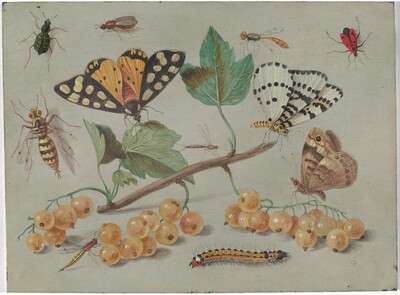
Jan van Kessel the Elder (1626-1679) was a Flemish painter known for his precisely observed small-scale paintings of insects, flowers, and naturalia on copper panels that combine scientific accuracy with artistic beauty in the manner of the Flemish cabinet painting tradition. Insects and a Sprig of Rosemary from 1653 depicts insects on a sprig of rosemary in the precisely observed, small-scale manner that distinguishes Kessel's best work. The 1653 date places this in Kessel's most productive period, when he was producing the small-scale naturalia paintings on copper that are his most accomplished works.
Cultural Impact
Insects and a Sprig of Rosemary is important in the history of Flemish painting because it demonstrates the precisely observed naturalia painting on copper that Kessel developed as a specialized genre within the Flemish cabinet painting tradition. Kessel's small-scale paintings of insects, flowers, and naturalia on copper panels represent the intersection of art and science in 17th-century Flanders, and the 1653 painting shows the scientific accuracy and artistic beauty that make this intersection one of the most accomplished traditions in Flemish painting.
Why It Matters
Insects and a Sprig of Rosemary is Kessel's naturalia on copper: insects and rosemary rendered with the precise observation and small-scale beauty that make his naturalia paintings the intersection of art and science in 17th-century Flanders. The 1653 painting on copper shows the Flemish cabinet painting tradition at its most scientifically accurate and artistically beautiful.