Provenance
Private Collection, Palo Alto, California; (Catherine Burns Fine Arts, Berkeley, CA , 2001); Hirschl & Adler Galleries, New York; National Gallery of Art, 2021
Accession Number
2021.16.1
Medium
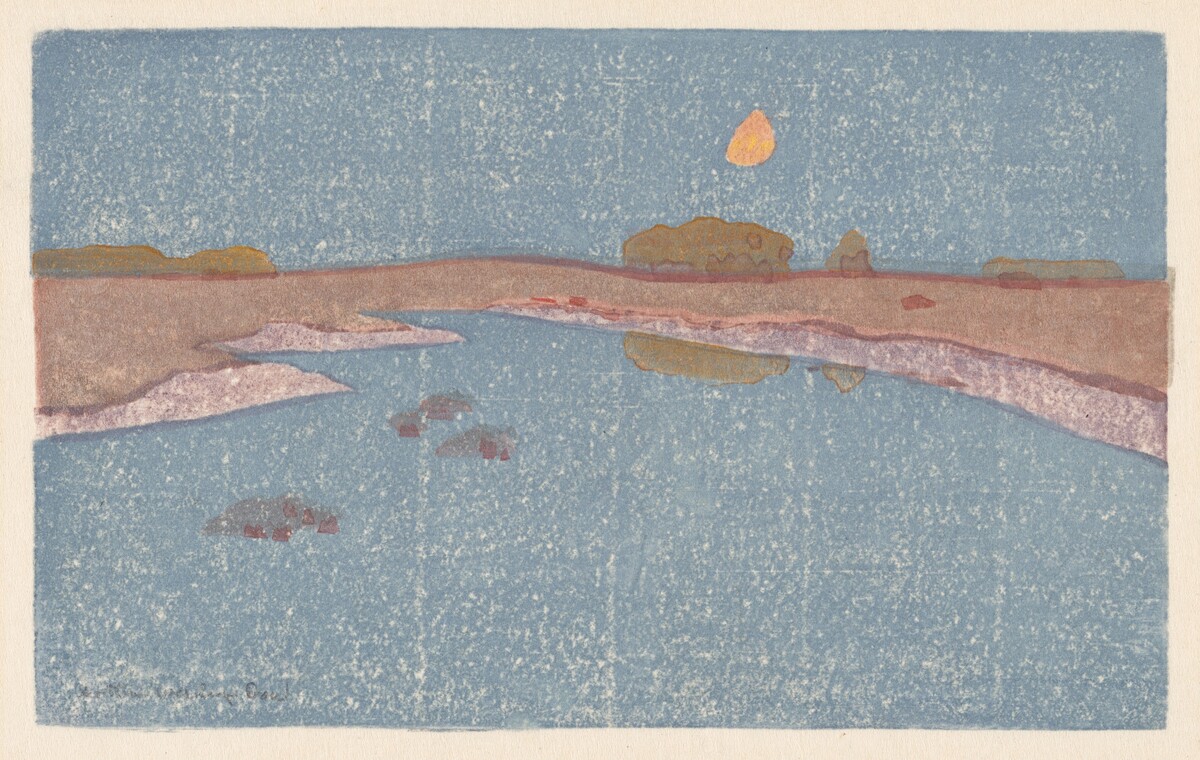
color woodcut on laid paper
Dimensions
image: 10.9 × 17.7 cm (4 5/16 × 6 15/16 in.) | sheet (irreg.): 13.4 × 20.1 cm (5 1/4 × 7 15/16 in.)
Classification
Credit Line
Ailsa Mellon Bruce Fund
Background & Context
Background Story
Bacchus and Ariadne, painted between 1520 and 1523, depicts the moment when Bacchus leaps from his chariot to rescue Ariadne, whom Theseus has abandoned on Naxos. The painting captures the instant before Bacchus lifts Ariadne to the stars, where she will become the constellation Corona Borealis.
Commissioned by Alfonso d'Este, Duke of Ferrara, for his Camerino d'Alabastro, the painting transformed a decorative commission into one of the most dynamic works of the High Renaissance. Bacchus's leap - a mid-air gesture of explosive energy - contrasts with Ariadne's static grief, creating dramatic tension that would define Baroque painting. Titian's color - ultramarine sky, crimson cloak, green landscape - achieved a richness that set the standard for Venetian painting.
Cultural Impact
Titian's Bacchus and Ariadne established the mythological narrative painting as a vehicle for the most ambitious color and compositional experimentation. Rubens, Delacroix, and the Impressionists all acknowledged Titian as their master in color.
Why It Matters
This painting captures the most dynamic moment in Titian's art: when grief transforms into rapture, when the abandoned woman meets the god who will make her immortal. Bacchus's leap across the canvas is the leap of imagination itself.