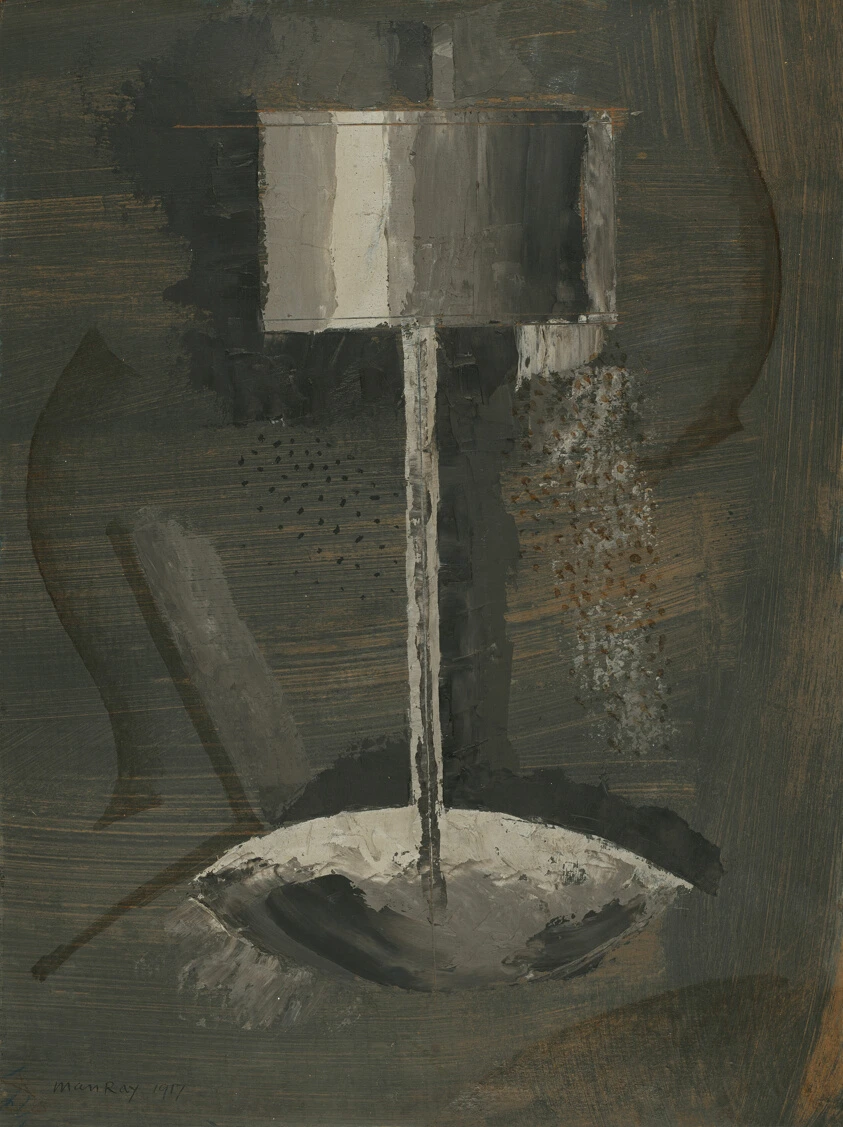
Description
In 1918, in New York, Man Ray decided to paint without making use of any of the traditional tools of the painter-neither an easel, nor brushes, palette, or tubes of color. Instead, he used a spray gun, and he called the resulting paintings "aerographs." The All-Seeing Eye, while not an "aerograph," is informed by Man Ray's experiments with industrial techniques.
Provenance
Given by the artist to Mary Reynolds (1891–1950) [letter from Elizabeth Humes to Frank Hubachek dated Feb. 5, 1964 and letter from Hubachek to AIC Registration staff dated Feb. 17, 1964, both in curatorial file]; to Reynolds estate (Frank Hubachek (1894–1986) and Marcel Duchamp (1887–1968) co-executors), 1950–1963 (lent by the estate to Reynolds’s friend, Elizabeth Humes, Rome, 1950–1963) [Humes affidavit dated Sept. 10, 1963 and Hubachek letter dated Feb. 17, 1964, both in curatorial file]; given by Frank Hubachek, Chicago, to the Art Institute of Chicago for the Mary Reynolds Collection, 1963 [work arrived at the Art Institute of Chicago in 1963 (RX4447, dated Oct. 29, 1963) but was never formally accessioned].
Accession Number
113495
Medium
Airbrush and brush and gouache on tan wood-pulp laminate board
Dimensions
30.5 × 24.6 cm (12 1/16 × 9 11/16 in.)
Classification
gouache
Credit Line
Gift of Mr. Frank B. Hubachek