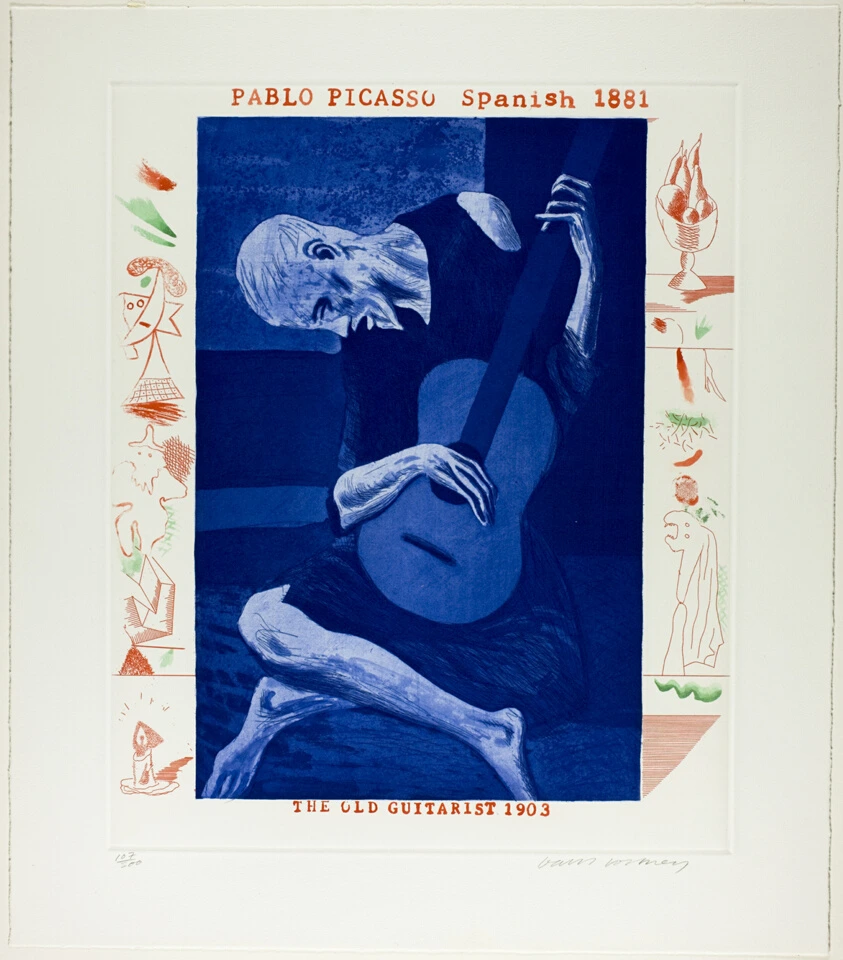
The Old Guitarist, from The Blue Guitar

Description

Since the early 1960s, David Hockney has sought ways to meld his modern aesthetic style with highly personalized subject matter. He started by inserting fragments of poems into his paintings, as, for example, in We Two Boys Together Clinging (1961), which integrates two lines from a Walt Whitman poem of the same title. Fifteen years later, inspired by Wallace Stevens’s “The Man with the Blue Guitar” (1937), with its themes of representation and imaginative transformation, Hockney made 10 drawings in colored inks and crayons. With the aid of master printer Aldo Crommelynck those drawings were converted into 20 mixed intaglio prints using a color-etching process initially developed for Pablo Picasso.

While not a literal illustration of Stevens’s poem, the print series The Blue Guitar interprets its themes in visual terms, and most of the images show Hockney’s love of Picasso. The print Old Guitarist juxtaposes the Art Institute’s famous painting of 1903–04 (1926.253) with later Picasso iconography. Other sheets likewise contrast Picasso’s different phases within the same image; throughout the series, Hockney distinguishes the disparate styles by using different colors.

It is perhaps Hockney’s Blue Guitar that has perpetuated the idea that Wallace Stevens was similarly inspired by Picasso’s Old Guitarist. Although Stevens was familiar with modern art and no doubt saw the painting when it was exhibited at the Wadsworth Atheneum in 1934, he insisted that no one picture inspired his famous poem.

The Old Guitarist, from The Blue Guitar

David Hockney

1976–77

Accession Number

131299

Medium

Color etching and aquatint from two copper plates on white wove paper

Dimensions

Plate: 42.5 × 34.5 cm (16 3/4 × 13 5/8 in.); Sheet: 52.5 × 46 cm (20 11/16 × 18 1/8 in.)

Classification

etching

Museum

The Art Institute of Chicago

Chicago, United States

Credit Line

Mrs. Solomon B. Smith Memorial Fund
Background & Context

Background Story

"The Old Guitarist, from The Blue Guitar" is a 1976–77 color etching and aquatint by David Hockney that belongs to the series of prints in which the British artist paid homage to Pablo Picasso while asserting his own distinctive vision, the image reinterpreting Picasso's famous Blue Period painting through the medium of etching and the sensibility of Hockney's California period. The composition shows the old guitarist in the characteristic pose of Picasso's original, the hunched figure and the oversized instrument rendered in Hockney's bright, high-keyed palette that transforms the melancholy of the Blue Period into something more vibrant and contemporary, the etching technique creating a surface of extraordinary tonal subtlety that suggests both the poverty of the subject and the richness of the artistic tradition. The white wove paper provides a clean, bright ground that makes the colors appear luminous and the lines crisp, the contrast between the subject matter and the cheerful palette creating a tension that is characteristic of Hockney's most interesting works. The 1976–77 date places this print in the period of Hockney's most intensive engagement with the print medium, when he was producing the series of etchings, lithographs, and photocollages that established his reputation as one of the great graphic artists of the postwar period. Art historians have connected this print to the broader tradition of the artist's homage to the master, from the copies of the Renaissance apprentices to the reinterpretations of the modernists, noting that Hockney's treatment is more playful, more focused on the pleasure of artistic conversation than the dutiful imitation of these predecessors.

Cultural Impact

This 1976–77 color etching transformed Picasso Blue Period melancholy into Hockney California vibrancy, using aquatint tonal subtlety and white-paper luminosity to make old-guitarist homage playful artistic-conversation rather than dutiful master-imitation.

Why It Matters

It matters because Hockney etched Picasso's old man and made him look like he was playing in the California sun—proving that even the blues could be bright if the aquatint was cheerful enough.