A Sunday on La Grande Jatte — 1884

Description

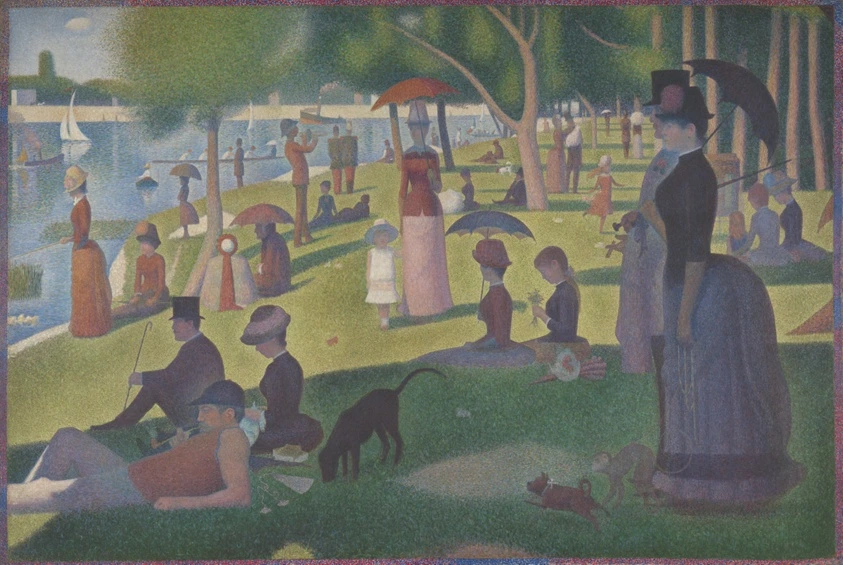
In his best-known and largest painting, Georges Seurat depicted people from different social classes strolling and relaxing in a park just west of Paris on La Grande Jatte, an island in the Seine River. Although he took his subject from modern life, Seurat sought to evoke the sense of timelessness associated with ancient art, especially Egyptian and Greek sculpture. He once wrote, “I want to make modern people, in their essential traits, move about as they do on those friezes, and place them on canvases organized by harmonies of color.”

Seurat painted A Sunday on La Grande Jatte—1884 using pointillism, a highly systematic and scientific technique based on the hypothesis that closely positioned points of pure color mix together in the viewer’s eye. He began work on the canvas in 1884 (and included this date in the title) with a layer of small, horizontal brushstrokes in complementary colors. He next added a series of dots that coalesce into solid and luminous forms when seen from a distance. Sometime before 1889 Seurat added a border of blue, orange, and red dots that provide a visual transition between the painting’s interior and the specially designed white frame, which has been re-created at the Art Institute.

Provenance

By descent to Mme. Seurat, the artist’s mother (died 1899), Paris, 1891; by descent to Emile Seurat, the artist’s brother; sold for 800 francs to Casimir Brû, Paris, 1900; given by him to his daughter, Lucie, Paris, 1900; Lucie Brû Cousturier and Edmond Cousturier, Paris; sold for $20,000 possibly through Charles Vildrac, Paris to Frederic Clay and Helen Birch Bartlett, Chicago, 1924; given to the Art Institute, 1926.

A Sunday on La Grande Jatte — 1884

Georges Seurat

1884–86, border added 1888–89

Accession Number

27992

Medium

Oil on canvas

Dimensions

207.5 × 308.1 cm (81 3/4 × 121 1/4 in.)

Classification

oil on canvas

Museum

The Art Institute of Chicago

Chicago, United States

Credit Line

Helen Birch Bartlett Memorial Collection

Background & Context

Background Story

In his best-known and largest painting, Georges Seurat depicted people from different social classes strolling and relaxing on La Grande Jatte, an island in the Seine River just west of Paris. The scene is ordinary — families picnicking, couples walking, children playing — yet Seurat transformed it into something monumental and timeless. He wrote: 'I want to make modern people, in their essential traits, move about as they do on those friezes, and place them on canvases organized by harmonies of color.'

Cultural Impact

Pointillism influenced artists from Signac and Cross to later Op Art and even digital pixel art. The painting's frozen, almost robotic figures — despite depicting a leisurely Sunday — create an uncanny atmosphere that anticipated 20th-century concerns about alienation in modern life.

Why It Matters

La Grande Jatte represents a revolutionary fusion of scientific color theory and artistic expression. Seurat applied tiny dots of pure color, letting the viewer's eye mix them optically — a technique that challenged the entire tradition of painterly color mixing and opened the door to systematic, almost mathematical approaches to art.