A Chemist Lifting with Extreme Precaution the Cuticle of a Grand Piano

Description

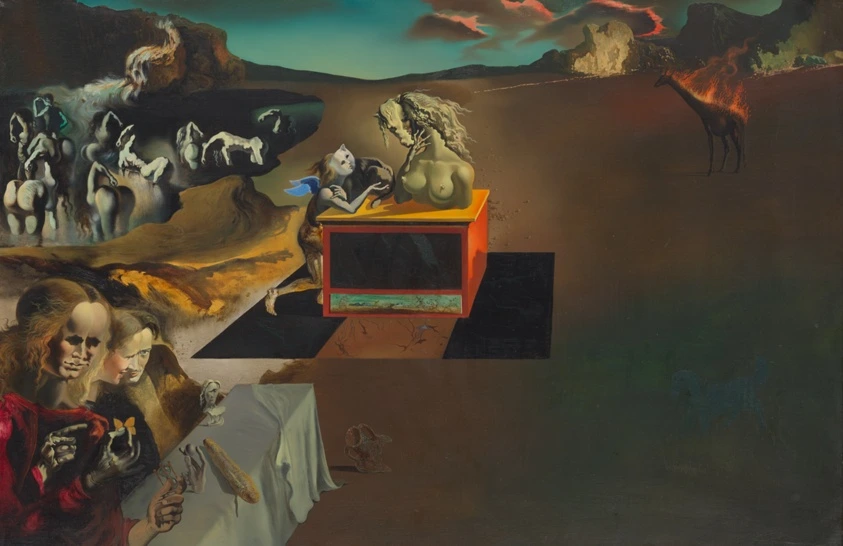
When this painting was first shown in Chicago in 1937, Salvador Dalí told a reporter that he intended to induce a feeling of malaise in the viewer. He expanded, “It is impossible to ask for an explanation. I try to get the nearest to a certain thing as seen in a dream.” The figures shown here often have multiple readings or identities: his hometown pharmacist or “chemist”; the German composer Richard Wagner; and a composite man blending aspects of Swiss folk hero William Tell, former Soviet leader Vladimir Lenin, and Dalí’s own father. Close examination of this work, aided by infrared imaging, reveals the presence of yet another figure – a ghostly portrait of Wagner’s patron, 19th-century King Ludwig II of Bavaria – nearly visible beneath the work’s surface.

Provenance

The artist; Julien Levy Gallery, New York, by Dec. 10, 1936 [New York 1936]; sold to Mr. Thomas Hart Fisher (died 1969) and Mrs. Ruth Page Fisher (died 1991), Chicago, Jan. 1936 until at least 1969 [Julien Levy Gallery ledger, 1929–35, Julien Levy Gallery Records, Philadelphia Museum of Art, Library and Archives; Art Institute of Chicago loan receipt 6173, Jan. 14, 1937 and letter from Thomas Hart Fisher, Apr. 28, 1969; copies in curatorial object file]. Joseph Shapiro (died 1996) and Jory Shapiro (died 1993), Oak Park, IL, by 1985 [Chicago 1985]; given to the Art Institute of Chicago, 1996.

A Chemist Lifting with Extreme Precaution the Cuticle of a Grand Piano

Salvador Dalí

1936

Accession Number

145241

Medium

Oil on canvas

Dimensions

48.3 × 64.1 cm (19 × 25 1/4 in.)

Classification

Painting

Museum

The Art Institute of Chicago

Chicago, United States

Credit Line

Gift of Mr. and Mrs. Joseph R. Shapiro
Background & Context

Background Story

"A Chemist Lifting with Extreme Precaution the Cuticle of a Grand Piano" is one of Salvador Dalí's most bizarre and meticulously painted Surrealist canvases, executed in 1936 during the period when he was at the height of his international fame and producing the "hand-painted dream photographs" that defined the movement's visual identity for a generation. The title itself is a masterpiece of Surrealist absurdity, combining the precision of scientific procedure with the impossibility of the described action to create a verbal image that is simultaneously logical and insane. The painting shows exactly what the title promises: a chemist in a laboratory coat carefully lifting the thin membrane of a piano's surface as if it were a specimen for analysis, the instrument transformed through Dalí's paranoiac-critical method into a soft, organic object that contradicts every expectation of its nature. The technique is hyperrealistic, the brushwork so precise that individual hairs and fabric textures are visible, creating a trompe-l'oeil effect that makes the impossible scene feel documentary. This paradox—realistic rendering of unreal events—is the core of Dalí's Surrealist method: he believed that the unconscious could only be revealed through the most painstaking technical accuracy, that fantasy required the anchor of observed reality to achieve its full disturbing power. The 1936 date places this work in the same year as the London International Surrealist Exhibition, where Dalí lectured in a diving suit and achieved international notoriety. Art historians have connected this painting to Dalí's fascination with Freudian psychoanalysis, particularly the theory of displacement, in which objects and actions are transformed through unconscious association. The chemist's careful gesture may represent the analytic process itself, the lifting of surfaces to reveal hidden meanings beneath.

Cultural Impact

This 1936 paranoiac-critical canvas combined hyperrealistic trompe-l'oeil with absurd verbal-image displacement, making the impossible documentary while embodying Freudian analytic procedure through meticulous oil technique.

Why It Matters

It matters because Dalí painted a man treating a piano like skin and made it look like a photograph—proving that even madness could be rendered with the patience of a scientist.