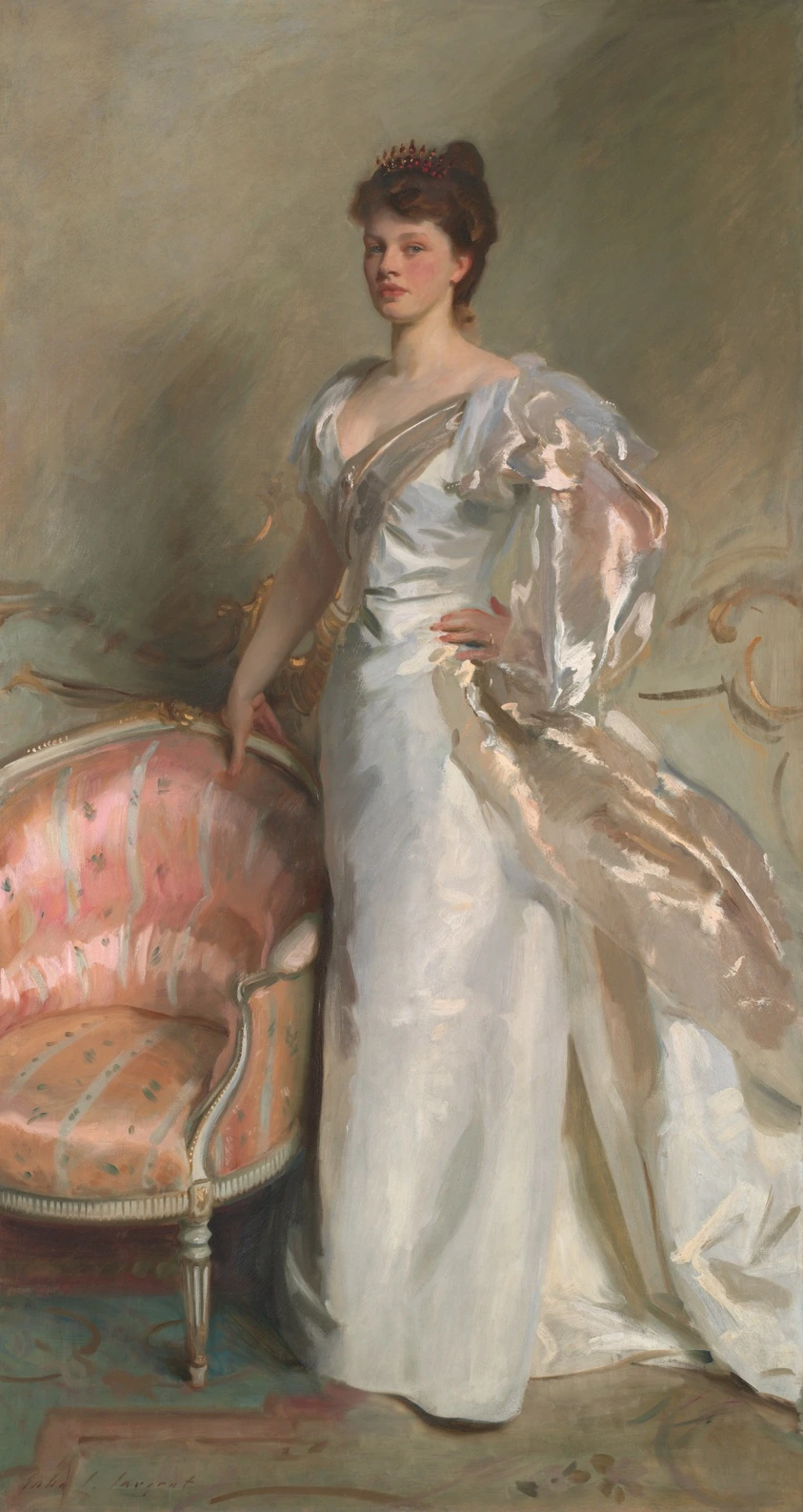
Mrs. George Swinton (Elizabeth Ebsworth)

Description

John Singer Sargent’s portrayal of musician Elizabeth “Elsie” Swinton epitomizes the painterly virtuosity that made the artist one of the most fashionable portraitists in late 19th-century Europe and America. Extravagant color and brushwork were central to Sargent’s success, as was his ability to present a refined and appealing likeness. Here, he accentuated the sitter’s regal bearing and elaborate dress. At the time, Swinton was a celebrated amateur singer, and the following decade she began performing professionally. Sargent harmonized the realism of her face and body with bursts of impressionistic brushstrokes describing the shimmering, translucent fabric descending from her shoulder.

Provenance

Commissioned by Mrs. Henry Edward Ebsworth (the sitter's mother), 1897 (1) Llandough Castle, Cowbridge, Glamorgan, South Wales: (2) Gattonside House, Melrose, Roxburghshire, Scotland; (3) London, England; consigned by her to M. Knoedler & Co., London, England, and New York, 1915; sold to the Art Institute of Chicago, 1922.

Mrs. George Swinton (Elizabeth Ebsworth)

John Singer Sargent

1897

Accession Number

4749

Medium

Oil on canvas

Dimensions

231 × 124 cm (90 3/4 × 48 3/4 in.)

Classification

Painting

Museum

The Art Institute of Chicago

Chicago, United States

Credit Line

Wirt D. Walker Collection

Background & Context

Background Story

This monumental portrait of Elizabeth Ebsworth, Mrs. George Swinton, painted in 1897, stands among the most ambitious works of Sargent's London period, a canvas over two meters high that transforms a society hostess into a figure of almost tragic dignity. Mrs. Swinton was a fashionable member of the British aristocracy, but Sargent's treatment minimizes social accessories—the dress, the jewels, the setting—in favor of psychological confrontation. She stands in three-quarter profile against a dark background, her pale face and hands emerging with the theatrical intensity that had made Sargent the most sought-after portraitist of his generation. The dress is a masterwork of textile description: pale silk or satin rendered with long, fluid strokes that suggest both the weight of the fabric and the light moving across its surface. Yet the viewer's attention is inevitably drawn to the face, with its direct gaze and slightly parted lips that suggest a woman interrupted in thought. The scale of the canvas was unusual for female portraits of the period, which were typically more intimate; by matching the dimensions of his male grandee portraits, Sargent asserted Mrs. Swinton's social and intellectual equality with the statesmen and generals who usually commanded such treatment. The painting also reveals Sargent's working method: the face was probably painted from life over multiple sessions, while the dress and background were executed from studio props and memory. This division between the living sitter and the decorative setting creates a tension that animates the canvas, preventing it from becoming mere flattery. In the history of women's portraiture, the work stands as a bridge between the passive beauties of the nineteenth century and the active, self-possessed women of the twentieth.

Cultural Impact

This monumental portrait re-scaled women's portraiture to match male grandee dimensions, asserting female intellectual equality and bridging nineteenth-century beauty conventions with twentieth-century self-possession.

Why It Matters

It matters because Sargent painted a society hostess the size of a general—claiming that women's faces deserved the same wall space as men's power.