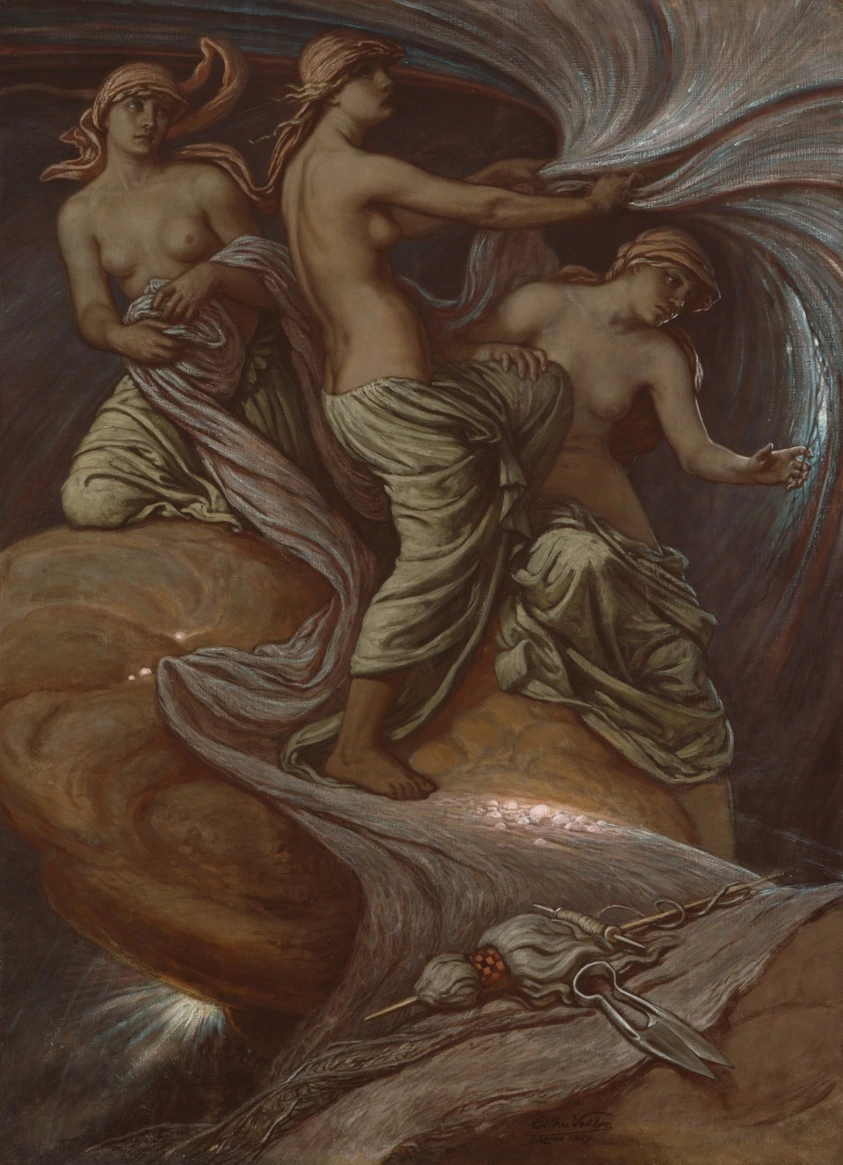
The Fates Gathering in the Stars

Description

Elihu Vedder depicted the three Fates of Greek mythology working the thread of life: Clotho spins the thread, Lachesis fixes its length, and Atropos cuts it at the appointed time of death. Their symbolic tools—spindle, distaff, and shears—rest in the foreground, emphasizing the Fates’ decisive role in matters of life and death. Vedder adapted this painting from an illustration he had designed for an 1884 publication by Edward FitzGerald—a translation of the work of 11th-century poet Omar Khayyám, The Rubáiyát. Vedder was attracted to mysterious, visionary subject matter. Here, he explored metaphysical questions of life, death, and afterlife, subjects at the core of Khayyám’s poetry.

Provenance

Henry Melville Whitney, Brookline, MA, 1887; American Art Association, New York, 1917; George H. Ainslie, New York, 1917. Montross Gallery, New York, by 1919; sold by them to the Art Institute of Chicago, 1919.

The Fates Gathering in the Stars

Elihu Vedder

1887

Accession Number

74967

Medium

Oil on canvas

Dimensions

113 × 82.6 cm (44 1/2 × 32 1/2 in.)

Classification

Painting

Museum

The Art Institute of Chicago

Chicago, United States

Credit Line

Friends of American Art Collection

Background & Context

Background Story

"The Fates Gathering in the Stars" is an 1887 oil on canvas by Elihu Vedder that captures the American Symbolist painter at his most cosmically ambitious, the image showing the three Fates of Greek mythology—Clotho, Lachesis, and Atropos—spinning, measuring, and cutting the thread of human destiny against a star-filled background that suggests both astronomical space and metaphysical eternity. The composition is a masterwork of Symbolist fantasy: the figures are rendered with the elongated, ethereal forms that Vedder favored, their draperies flowing in cosmic winds, their gestures suggesting both the mechanical regularity of fate and the mysterious arbitrariness of mortal existence. The palette is dark and luminous—deep blues, purples, and golds that suggest the night sky and the supernatural light that illuminates the divine weavers. The 1887 date places this work in the period of Vedder's greatest international recognition, when he was producing the series of visionary paintings and illustrations that established his reputation as the American artist closest to the European Symbolist movement. Art historians have compared this painting to the star-filled canvases of Blake and the mystical landscapes of Böcklin, noting that Vedder's treatment is more literary, more directly engaged with classical mythology than the more personal visionary imagery of these European contemporaries. The work also reflects Vedder's lifelong interest in theosophy and esoteric spirituality: the gathering of the Fates in the stars suggests a universe governed by cosmic law rather than chance, a metaphysical order that Vedder sought to reveal through his art.

Cultural Impact

This 1887 oil canvas made Greek cosmic destiny cosmically ambitious through Symbolist star-filled ethereal elongation, using deep blue-purple-gold supernatural light to make mythological fate feel astronomically eternal and theosophically ordered.

Why It Matters

It matters because Vedder painted three women in the stars and made them look like they were weaving the universe—proving that even destiny could be beautiful if the night was dark enough.