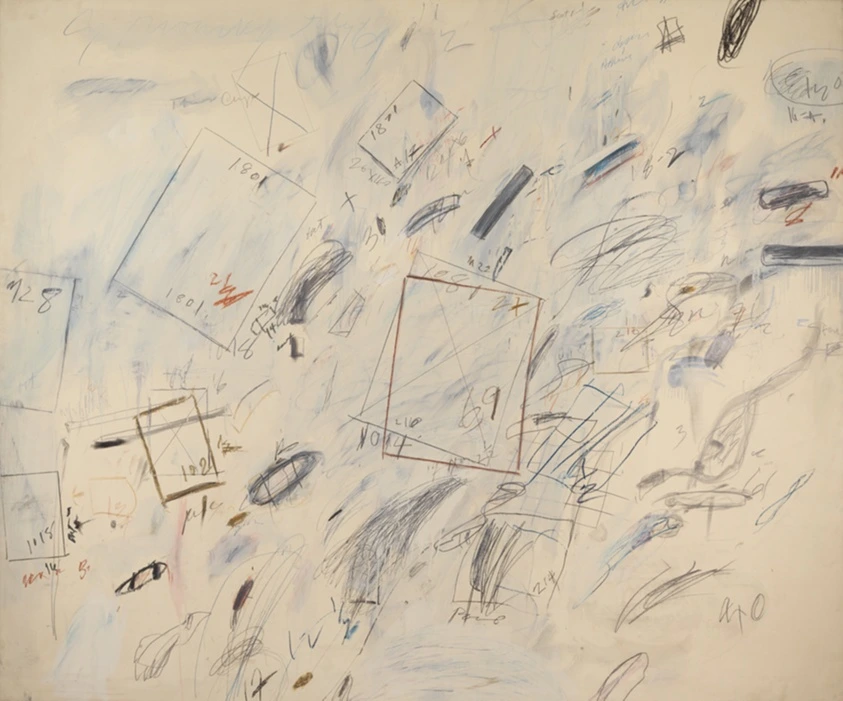
Untitled (Bolsena)

Description

Cy Twombly is best known for a synthesis of drawing, painting, and writing that balances abstract with suggestively pictorial impulses. His inimitable scribbles and scrawls are at once intuitive and sublime, casual or even crude and refined. Twombly made the dynamic, brooding Untitled as one in a suite of fourteen large-scale paintings during the summer of 1969 while ensconced at Palazzo del Drago on the shores of Lake Bolsena in central Italy. Against a rich, creamy ground, he elaborated on the cascades of planar and tubular shapes that had emerged in his painting the year before, using diagram-like forms to imbue the canvas with a sense of spatiotemporal flow, as well as a certain airiness. On the other hand, the white field—darkened here and there by passages of erasure—also takes on the aspect of a heavily revised mathematical worksheet. Twombly was immersed both in his work and in his particular location, titling these paintings with the place-name Bolsena. But while typically he might find inspiration in the history of his ancient rural retreat, in this case he was as attuned to that summer’s defining moment: the Apollo II moon landing. Such context enhances our reading of the painting’s enigmatic visual language of measurement, drift, and direction.

Untitled (Bolsena)

Cy Twombly

1969

Accession Number

229371

Medium

Oil-based house paint, wax crayon, and graphite on canvas

Dimensions

199.4 × 240 cm (78 1/2 × 94 1/2 in.)

Classification

Painting

Museum

The Art Institute of Chicago

Chicago, United States

Credit Line

Gift of Edlis Neeson Collection

Background & Context

Background Story

"Untitled (Bolsena)" is one of Cy Twombly's most monumental and atmospheric paintings from his Italian period, executed in 1969 during the years when he was living in Rome and producing the large-scale works that would establish his reputation as one of the most original painters of the postwar era. The composition shows a pale, luminous field of oil-based house paint, wax crayon, and graphite on canvas, the surface covered with scrawled words, numbers, and gestural marks that suggest both ancient graffiti and modern abstract expression. The title refers to Bolsena, a town in central Italy near Lake Bolsena, and the work evokes the historical layers of the Italian landscape—Etruscan, Roman, medieval, and modern—that Twombly experienced daily in his adopted country. The medium of house paint is significant: unlike traditional artist's oil, house paint is cheap, matte, and fast-drying, allowing Twombly to work quickly and spontaneously, covering large areas with the sweeping gestures that characterize his mature style. The wax crayon and graphite add linear elements that contrast with the painted ground, creating a dialogue between color and line, atmosphere and inscription. The scale is enormous—nearly 200 × 240 centimeters—making the canvas a physical presence that envelops the viewer and demands a bodily response. Art historians have connected this work to the broader tradition of European lyrical abstraction, from the tachiste paintings of the 1950s to the Italian "scuola di Piazza del Popolo," noting that Twombly's treatment is more literary, more historically referential than these contemporaries. The painting also reflects the influence of ancient Roman graffiti, which Twombly studied and photographed: the scrawled marks on the canvas echo the scratched inscriptions on Roman walls, creating a dialogue between ancient and modern that is central to his artistic identity.

Cultural Impact

This 1969 monumental canvas fused house-paint spontaneity with Etruscan-Roman graffiti memory, using enormous pale scale to make Italian historical layers envelop the viewer in lyrical abstract bodily presence.

Why It Matters

It matters because Twombly wrote on a wall-sized canvas like it was ancient stone—proving that even house paint could carry two thousand years if the hand was urgent enough.