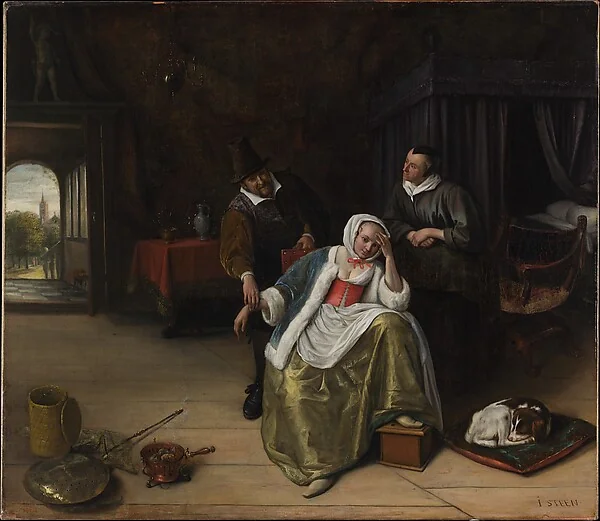
Description
This well-appointed interior sets the scene for the courtship ritual of music-making, through which men and women became acquainted by singing and playing instruments together. The boy in the foreground, mimicking the adults, strums a cello with a pipe and breaks a string, a subtle allusion to the perils of unbridled passion. Jan Steen, one of the Dutch Republic’s most prolific comic painters, crafted his scenes upon the contemporary notion that comedy mirrors everyday life.
Provenance
Sir Charles Bagot, Bart., by 1833 [according to Smith 1833]. Presumably Prince Anatole Demidoff, Villa San Donato, near Florence (died 1870); by descent to his nephew Prince Paul Demidoff (died 1885) and included in the sale of the contents of Villa San Donato, Pillet, Mannheim, and Le Roy, Florence, March 15, 1880, lot 1054, bought in; remained in the Demidoff collection, passing into the possession of Paul Demidoff’s widow, Helena Troubetskoi, Pratolino, near Florence; included in the group of 13 paintings from the Demidoff collection sold to trustees of the Art Institute through Durand-Ruel, Paris, in 1890; purchase price reimbursed by Timothy B. Blackstone, 1891.
Accession Number
561
Medium
Oil on canvas
Dimensions
86.6 × 101 cm (34 1/8 × 39 3/4 in.); Framed: 101.6 × 115.6 × 5.1 cm (40 × 45 1/2 × 2 in.)
Classification
oil on canvas
Credit Line
Gift of Timothy B. Blackstone
Background & Context
Background Story
Jan Steens The Family Concert from 1666 is an oil painting that exemplifies the artists signature subject: the disorderly household, a scene of domestic chaos in which music making, drinking, and flirtation combine to create an image of human folly that is simultaneously moralizing and celebratory. Steen, the greatest genre painter of the Dutch Golden Age, developed a type of scene so distinctive that it gave rise to the Dutch proverb a Jan Steen household, meaning a disorderly and chaotic home. The Family Concert depicts a group of family members and visitors gathered around a table making music, a popular subject in 17th-century Dutch painting that typically symbolized the harmony of a well-ordered household. Steen subverts this tradition by showing the musical gathering on the verge of dissolution: one figure drinks too much, another flirts inappropriately, and the general atmosphere of merriment suggests the loss of self-control that leads to sin. The year 1666, at the height of Steens productive period, places this painting in the context of an artist who was running a tavern in Leiden while producing some of the most vivid and psychologically acute genre paintings in the history of art. The oil on canvas medium allows Steen to render the textures of food, drink, fabric, and flesh with a tactile specificity that makes the chaos of the household vividly present, while the compositional complexity, with figures arranged in overlapping groups that create a series of visual vignettes within the overall disorder, demonstrates a mastery of pictorial organization that belies the apparent randomness of the scene.
Cultural Impact
Steen genre paintings are foundational works in the history of Dutch art and in the broader tradition of comic genre painting that extends from Bruegel through Hogarth to the satirical artists of the modern period. The Family Concert exemplifies his unique combination of moralizing content and celebratory observation that makes his work the most psychologically rich genre painting of the 17th century.
Why It Matters
A genre painting by Steen depicting a disorderly family musical gathering that subverts the traditional symbolism of the household concert, combining moralizing commentary on human folly with celebratory observation of domestic chaos in the manner that gave rise to the Dutch proverb a Jan Steen household.