The Millinery Shop

Description

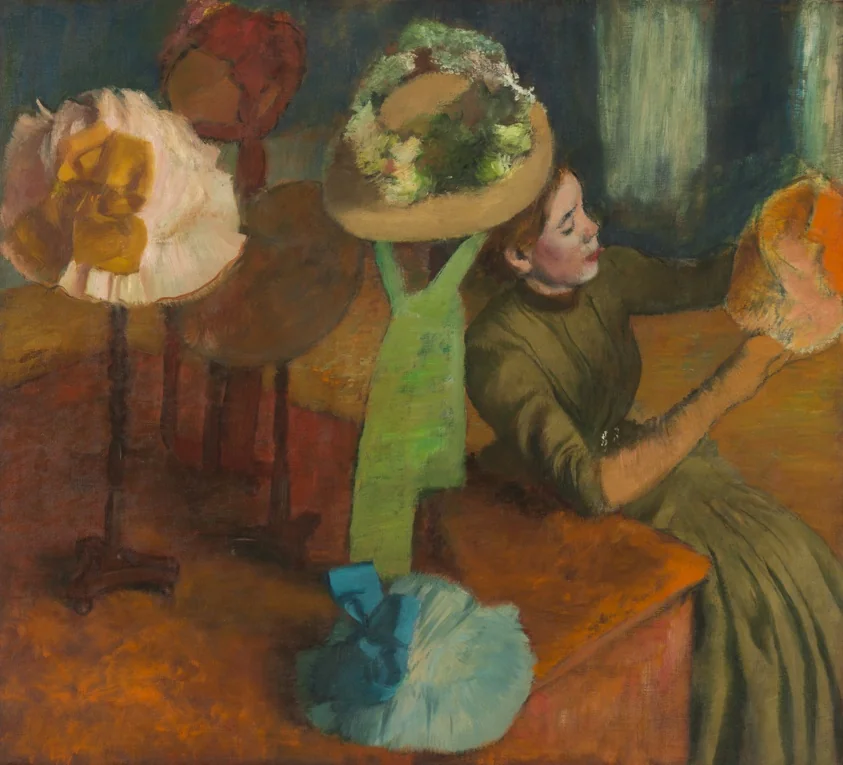
Of at least fifteen pastels, drawings, and paintings that Edgar Degas created on this subject during the 1880s, The Millinery Shop is the largest and perhaps the most ambitious. As a result of its unusual cropping and tilted perspective, it seems to capture an unedited glimpse of the interior of a small nineteenth-century millinery shop. The identity of the young woman in the painting remains unclear: she may be a shop girl or a customer. In an early version of the composition, the woman is clearly intended to be a customer; she wears a fashionable dress, though her hat—a prerequisite token of bourgeois culture—is absent. In the final painting, however, the woman appears with her mouth pursed, as if around a pin, and her hands gloved, possibly to protect the delicate fabric of the hat she holds. Degas seems to have deliberately left her role as a creator or consumer ambiguous. She is totally absorbed in her activity and, like most of the women in Degas’s paintings, seems unaware of being watched. The bonnets that are displayed on the table next to her like a still life present an analogy to the artist’s creative process: where they are unfinished, so too is the painting.

Provenance

Sold by the artist to Paul Durand-Ruel, Paris on February 22, 1913 for 50,000 francs [see Durand-Ruel stock no. 10253; this and the following information according to Paris 1988]; sent to Durand-Ruel Gallery in New York, 1917; sold to Mrs. Lewis Larned (Annie Swan) Coburn (died 1932), Chicago on January 19, 1932 for $36,000 or $35,000 [see Durand-Ruel stock no. 4114; the date 1932 given in the Durand-Ruel stockbook contradicts a loan receipt, dated January 23, 1930, for a “Millinery Shop, 1882” from Mrs. L.L. Coburn to the Art Institute of Chicago, copy in curatorial file]; bequeathed to the Art Institute of Chicago, 1933.

The Millinery Shop

Hilaire Germain Edgar Degas

1879-86

Accession Number

14572

Medium

Oil on canvas

Dimensions

100 × 110.7 cm (39 3/8 × 43 9/16 in.); Framed: 132.1 × 142.3 × 9.6 cm (52 × 56 × 3 3/4 in.)

Classification

Painting

Museum

The Art Institute of Chicago

Chicago, United States

Credit Line

Mr. and Mrs. Lewis Larned Coburn Memorial Collection

Background & Context

Background Story

"The Millinery Shop" is one of Edgar Degas's most psychologically complex and visually innovative paintings, executed between 1879 and 1886 during the period when he was exploring the world of Parisian commerce with the same observational intensity that he brought to ballet dancers and racehorses. The composition shows the interior of a millinery shop, where a customer—probably a well-dressed Parisian woman—examines a hat while the shopgirl or milliner observes her with an expression that is simultaneously servile and knowing. The perspective is characteristically oblique: Degas positions the viewer slightly behind and to the side of the figures, creating a sense of voyeuristic observation that makes the scene feel like a stolen moment rather than a staged tableau. The palette is warm and restrained—beiges, browns, and the pale greens of the shop's furnishings—creating an atmosphere of bourgeois respectability that contrasts with the subtle tension between the two women. The mirror in the background is a masterstroke of compositional complexity: it reflects the customer from behind, showing her hat and the back of her neck while her face remains hidden, creating a double portrait that questions the relationship between appearance and identity. The painting also reflects Degas's fascination with modern consumer culture: the hat shop was a new kind of urban space where women could try on identities along with accessories, and Degas treats this commercial theater with the same seriousness that his contemporaries reserved for historical or mythological subjects. Art historians have compared this work to the shop scenes of Manet and the later department store paintings of Bonnard, noting that Degas's treatment is more detached, more analytically observant than these contemporaries. The canvas also demonstrates Degas's mastery of spatial construction: the receding planes of the shop, the mirror's reflection, and the angled counter create a cubist-like complexity that anticipates the spatial experiments of Cézanne and Braque.

Cultural Impact

This 1879–86 painting analyzed Parisian consumer identity through oblique voyeuristic perspective and mirror-compositional complexity, treating commercial theater with the gravity of historical subject matter.

Why It Matters

It matters because Degas painted a woman trying on a hat and made it look like she was trying on herself—proving that even shopping could be a kind of existential crisis.