American Gothic

Description

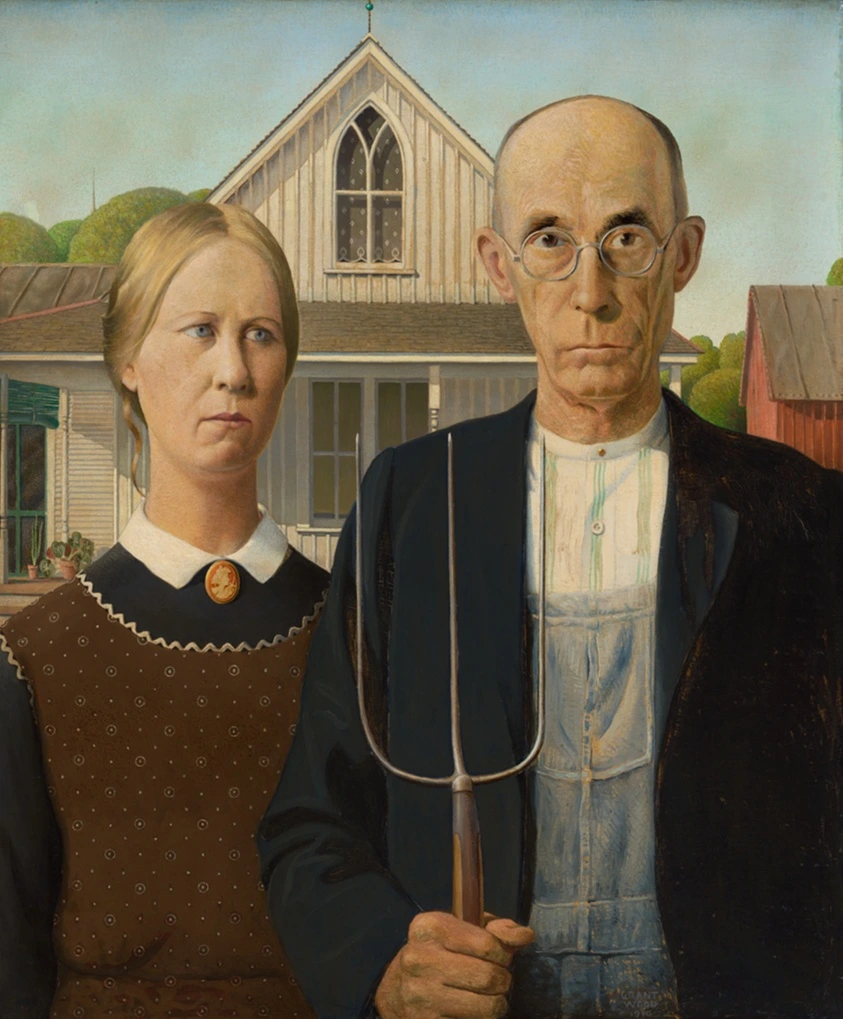
In American Gothic, Grant Wood directly evoked images of an earlier generation by featuring a farmer and his daughter posed stiffly and dressed as if they were, as the artist put it, “tintypes from my old family album.” They stand outside of their home, built in an 1880s style known as Carpenter Gothic. Wood had seen a similar farmhouse during a visit to Eldon, Iowa.

When it was exhibited at the Art Institute in 1930, the painting became an instant sensation, its ambiguity prompting viewers to speculate about the figures and their story. Many understood the work to be a satirical comment on midwesterners out of step with a modernizing world. Yet Wood intended it to convey a positive image of rural American values, offering a vision of reassurance at the beginning of the Great Depression.

Provenance

The artist, Cedar Rapids, IA; sold to the Art Institute of Chicago, Nov. 1930.

American Gothic

Grant Wood

1930

Accession Number

6565

Medium

Oil on Beaver Board

Dimensions

78 × 65.3 cm (30 3/4 × 25 3/4 in.)

Classification

oil paintings (visual works)

Museum

The Art Institute of Chicago

Chicago, United States

Credit Line

Friends of American Art Collection

Background & Context

Background Story

In 1930, Grant Wood visited the small town of Eldon, Iowa, and spotted a white farmhouse built in the Carpenter Gothic style — a modest home adorned with an ornate, medieval-inspired window. This architectural incongruity between high-culture aspiration and rural simplicity struck Wood as quintessentially American. For the figures, Wood recruited his dentist, Dr. Byron McKeeby, to pose as the stern-faced farmer, and his sister Nan to model as the daughter. He dressed them in period clothing evoking 'old family album tintypes,' giving the painting a nostalgic, anachronistic quality.

Cultural Impact

American Gothic became the most parodied painting in American art history. Its stiff, frontal composition and the couple's unsmiling expressions have been reimagined with everything from politicians to cartoon characters. It remains a defining icon of American identity — simultaneously a celebration and critique of the nation's rural heartland.

Why It Matters

When exhibited at the Art Institute of Chicago in 1930, the painting became an instant sensation, its ambiguity prompting viewers to speculate about the figures and their story. Wood insisted it was intended positively — a celebration of 'rural American values' and a 'vision of reassurance' at the dawn of the Great Depression.