Yellow Dancers (In the Wings)

Description

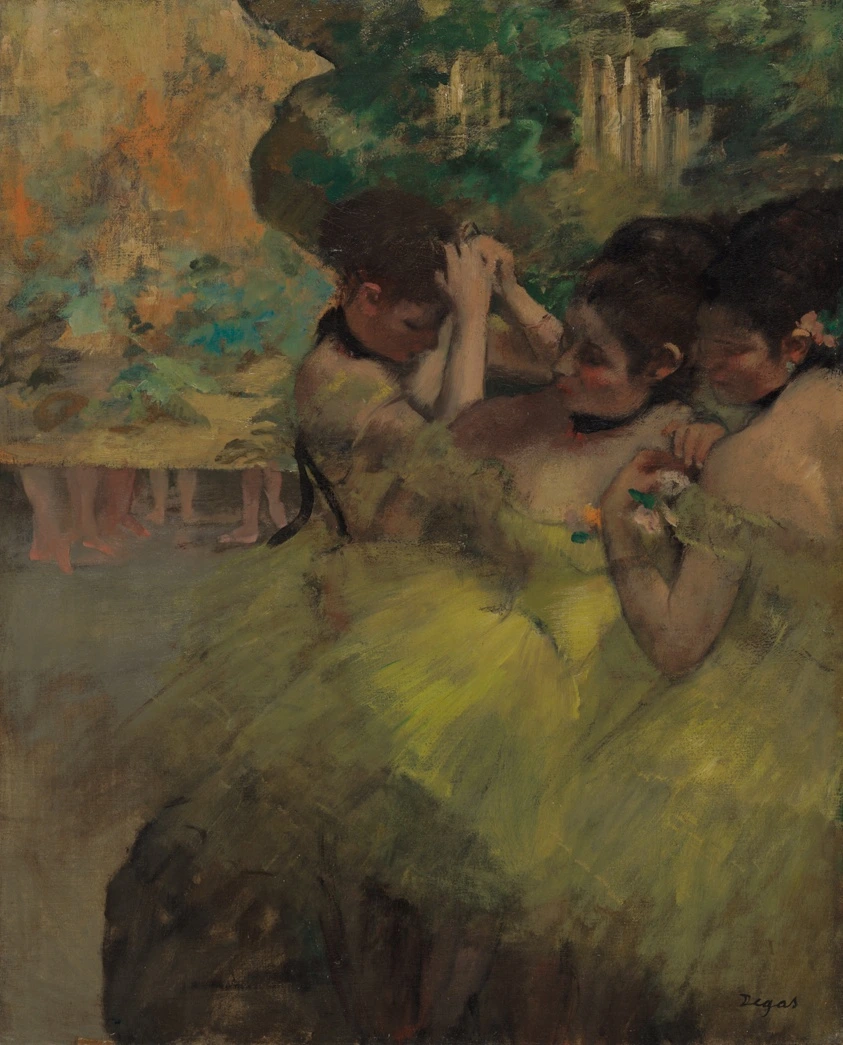
Edgar Degas first painted dancers as an independent subject in 1871. He was to devote almost half his output as an artist to this subject, observing countless performances and rehearsals at the Paris Opéra. Here he placed the viewer in the wings, as if among the elite Opéra subscribers who roamed and socialized backstage. Dance subjects allowed Degas to contemporize his lifelong interest in showing the human body in complex movement, shifting the scene from ancient history to modern Paris. He finished and signed the present canvas in time for the second Impressionist exhibition, in April 1876.

Provenance

Shipped by the artist to the art dealer, Charles W. Deschamps, London, around May 15, 1876 [see letter of May 15, 1876 from Degas to Deschamps, Collection Frits Lugt, Institut Néerlandais, Paris, published in Reff 1968]. James Staats Forbes, London; sold to Goupil et Cie, Paris on July 25, 1891 [see Goupil-Boussod & Valadon Successeurs Ledgers, cited in John Rewald 1973]; sold to Potter Palmer (died 1902), Chicago on September 18, 1891 [see Goupil Ledgers citied above]; by descent in the Palmer family; given to the Art Institute, 1963.

Yellow Dancers (In the Wings)

Hilaire Germain Edgar Degas

1874–76

Accession Number

18951

Medium

Oil on canvas

Dimensions

73.5 × 59.5 cm (28 15/16 × 23 7/16 in.); Framed: 91.5 × 78.2 × 7 cm (36 × 30 3/4 × 2 3/4 in.)

Classification

Painting

Museum

The Art Institute of Chicago

Chicago, United States

Credit Line

Gift of Mr. and Mrs. Gordon Palmer, Mrs. Bertha P. Thorne, Mr. and Mrs. Arthur M. Wood, and Mrs. Rose M. Palmer

Background & Context

Background Story

"Yellow Dancers (In the Wings)" is one of Degas's most radiant and dynamic ballet paintings, executed between 1874 and 1876 during the period when he was producing the series of dance images that would make him the definitive chronicler of the Paris Opéra and its backstage world. The composition shows a group of dancers in yellow tutus preparing to enter the stage or having just exited, their bodies caught in a moment of transition between the disciplined performance and the informal camaraderie of the wings. The palette is dominated by the brilliant yellow of the costumes, a color that Degas used with unprecedented boldness to create a focal point of chromatic energy against the muted greens and browns of the backstage setting. The brushwork is notably free and summary, the dancers' faces barely indicated, their forms suggested rather than meticulously described, creating an effect of movement and immediacy that makes the canvas feel like a snapshot of lived experience. The 1874–76 date places this work in the same period as the first Impressionist exhibitions, though Degas himself resisted the label and maintained a more structured, compositionally deliberate approach than his contemporaries. The painting also reflects Degas's unusual working method: he rarely painted dancers from life in the theater but composed his images in the studio from memory, photographs, and drawings, creating a synthesis of observation and imagination that gives his ballet scenes their dreamlike quality. Art historians have compared this work to the dance paintings of Toulouse-Lautrec and the later photographs of Lartigue, noting that Degas's treatment is more formal, more concerned with the geometry of the group than the individual personalities of the dancers. The canvas also demonstrates Degas's lifelong fascination with the female body in motion: the dancers are not idealized nymphs but working women, their muscular legs and tired expressions suggesting the physical cost of their apparent grace.

Cultural Impact

This 1874–76 ballet painting synthesized studio memory with backstage chromatic energy, using bold yellow tutus against muted wings to document the physical cost of dancers' apparent grace in transitional moments.

Why It Matters

It matters because Degas painted dancers waiting to go on and made the waiting look as important as the dance—proving that even in the wings, the body could tell the whole story.