Two Sisters (On the Terrace)

Description

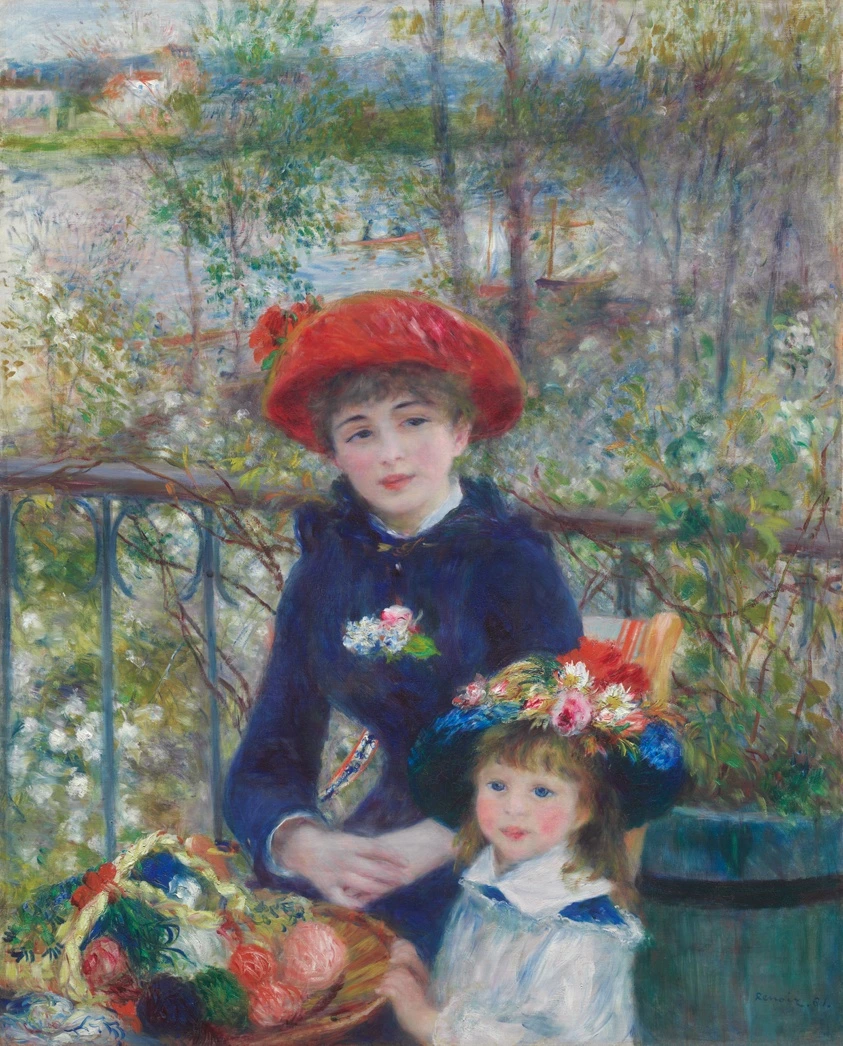
“He loves everything that is joyous, brilliant, and consoling in life,” an anonymous interviewer once wrote about Pierre-Auguste Renoir. This may explain why Two Sisters (On the Terrace) is one of the most popular paintings in the Art Institute. Here Renoir depicted the radiance of lovely young women on a warm and beautiful day. The older girl, wearing the female boater’s blue flannel, is posed in the center of the evocative landscape backdrop of Chatou, a suburban town where the artist spent much of the spring of 1881. She gazes absently beyond her younger companion, who seems, in a charming visual conceit, to have just dashed into the picture. Technically, the painting is a tour de force: Renoir juxtaposed solid, almost life-size figures against a landscape that—like a stage set—seems a realm of pure vision and fantasy. The sewing basket in the left foreground evokes a palette, holding the bright, pure pigments that the artist mixed, diluted, and altered to create the rest of the painting. Although the girls were not actually sisters, Renoir’s dealer showed the work with this title, along with Acrobats at the Cirque Fernando and others, at the seventh Impressionist exhibition, in 1882.

Provenance

The artist (d. 1919); sold to Durand-Ruel, Paris, July 7, 1881, for 1,500 francs [per Durand-Ruel, Paris, stock book for 1880–82 (no. 1451, as Femme sur une terrasse au bord de la Seine), as confirmed by Paul-Louis Durand-Ruel and Flavie Durand-Ruel, Durand-Ruel Archives, to the Art Institute of Chicago, Oct. 5, 2010, curatorial object file]; transferred to Durand-Ruel, New York, 1922 [per Durand-Ruel, New York, stock book for 1904–24 (no. 8124, as Sur la terrasse), as confirmed by Paul-Louis Durand-Ruel and Flavie Durand-Ruel, Durand-Ruel Archives, to the Art Institute of Chicago, Oct. 5, 2010, curatorial object file]; sold to Mrs. Lewis Larned (Annie Swan) Coburn, Chicago, February 4, 1925, for $100,000 [per Durand-Ruel Archives, as confirmed by Paul-Louis Durand-Ruel and Flavie Durand-Ruel, Durand-Ruel Archives, to the Art Institute of Chicago, Oct. 5, 2010, curatorial object file; see also a letter on Durand-Ruel letterhead, Mar. 18, 1932, verifying that Coburn purchased the painting from Durand-Ruel, on file in Institutional Archives, Art Institute of Chicago]; Bequeathed to the Art Institute of Chicago, 1933.

Two Sisters (On the Terrace)

Pierre-Auguste Renoir

1881

Accession Number

14655

Medium

Oil on canvas

Dimensions

100.4 × 80.9 cm (39 1/2 × 31 7/8 in.); Framed: 119.1 × 100.1 × 7.7 cm (46 7/8 × 39 3/8 × 3 in.)

Classification

Painting

Museum

The Art Institute of Chicago

Chicago, United States

Credit Line

Mr. and Mrs. Lewis Larned Coburn Memorial Collection

Background & Context

Background Story

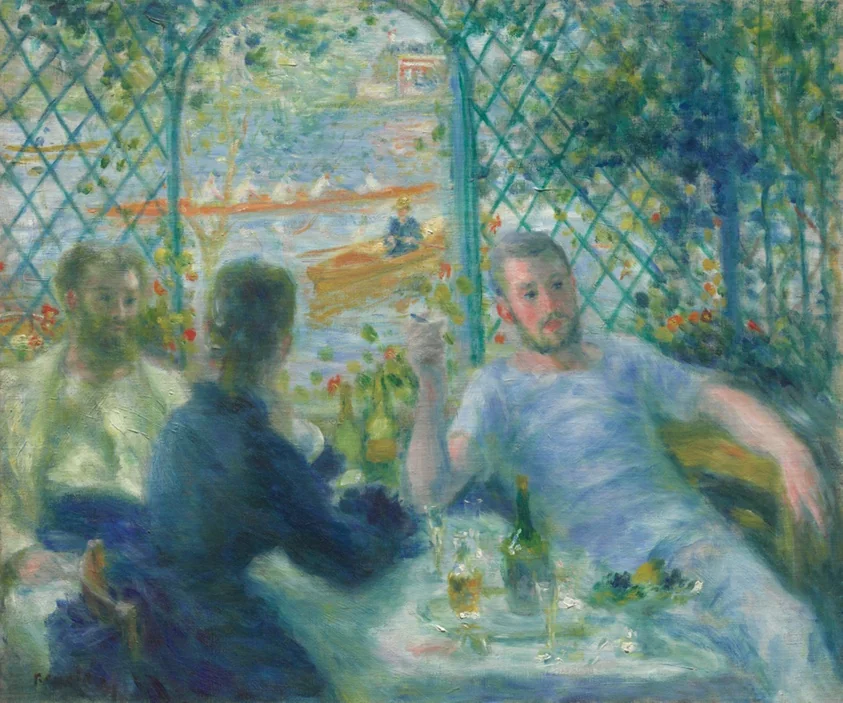
Pierre-Auguste Renoir's "Two Sisters (On the Terrace)" (1881) is one of the most beloved paintings of the Impressionist era, depicting two young women — not actually sisters, but models posed as such — sitting on the terrace of the Maison Fournaise, a restaurant on the Île de Chatou in the Seine west of Paris. The older woman wears a blue hat and blue dress, the younger a flower-trimmed hat and matching dress; between them, a basket of brilliantly coloured wool balls suggests the pastime of knitting or embroidery. Behind them, the Seine glitters in the spring sun, dotted with sailboats and the foliage of the island's trees. The painting exemplifies the qualities that an anonymous interviewer once attributed to Renoir: 'He loves everything that is joyous, brilliant, and consoling in life.' This statement, made during Renoir's lifetime, captures the essence of his appeal — a painting style that celebrates beauty, youth, and the pleasure of being alive. Renoir's refusal to engage with the darker aspects of modern life — the poverty, the industrialization, the political violence that surrounded him — has been criticized as naïve or escapist, but it is also the source of his enduring popularity. In a world of suffering, Renoir insisted on painting happiness. The restaurant at Chatou was a popular leisure destination for Parisians, accessible by train from the Gare Saint-Lazare in about thirty minutes. Renoir painted there repeatedly in 1880–81, producing both "Two Sisters" and the more famous "Luncheon of the Boating Party" (Phillips Collection, Washington). The Maison Fournaise offered everything an Impressionist painter could want: attractive people enjoying themselves, bright sunlight filtering through the trees, the sparkle of water, and the vibrant colors of outdoor leisure. The models were not the bourgeois diners who actually frequented the restaurant but young women hired by Renoir to embody the carefree spirit of the occasion. The painting's composition is masterful in its apparent casualness. The two figures are arranged in a triangular composition that gives the image stability and balance, while their overlapping positions create a sense of intimacy and closeness. The older sister's arm around the younger one's waist reinforces this sense of protective affection. The background — the river, the boats, the distant trees — is rendered in the loose, broken brushstrokes that characterize Impressionist landscape painting, creating a shimmering veil of color that sets off the more carefully modeled figures in the foreground. The painting's color is its most striking feature. Renoir was a supreme colorist, and "Two Sisters" presents a symphony of complementary colors — blue and orange, red and green — that create a visual vibration reminiscent of Delacroix, whom Renoir admired. The wool balls in the basket provide a chromatic anchor, their round forms echoing the curves of the figures and the shimmering light on the water.

Cultural Impact

Renoir's celebration of beauty, youth, and pleasure made him the most beloved Impressionist — and the most controversial. His insistence on painting the joyous side of life, even in an era of turmoil, speaks to a fundamental human need for images of happiness.

Why It Matters

This painting of two young women on a Seine-side terrace is Renoir at his most irresistible — a symphony of complementary colors and youthful beauty that captures the joy of Impressionist leisure at its most radiant.