The Herring Net

Description

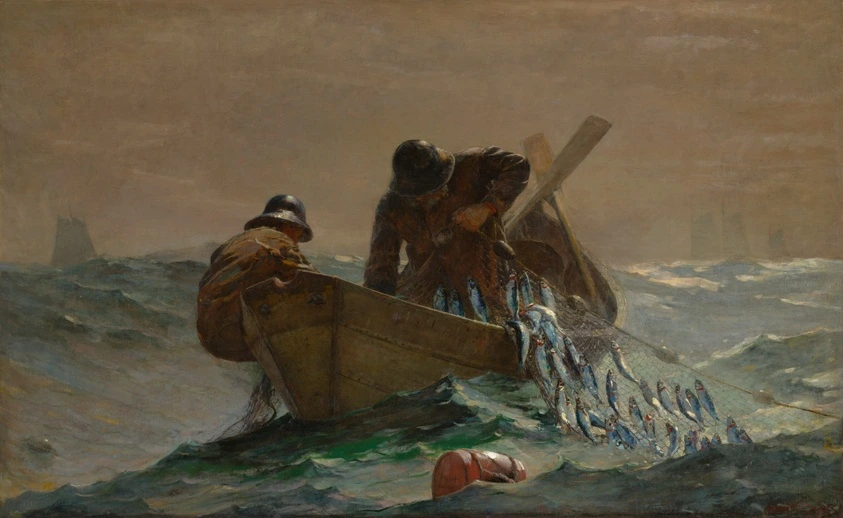
In 1883 Winslow Homer moved to the small coastal village of Prouts Neck, Maine, where he created a series of paintings of the sea unparalleled in American art. Long inspired by the subject, Homer had spent summers visiting New England fishing villages during the 1870s, and in 1881–82 he made a trip to a fishing community in Cullercoats, England, that fundamentally changed his work and his life. The paintings he created after 1882 focus almost exclusively on humankind’s age-old contest with nature. Here Homer depicted the heroic efforts of fishermen at their daily work, hauling in an abundant catch of herring. In a small dory, two figures loom large against the mist on the horizon, through which the sails of the mother schooners are dimly visible. While one fisherman hauls in the netted and glistening herring, the other unloads the catch. Utilizing the teamwork so necessary for survival, both strive to steady the precarious boat as it rides the incoming swells. Homer’s isolation of these two figures underscores the monumentality of their task: the elemental struggle against a sea that both nurtures and deprives.

Provenance

Charles W. Gould, New York, by 1908 to 1915; M. Knoedler and Company, New York, 1915; sold to Martin A. Ryerson (1856–1932), Chicago, 1915; by descent to his wife Carrie Hutchinson Ryerson (1859–1937), Chicago, 1932 [Last Will and Testament of Martin A. Ryerson, Died August 11, 1932, copy in Institutional Archives, Art Institute of Chicago]; bequeathed to the Art Institute of Chicago, 1937.

The Herring Net

Winslow Homer

1885

Accession Number

25865

Medium

Oil on canvas

Dimensions

76.5 × 122.9 cm (30 1/8 × 48 3/8 in.)

Classification

Painting

Museum

The Art Institute of Chicago

Chicago, United States

Credit Line

Mr. and Mrs. Martin A. Ryerson Collection

Background & Context

Background Story

Winslow Homer (1836-1910) painted The Herring Net in 1885, depicting two fishermen pulling in a herring net in the waters off the coast of Maine, where Homer had moved in 1883 to paint the sea that would become his most important subject. The Herring Net shows Homer at the height of his powers as a painter of maritime subjects—the muscular figures hauling the net, the choppy sea, and the atmospheric light all rendered with the directness and power that distinguish Homer's best marine painting from the more decorative maritime painting of his contemporaries. The 1885 date places this in Homer's most productive Maine period, when he was producing the marine paintings that are his most accomplished works.

Cultural Impact

The Herring Net is important in the history of American painting because it demonstrates the direct, powerful manner that Homer brought to marine subjects in his Maine period. Homer's fishermen are not the romantic heroes of earlier maritime painting but real men doing real work, and the direct, powerful manner of the painting shows American art moving toward the realism and authenticity that would define the best American painting of the late 19th century.

Why It Matters

The Herring Net is Homer's powerful Maine realism: two fishermen hauling a herring net in the waters off the coast of Maine, rendered with the directness and power that distinguish his best marine painting. The 1885 painting shows Homer at the height of his powers, painting real men doing real work with the authenticity that defines the best American realism.