Mao

Description

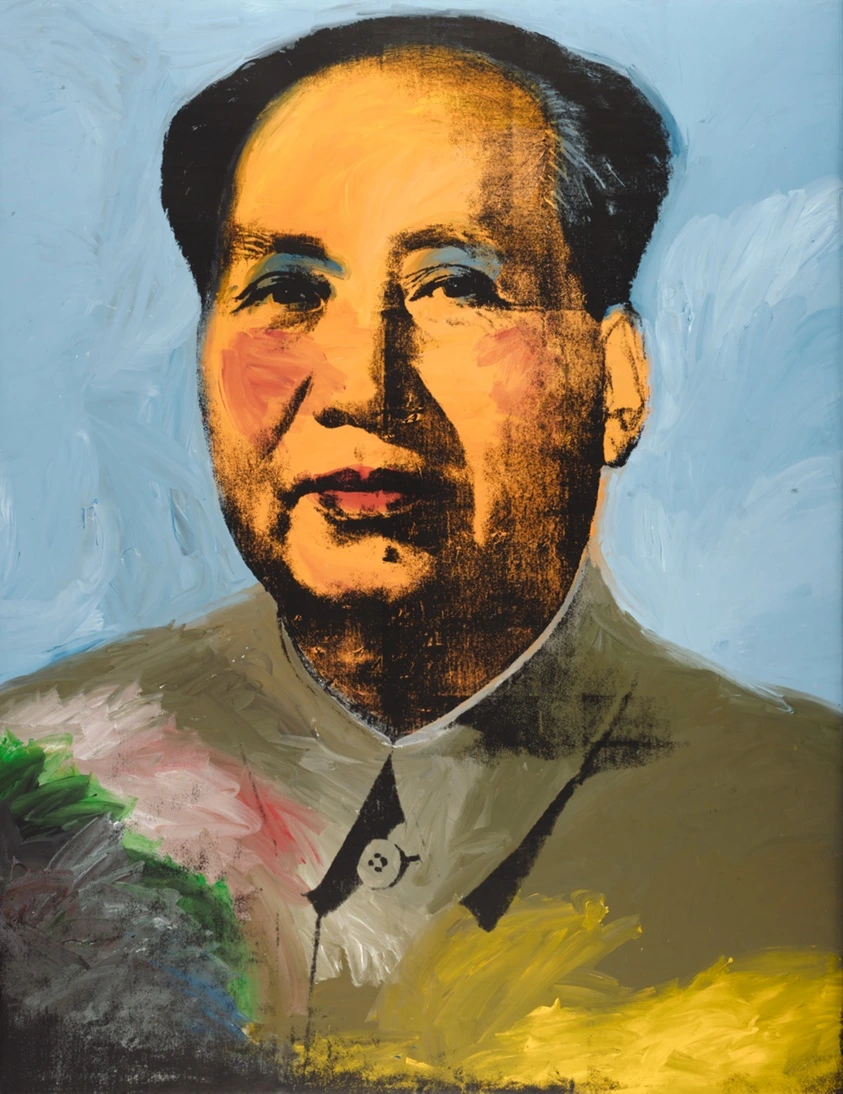
The most influential of Pop artists, Andy Warhol cast a cool, ironic light on the pervasiveness of commercial culture and contemporary celebrity worship. Early in his career, he began to utilize the silk-screen process to transfer photographed images to canvas, creating multiple portraits of celebrities including Marilyn Monroe, Elvis Presley, and Jacqueline Kennedy, as well as duplicated images of mass-produced products such as Campbell’s soup cans and Coca-Cola bottles. In this example from his Mao series, Warhol melded his signature style with the scale of totalitarian propaganda to address the cult of personality surrounding the Chinese ruler Mao Zedong (1893–1976). Nearly fifteen feet tall, this towering work mimics the representations of the political figure that were ubiquitously displayed throughout China. Warhol’s looming portrait impresses us with the duality of its realistic qualities and its plastic artificiality. In contrast to the photographic nature of the image, garish colors are applied to Mao’s face like makeup. The gestural handling of color in the portrait shows Warhol at his most painterly.

Provenance

Sold by the artist through Leo Castelli Gallery, New York, to the Art Institute of Chicago, 1974.

Mao

Andy Warhol

1972

Accession Number

47149

Medium

Acrylic, silkscreen ink, and pencil on linen

Dimensions

448.3 × 346.7 cm (176 1/2 × 136 1/2 in.)

Classification

Painting

Museum

The Art Institute of Chicago

Chicago, United States

Credit Line

Mr. and Mrs. Frank G. Logan Purchase Prize and Wilson L. Mead funds

Background & Context

Background Story

This Mao from 1972 is another version from Warhol's Mao series, executed in acrylic, silkscreen ink, and pencil on linen—the additional pencil drawing creating a different relationship between the mechanical reproduction of the silkscreen and the hand-drawn marks of the artist. The pencil additions around Mao's face create a personalized gesture within the mechanically reproduced image, introducing a tension between the mass-produced quality of the silkscreen and the individual quality of the hand drawing that is central to Warhol's practice. The 1972 date makes this one of the earliest works in the Mao series, produced in the same year as Nixon's visit to China.

Cultural Impact

The pencil-drawn additions in this Mao create a tension between mechanical reproduction and hand drawing that is central to Warhol's practice and to the broader question of art in the age of mechanical reproduction. The silkscreen reproduces Mao's face as a media image, but the pencil additions reassert the artist's hand, creating a dialogue between mass production and individual gesture that defines Warhol's most complex works.

Why It Matters

Mao with pencil additions is Warhol creating tension between mechanical reproduction and hand drawing: the silkscreen reproduces Mao's face as a mass media image, while the pencil marks reassert the artist's individual gesture. The 1972 painting produces a dialogue between mass production and individual gesture that defines Warhol's most complex works.