Description
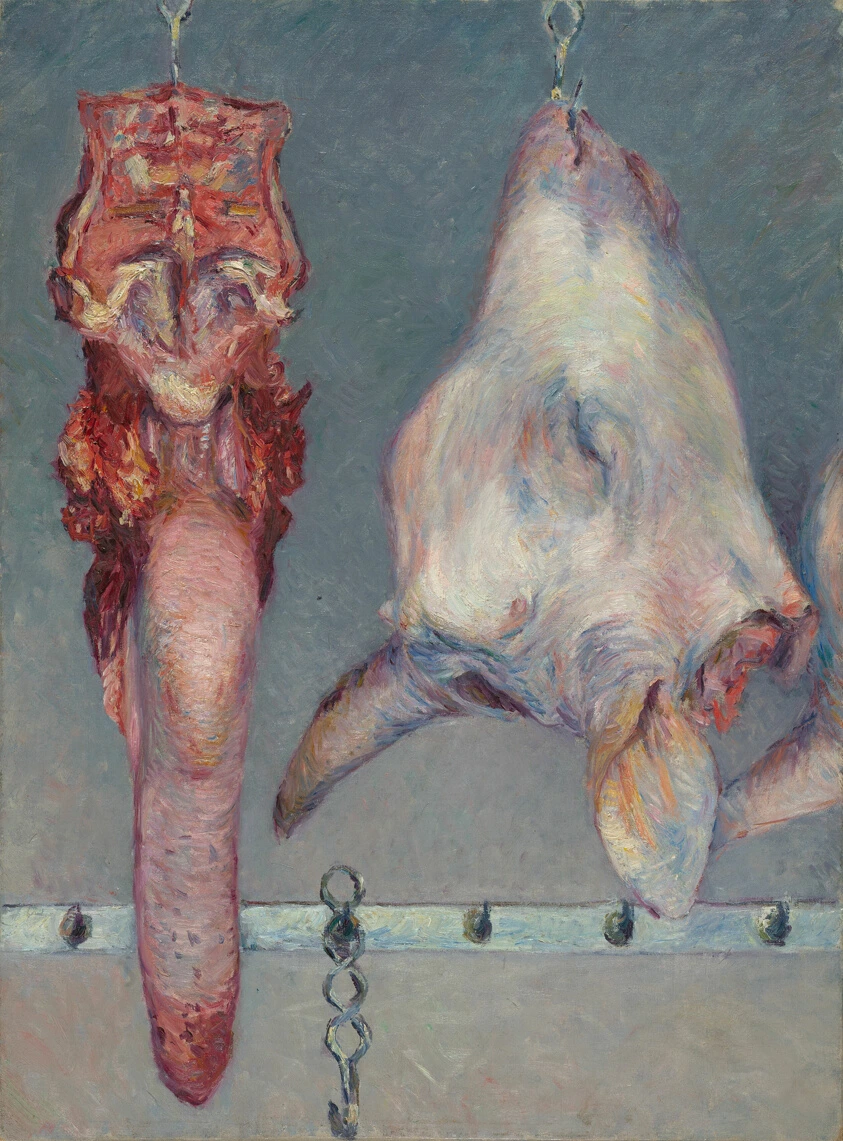
Gustave Caillebotte may have been inspired by the butcher’s shop below his family home in Paris when he painted this bloody scene of animal parts ready for human consumption. Calf’s Head and Ox Tongue confronts viewers with objects that are visually unpleasant and yet rendered with highly decorative pastel colors and soft brushstrokes. Such still lifes are among Caillebotte’s most original compositions and stand in contrast to the attractive, highly marketable still lifes of his contemporaries Claude Monet and Pierre-Auguste Renoir.
Provenance
The artist (died 1894); by descent to the artist’s family, 1894 [per Berhaut 1994, p. 165, cat. 244 (ill.)]; sold to the Art Institute of Chicago, though Galerie Cazeau-Béraudière, Paris, 1999.
Accession Number
154121
Medium
Oil on canvas
Dimensions
73 × 54 cm (29 × 21 in.); Framed: 87.7 × 69.3 × 7.7 cm (34 1/2 × 27 1/4 × 3 in.)
Classification
oil on canvas
Credit Line
Major Acquisitions Centennial Endowment
Background & Context
Background Story
Gustave Caillebotte (1848-1894) was a French painter known as one of the most important members of the Impressionist group, whose precisely observed paintings of modern Parisian life and still lifes make him one of the most distinctive painters of the Impressionist movement. Calf's Head and Ox Tongue from c. 1882 depicts a butcher's subject in the precisely observed, matter-of-fact manner that distinguishes Caillebotte's best still lifes from the more decorative work of his Impressionist contemporaries. The c. 1882 date places this in Caillebotte's most productive period, when he was producing the precisely observed paintings of modern life and still lifes that are his most distinctive works, and the butcher's subject shows his ability to find beauty in the everyday and the unglamorous.
Cultural Impact
Calf's Head and Ox Tongue is important in the history of Impressionist painting because it demonstrates the precisely observed, matter-of-fact manner that Caillebotte brought to still life as one of the most distinctive painters of the Impressionist movement. Caillebotte's precisely observed still lifes—finding beauty in the everyday and the unglamorous with the matter-of-fact precision that is his most distinctive contribution—represent an important alternative to the more decorative Impressionist tradition, and the c. 1882 painting shows this alternative at its most precisely observed.
Why It Matters
Calf's Head and Ox Tongue is Caillebotte's matter-of-fact Impressionism: a butcher's subject rendered in the precisely observed manner of one of the most distinctive painters of the Impressionist movement. The c. 1882 painting shows Caillebotte's most distinctive contribution—finding beauty in the everyday and the unglamorous with matter-of-fact precision.