Mountain Brook

Description

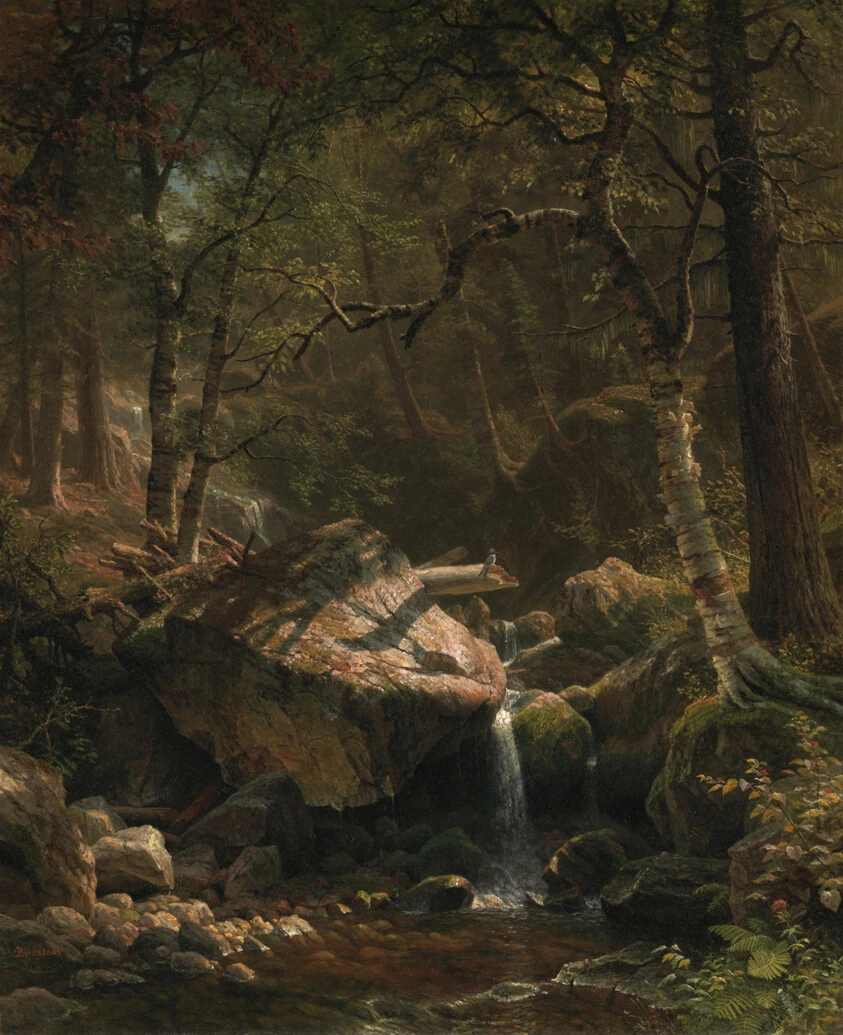
Albert Bierstadt is best remembered for his paintings of the American West, but during his early career, the ambitious artist also created New England landscapes, particularly of the White Mountains, as seen here. When this painting was first exhibited in 1863, critics declared it Bierstadt’s “best work” and praised the artist’s deft contrast of “light and shade,” which brought a heightened realism to the image. Bierstadt’s affinity for the White Mountains mirrored a growing interest in the region as one of America’s premier tourist attractions. Photographs of the area from the 19th century suggest that Bierstadt utilized landscape elements from the Flume, a popular New Hampshire tourist site, in this imaginary composition.

Provenance

Oliver Kelly, Ohio, before 1900; by descent in the family until 1989; Hirschl and Adler Galleries, New York; Private collection, Los Angeles; Michael N. Altman and Company, New York, by 1997; the Art Institute of Chicago,1997.

Mountain Brook

Albert Bierstadt

1863

Accession Number

146701

Medium

Oil on canvas

Dimensions

111.8 × 91.4 cm (44 × 36 in.)

Classification

Painting

Museum

The Art Institute of Chicago

Chicago, United States

Credit Line

Purchased with funds provided by Mrs. Herbert A. Vance; fund of an anonymous donor; Wesley M. Dixon Jr. Fund and Endowment; Henry Horner Straus and Mr. and Mrs. Frederick G. Wacker Jr. endowment funds; through prior acquisitions of various donors, including Samuel P. Avery Endowment, Mrs. George A. Carpenter, Frederick S. Colburn, Mr. and Mrs. Stanley Feinberg, Field Museum of Natural History, Mr. and Mrs. Frank Harding, International Minerals and Chemicals Corp., Mr. and Mrs. Ralph Loeff, Mrs. Frank C. Miller, Mahlan D. Moulds, Mrs. Clive Runnells, Mr. and Mrs. Stanley Stone, and the Charles H. and Mary F.S. Worcester Collection
Background & Context

Background Story

Albert Bierstadts Mountain Brook, painted in 1863, captures a rushing alpine stream cascading over rocks amid a lush wilderness setting, demonstrating the artists remarkable ability to render the play of light on water and foliage with almost photographic precision. Painted during the same period as his monumental western landscapes, this intimate work focuses on a close-up view of nature rather than the sweeping panoramas for which Bierstadt is better known. The composition draws the viewer into a cool, shaded ravine where sunlight filters through the canopy to dapple the streams surface with flickering highlights. Bierstadts technique of glazing thin layers of oil over a smooth ground creates the luminous depth for which his work was celebrated, while his attention to botanical detail, aquatic plants, mossy rocks, and ferns along the banks, reflects the 19th-century fascination with cataloging the natural world. The painting embodies the transcendental vision of the American landscape as a pristine Eden, a theatrical manifestation of divine creation untouched by human industry, at the very moment when the frontier was being rapidly transformed by westward expansion.

Cultural Impact

Bierstadts landscapes were instrumental in shaping the popular image of the American West for eastern audiences and European collectors. His paintings hung in the same galleries that housed the work of the Hudson River School, but their theatrical scale and luminist technique pushed American landscape painting toward a more spectacular, almost cinematic mode that anticipated the themes of environmental conservation.

Why It Matters

An intimate alpine stream scene by Bierstadt that showcases the artists luminist technique at close range, revealing the meticulous naturalism and transcendental vision that made him Americas foremost painter of the western landscape.