Description
In 1882 Fernand Lungren traveled to Paris, where he briefly attended classes at the Académie Julian before abandoning formal training in favor of direct observation of the city and its people. Here, a fashionably dressed woman sits alone and alert. Her presence is a sign of modern Paris’s changing social environment, in which café culture offered women new opportunities for leisure in public spaces. Although Lungren employed a dense, hard-edged style, his interest in modern life and the effects of light (here both gas and electric lighting) was nevertheless indebted to French Impressionism.
Provenance
Lester Field (born Lester Rosenfield, 1886–1937) and Louis Ritman (1889–1963), Chicago and Paris, by 1937; sold to Albert Milch, Milch Gallery, New York, 1937 [according to letter from son Harold C. Milch, dated November 5, 1979, copy in curatorial object file]; sold to Charles H. Worcester (1864–1956), 1945; given to the Art Institute of Chicago, 1947.
Accession Number
59908
Medium
Oil on canvas
Dimensions
79.7 × 104.8 cm (31 3/8 × 41 1/4 in.)
Classification
Painting
Credit Line
Charles H. and Mary F. S. Worcester Collection
Background & Context
Background Story
Fernand Lungrens In the Cafe from 1882-84 is a painting of Parisian cafe life that captures the atmosphere of urban leisure with a tonal subtlety and psychological observation that place it among the finest American paintings of Paris in the 1880s. Lungren, born in Maryland and trained in Paris, belonged to the generation of American painters who absorbed the lessons of Impressionism while retaining a darker, more tonal palette that reflected their academic training. The painting depicts a cafe interior in which figures sit at tables under gaslight, their faces half-lit and their postures suggesting the particular anonymity of cafe culture, where proximity does not guarantee intimacy and each patron occupies a private world within a shared public space. The brownish tonalities and controlled values of the painting owe more to Whistlers nocturnes than to Monets sunlit landscapes, and Lungrens handling of the reflected light from mirrors and the glow of gas lamps demonstrates a pictorial intelligence that understands the cafe as an environment defined by artificial illumination in which the boundaries between public and private are renegotiated. The painting was created during Lungrens extended stay in Paris, when the cafe was not merely a place of refreshment but a key institution of artistic and intellectual exchange, and the quiet concentration of the patrons suggests the absorption of people who are thinking, reading, or simply being present in a space that encourages contemplation.
Cultural Impact
Lungrens In the Cafe is an important document of American artists engagement with Parisian urban life in the 1880s, demonstrating that American painting could achieve the same psychological depth and tonal sophistication as its European models. It anticipates the tonal painting of the American urban scene that would be developed by Whistler, Sargent, and the Ashcan School.
Why It Matters
A tonally sophisticated painting of Parisian cafe life by Lungren that captures the atmosphere of gaslight and urban anonymity with a psychological depth reminiscent of Whistler, documenting the American painters engagement with Parisian modernity in the 1880s.

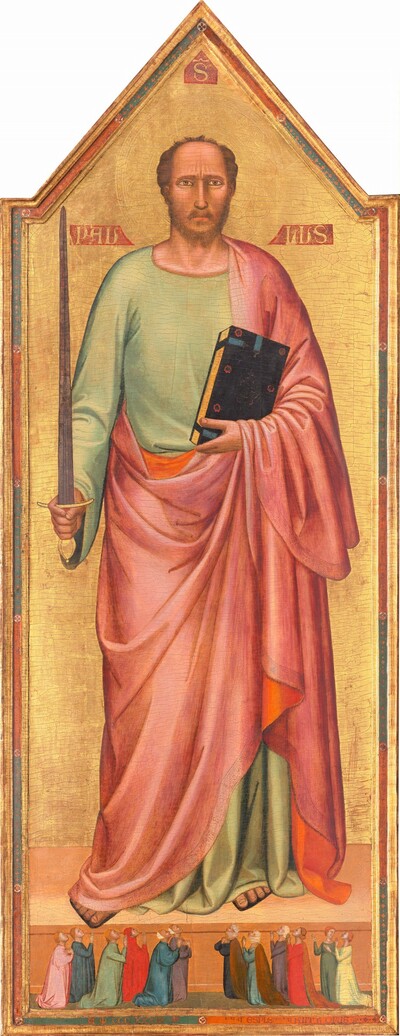
![Saint Bernard and Saint Catherine of Alexandria with the Virgin of the Annunciation [right panel]](https://api.nga.gov/iiif/e6890364-4d99-4684-a62b-5060ee3c3446/full/400,/0/default.jpg)