The Small Crucifixion ("The Pommel of Emperor Maximilian")

Description

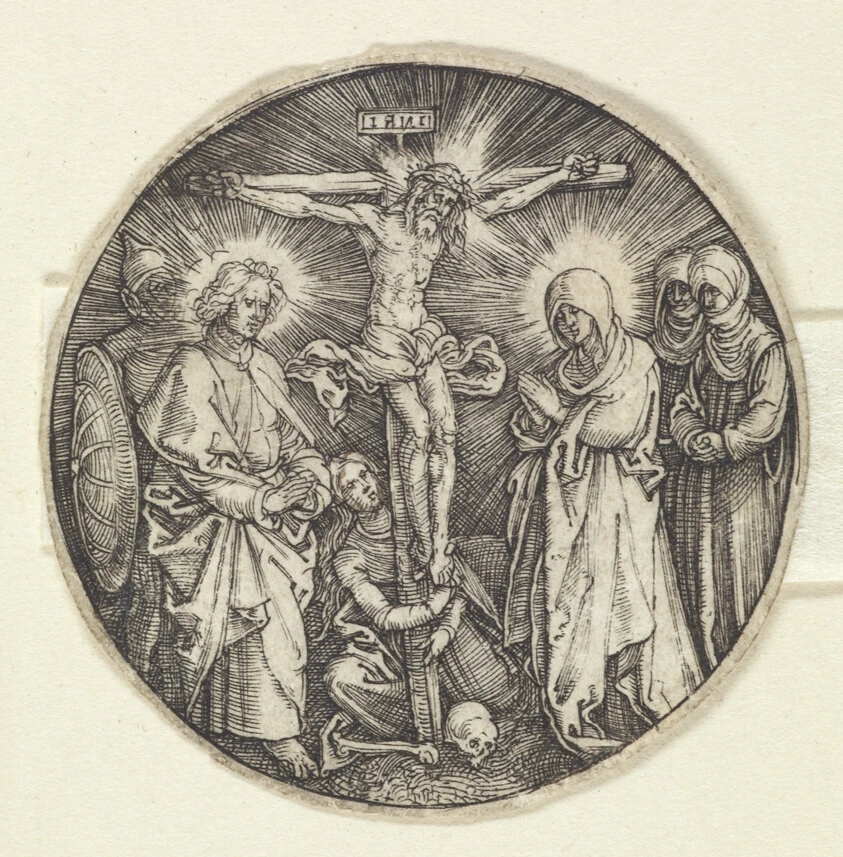
Albrecht Dürer engraved this Crucifixion scene on a small golden plate, which likely decorated the Holy Roman Emperor Maximilian’s hat or sword hilt. The backward letters INRI (identifying Christ as the so-called King of the Jews) and the switched placement of Mary and John suggest that this impression was pulled from such a plate, the image appearing in reverse as a result of the printing process. Considering the softness of precious metals, gold plates were primarily intended as jewelry rather than as printing matrices. Dürer’s early training with his goldsmith father likely influenced his skill with the burin, especially on this minute scale.

The Small Crucifixion ("The Pommel of Emperor Maximilian")

Albrecht Dürer

1519

Accession Number

4102

Medium

Engraving in black on ivory laid paper

Dimensions

Sheet: 3.6 × 3.6 cm (1 7/16 × 1 7/16 in.)

Classification

engraving

Museum

The Art Institute of Chicago

Chicago, United States

Credit Line

Bequest of Mrs. Potter Palmer, Jr.
Background & Context

Background Story

"The Small Crucifixion" is one of the most exquisite miniature engravings in Albrecht Dürer's entire output, a 1519 plate barely 3.6 centimeters square that transforms the monumental subject of Christ's sacrifice into an object of intimate contemplation. The image shows Christ on the cross between the two thieves, with the Virgin Mary and Saint John mourning below, all compressed into a space smaller than a modern postage stamp. Dürer's technique at this scale is almost inconceivable: individual lines are incised with microscopic precision, creating figures that are fully modeled in light and shadow despite their diminutive size. The cross itself is rendered as a gnarled tree trunk rather than the smooth timber of earlier depictions, emphasizing the raw physicality of the sacrifice. The composition is rigorously symmetrical, the central cross forming a stable vertical around which the subsidiary figures are arranged with classical balance. This miniature was probably intended as a personal devotional object, perhaps mounted in a pendant or prayer book, and its size made it accessible to private meditation rather than public worship. The 1519 date places it in the final years of Dürer's life, when failing health and religious anxiety intensified his engagement with sacred subjects. Art historians have linked this print to the broader German Renaissance tradition of the "Ars Moriendi" (Art of Dying), in which small devotional images served as aids to preparation for death. The so-called "pommel" reference in the variant title suggests that the image was intended to be mounted on the pommel of a sword or dagger, making it a literally portable shrine for the knightly class.

Cultural Impact

This microscopic engraving transformed monumental crucifixion into portable devotion, demonstrating Dürer's unsurpassed technical precision while serving the German Renaissance tradition of preparation for death.

Why It Matters

It matters because Dürer fit the entire crucifixion onto a coin—proving that faith could be carried in the palm of a hand.