Description
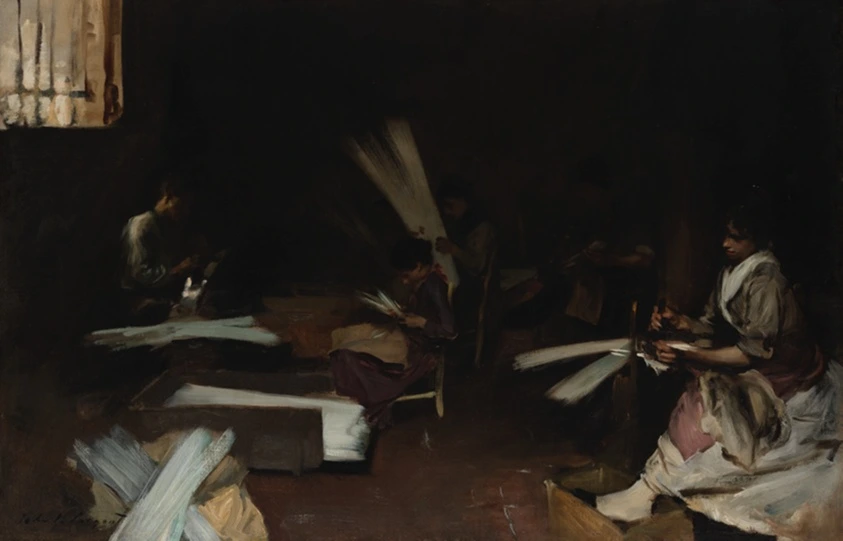
Trained in Paris, John Singer Sargent traveled to Spain, the Netherlands, and Italy early in his career in order to study how painters such as Diego Velázquez and Frans Hals captured the effects of light and rendered figures in space. Venetian Glass Workers is one of several genre scenes featuring glass-bead workers that Sargent executed in the early 1880s. This backlit view of a shop in Venice is dark and atmospheric except for the brilliant strokes of light green and silvery white paint that describe the canes of glass as tradespeople prepare to cut them into bead-sized pieces, which will then be polished and strung into jewelry.
Provenance
Friedrich Wilhelm Carl Bechstein, Berlin, by 1886. Hotel Drouot, Paris, by 1895. Charles Hovey Pepper, (Paris?), by 1896. Macbeth Gallery, New York, by 1911; Mr. and Mrs. Martin A. Ryerson, Chicago, 1912; by descent to Mrs. Martn A. Ryerson, Chicago, 1932; bequeathed to the Art Institute of Chicago, 1933.
Accession Number
110761
Medium
Oil on canvas
Dimensions
56.5 × 84.5 cm (22 1/4 × 33 1/4 in.)
Classification
Painting
Credit Line
Mr. and Mrs. Martin A. Ryerson Collection
Background & Context
Background Story
"Venetian Glass Workers" is one of the earliest paintings from John Singer Sargent's first extended stay in Venice, executed between 1880 and 1882 during the period when the young American was establishing himself as the most promising portraitist of his generation. The scene shows workers in a glass factory on the island of Murano, their figures absorbed in the specialized craft that had made Venetian glass famous for centuries. Sargent's treatment is notable for its democratic sympathy: unlike the society portraits that would make his fortune, this canvas presents working people with the same compositional gravity he would later reserve for duchesses and industrialists. The interior is rendered with the bravura brushwork that already characterized the young artist's style—swift strokes that suggest the flickering furnace light, the molten glass, and the concentrated attention of the craftsmen. The palette is warm and smoky, dominated by the oranges and yellows of the fire and the cool blues of Venetian daylight filtering through high windows. This early genre scene also reveals Sargent's engagement with the French naturalism of Bastien-Lepage and the Impressionist interest in modern labor; though his technique is more academic than Monet's, his subject matter is equally committed to contemporary life. The painting belongs to the same Venetian series that included "The Grand Canal" and "Street in Venice," all produced during a period of intense creative activity before the pressures of portrait commissions limited his freedom. Art historians have compared this work to the glass-blowing scenes of nineteenth-century French painting, but Sargent's version is distinguished by its atmospheric handling and its refusal to moralize about working-class conditions.
Cultural Impact
This early genre scene applied society-portrait compositional gravity to working-class subjects, bridging French naturalism and American democratic sympathies in Venice's glass workshops.
Why It Matters
It matters because Sargent painted glassblowers like they were dukes—proving that a furnace worker deserved the same wall space as a millionaire.


