Woman in a Garden

Description

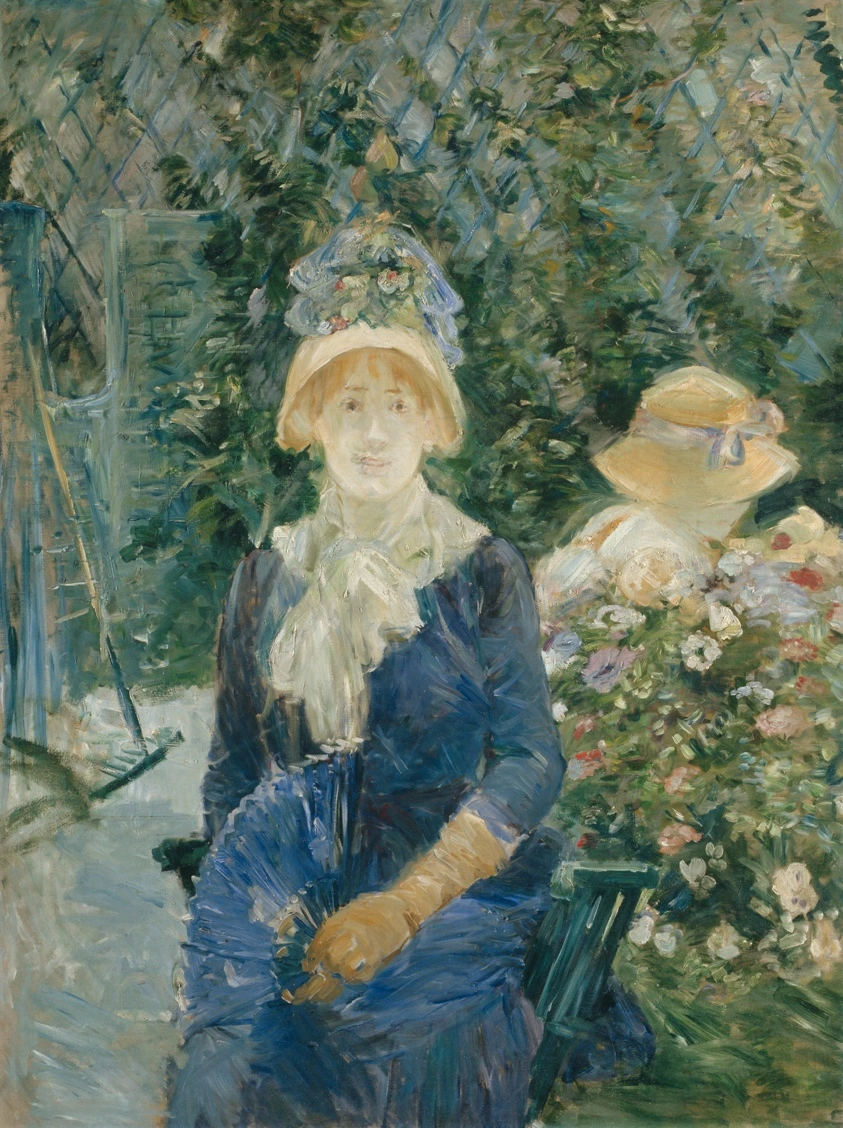
This work was probably begun in the summer of 1882, when Berthe Morisot and her family rented a house in Bougival, a picturesque village along the Seine River in northern France. Morisot spent the season there with her husband, Eugène Manet (artist Édouard Manet's brother), and their nearly four-year-old daughter, Julie. The child wearing a straw hat in the background of this painting is likely based on Julie, while the identity of the main figure is unknown.

Morisot applied paint as if she were making a landscape in the Impressionist style, slashing acid green pigments and bluish ochers across the canvas to transcribe the effects of dappled sunlight without differentiating between the strokes used for the figure and setting.

Provenance

With the artist until her death in 1895; by descent to the artist’s daughter Julie and her husband Ernest Rouart; by descent to their son, Denis Rouart; sold to Nathan Cummings, 1955, Palm Beach, Florida [this and the following information provided by Consolidated Foods Corporation, Sara Lee Corporation; see also Chicago 2000]; given to Mrs. Robert B. Mayer, Chicago in the 1970s; sold to Consolidated Foods Corporation, Nathan Cummings Collection, 1983; given to the Art Institute, 1999.

Woman in a Garden

Berthe Morisot

1882–83

Accession Number

153798

Medium

Oil on canvas

Dimensions

123 × 94 cm (48 1/2 × 37 in.); Framed: 153.7 × 123.9 × 12.1 cm (60 1/2 × 48 3/4 × 4 3/4 in.)

Classification

oil on canvas

Museum

The Art Institute of Chicago

Chicago, United States

Credit Line

A Millennium Gift of Sara Lee Corporation
Background & Context

Background Story

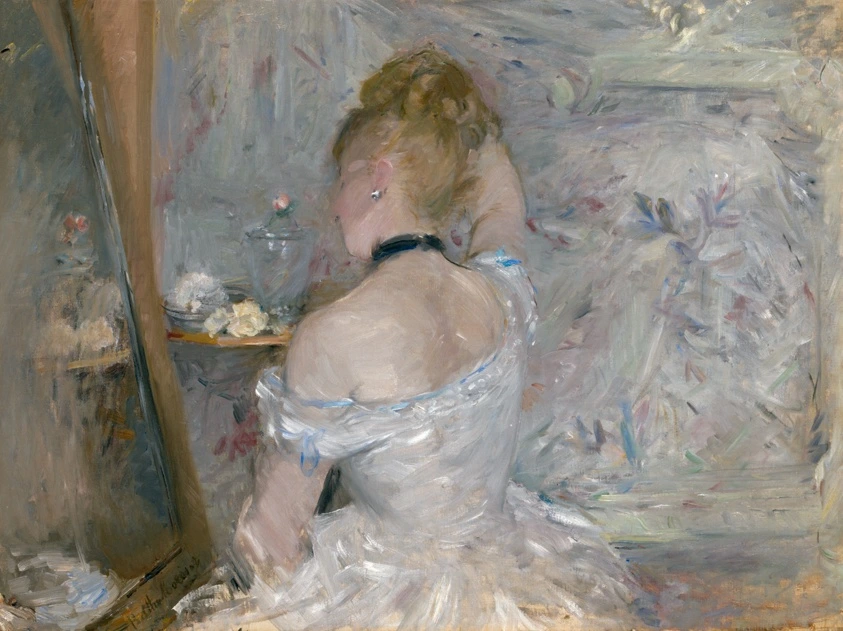
Berthe Morisot's "Woman in a Garden" (1882–83) is an oil on canvas that exemplifies the intimate, domestic vision of one of the founding members of Impressionism. Morisot (1841–1895) was the only woman among the original Impressionist group, and her work brings a distinctive perspective to the movement. This painting shows a woman—perhaps Morisot's sister or a model—in a garden, the sunlight filtering through the leaves creating a dappled pattern of light and shadow across the figure and the surrounding foliage. Morisot's brushwork is characteristically light and feathery, the paint applied in quick, sketchy strokes that capture the sensation of a summer afternoon rather than describing every detail. The palette is fresh and luminous: whites, greens, soft blues, touches of pink. Unlike many of her Impressionist colleagues who painted the bustling boulevards of Paris, Morisot focused on the private world of women and children, domestic interiors, and gardens. Her work offers a quieter, more intimate vision of modern life that is no less perceptive for its modesty of scale and subject.

Cultural Impact

Morisot was a pioneering figure in the Impressionist movement, her intimate depictions of women's domestic life providing a counterpoint to the more public subjects favored by her male colleagues and expanding the range of Impressionist subject matter.

Why It Matters

This garden scene captures the essence of Morisot's art: the intimate observation of women in private spaces, the luminous palette, and the feathery brushwork that seems to dissolve form into light and atmosphere.