Provenance
S. Tozzi [this and other information derives from Morassi 1973]; sold, Paris, Galerie Georges Petit, June 1919. Private collection, California. Wildenstein, New York. Mrs. Joseph Regenstein, by 1964; given to Art Institute, 1964.
Accession Number
20597
Medium
Oil on canvas
Dimensions
21.3 × 17.2 cm (8 3/8 × 6 3/4 in.)
Classification
oil on canvas
Credit Line
Gift of Mrs. Joseph Regenstein
Background & Context
Background Story
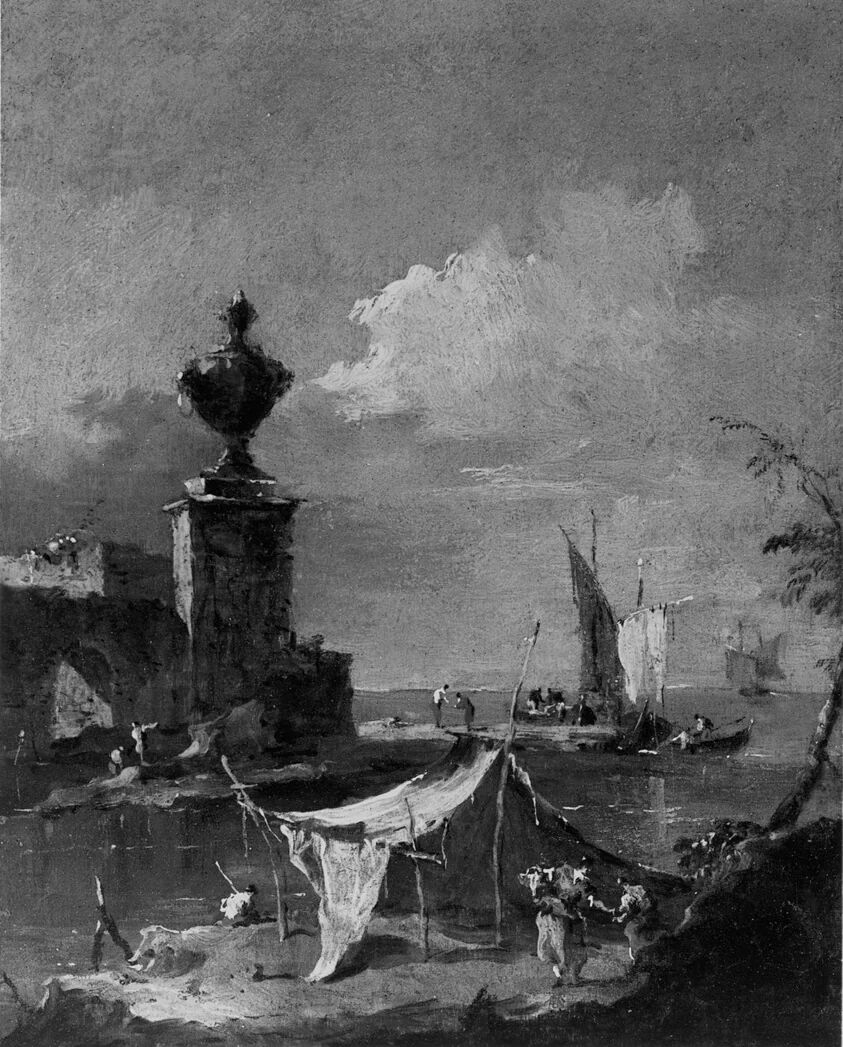
Francesco Guardi's "Capriccio: The Lagoon" (after 1770) is an oil on canvas that exemplifies the Venetian tradition of the capriccio—a landscape or cityscape that combines real and imaginary elements in a playful, poetic composition. Guardi (1712–1793) was the last great painter of the Venetian school, known for his atmospheric views of Venice and its lagoon. This capriccio shows the Venetian lagoon with its characteristic combination of real landmarks and invented elements: perhaps recognizable buildings from Venice combined with imaginary ruins, boats, and figures arranged in a composition that captures the spirit of the city rather than its literal topography. Guardi's technique is loose and painterly, the forms suggested with rapid, broken brushwork that conveys the vibration of light on water and the hazy atmosphere of the lagoon. His palette is characterized by warm golds, cool blues, and soft greens. Guardi's capricci were highly prized by collectors for their imaginative freedom and their evocation of the unique beauty of Venice.
Cultural Impact
Guardi's capricci represent the culmination of the Venetian veduta tradition, pushing the genre toward a more personal, poetic, and atmospheric mode that looks forward to the Romanticism of the 19th century.
Why It Matters
This capriccio of the lagoon captures the dreamlike beauty of Venice, the imaginary composition and loose brushwork creating an atmospheric vision of the city that is more true to its spirit than any topographically accurate view.
Related Artworks

Harem Scene
Francesco Guardi

A Capriccio with a Ruined Gothic Arch
Francesco Guardi

Adoration of the Shepherds (recto); Three Sketches: Buildings by Canal with Boats, Landscape with Buldings on Hillside, Buildings with Portico (verso)
Francesco Guardi

Capriccio with a Squall on the Lagoon
Francesco Guardi