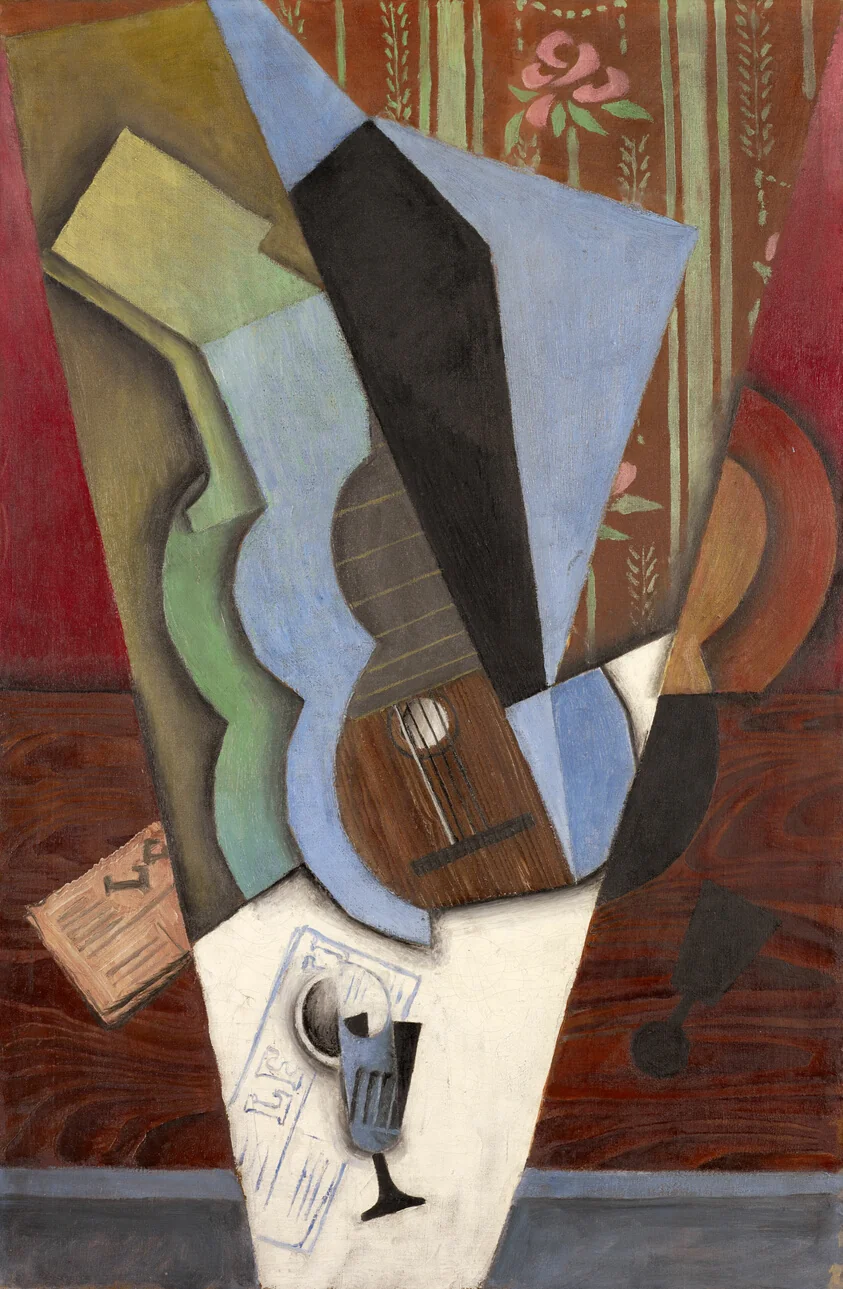
Abstraction (Guitar and Glass)

Description

Juan Gris traveled to Paris in 1906 and soon moved to the neighborhood of Montmartre, where he met Pablo Picasso and Georges Braque. Eventually, Gris joined their artistic circle and participated in the development of Cubism. In Abstraction (Guitar and Glass), he incorporated objects often used in Cubist still-life painting—musical instruments, newspaper, a glass, and a tabletop. Rather than shatter their forms, however, Gris took a more synthetic approach to the composition. The overlapping planes, flattened appearance, and rhythmic patterns of the painting reinforce the two-dimensional nature of the picture’s surface, while the trompe l’oeil effects, deeply saturated colors, strong light-dark contrasts, and precise definition of forms give the still life an extraordinary physical reality.

Provenance

The artist; Daniel-Henry Kahnweiler (1884–1979), Paris, 1913 [letter from Maurice Jardot of Galerie Louise Leiris, Aug. 1976, in curatorial file]; sold, Hôtel Drouot, Paris, 3rd Kahnweiler sequestration sale, July 4, 1922, lot 98, as La Guitare. Flora Schofield (1873-1960), Chicago, by 1927 [Hanzel Galleries 1961]; sold, Hanzel Galleries, Chicago, Feb. 26, 1961, lot 50, to the Art Institute of Chicago.

Abstraction (Guitar and Glass)

Juan Gris

1913

Accession Number

12874

Medium

Oil on canvas

Dimensions

91.4 × 59.7 cm (36 × 23 1/2 in.)

Classification

Painting

Museum

The Art Institute of Chicago

Chicago, United States

Credit Line

Charles H. and Mary F. S. Worcester Fund

Background & Context

Background Story

Juan Gris's Abstraction (Guitar and Glass) (1913) is an oil on canvas from the height of the Cubist movement. Gris (1887-1927) was a Spanish painter who worked in Paris and was one of the leading figures of Cubism, along with Picasso and Braque. This painting shows a guitar and a glass, two classic Cubist subjects, broken down and reassembled according to Cubist principles. The forms are fragmented and faceted, the space is flattened and ambiguous, the palette is limited to the muted earth tones characteristic of Analytic Cubism. The painting is an analysis of the subject, breaking it down into its component parts and reconstructing it on the canvas in a new configuration. Gris's approach to Cubism was more systematic and rigorous than Picasso's or Braque's, and his works from 1913 are among the most intellectually coherent products of the Cubist movement. Abstraction (Guitar and Glass) is a masterwork of Analytic Cubism, demonstrating the movement's ability to transform the most ordinary subjects into compositions of extraordinary complexity and beauty.

Cultural Impact

Gris was the most systematic of the Cubist painters, and his works represent the intellectual culmination of the Cubist project.

Why It Matters

This Cubist still life of a guitar and glass breaks down the ordinary objects into a composition of fragmented forms and ambiguous spaces, Gris's systematic approach creating a work of intellectual rigor and visual beauty.