Description
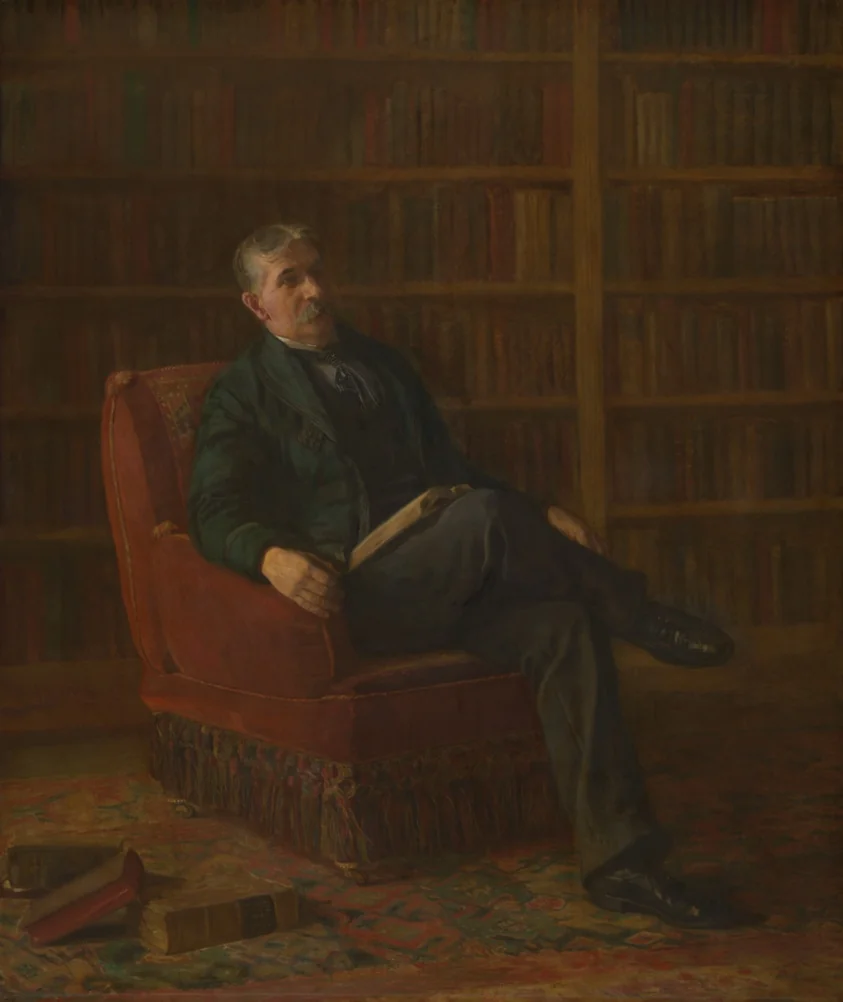
Riter Fitzgerald—the art, music, and literary critic for the Philadelphia Evening Item—championed Thomas Eakins’s work and publicly defended the artist when his teaching methods proved controversial. Eakins’s portrait of the journalist is informed by Fitzgerald’s open-minded opinions, his appreciation of diverse art forms, and his commitment to intellectual life. Comfortably seated in his book-lined library, Fitzgerald is portrayed as a genteel man who enjoys a leisurely, yet contemplative lifestyle. With an open book in his lap, he thoughtfully gazes into the distance, peacefully lost in the realm of ideas.
Provenance
Riter Fitzgerald, Philadelphia, from 1895 to 1911; Geraldine Hubbard (Mrs. Jacob K. Spare), Philadelphia, from 1911 to 1930; Whitney Museum of American Art, New York City, from 1930 to 1950; M. Knoedler and Company, New York City, 1950; sold to the Art Institute of Chicago, 1950.
Accession Number
72864
Medium
Oil on canvas
Dimensions
193.7 × 163.2 cm (76 1/4 × 64 1/4 in.)
Classification
Painting
Credit Line
Friends of American Art Collection; Goodman Fund
Background & Context
Background Story
"Riter Fitzgerald" is one of Thomas Eakins's most imposing full-length portraits, painted in 1895 during the period when the Philadelphia artist was systematically recording the leading intellectual and cultural figures of his adopted city with an unsparing realism that alienated many sitters while guaranteeing the works' enduring power. Fitzgerald was a local journalist and art critic who had defended Eakins against the controversies that had driven the artist from the Pennsylvania Academy of the Fine Arts in 1886, and this portrait can be read as both gratitude and assertion—Eakins showing his supporter as a man of substance worthy of monumental treatment. The scale of the canvas—nearly two meters high—places it among Eakins's largest portraits, and the frontal pose and dark clothing create a severity that recalls the grand manner of Reynolds and Raeburn while remaining unmistakably modern in its psychological penetration. The palette is restricted to blacks, grays, and warm flesh tones, with Fitzgerald's face emerging from the surrounding darkness like a nocturnal apparition. Eakins's brushwork is precise and deliberate, each stroke serving the description of form rather than asserting its own painterly identity. This restraint is characteristic of Eakins's mature style: he believed that technique should be invisible, that the painting should disappear before the sitter's presence. Art historians have compared this portrait to Eakins's famous painting of the surgeon Samuel D. Gross, noting that both works present their subjects as professionals engaged in the serious business of their vocations. The painting also documents the urban culture of Gilded Age Philadelphia, a city that prided itself on intellectual seriousness and moral rectitude.
Cultural Impact
This monumental portrait monumentalized a supportive critic while asserting Eakins's unsparing realist philosophy, translating Reynolds's grand manner into modern psychological severity.
Why It Matters
It matters because Eakins painted a friend who defended him and made him look like a tombstone—proving that gratitude in art could look like unflinching honesty.


