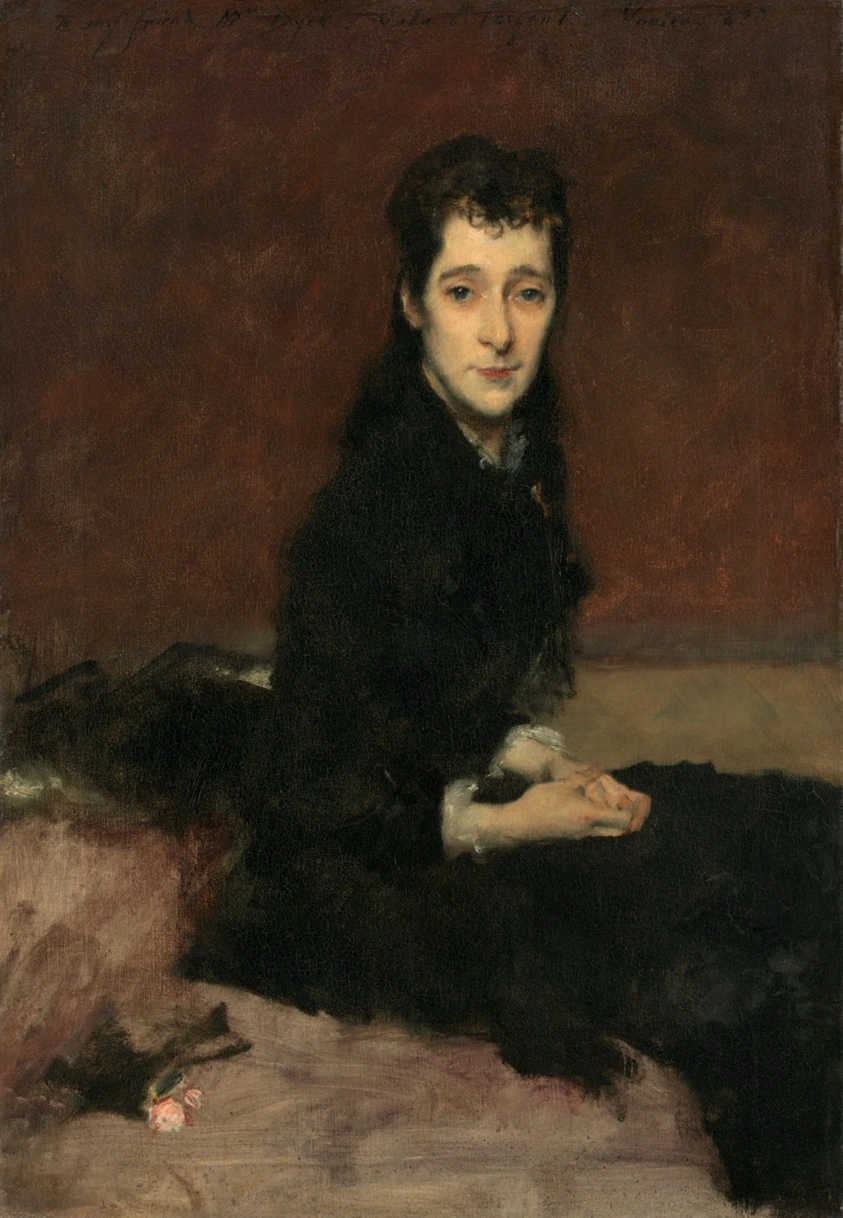
Mrs. Charles Gifford Dyer (Mary Anthony)

Description

The sitter and her husband, the painter Charles Gifford Dyer, were part of an expatriate community of American artists that lived and worked in Europe in the late 19th century. John Singer Sargent painted this portrait during his first extended stay in Venice as a professional artist. Rather than a formal commission, the work likely served as a souvenir of friendship and shared experiences. Its relatively small scale and the background’s thin, quick brushwork suggest that Sargent completed the canvas in a single sitting. The painting’s dark tones and limited palette are reminiscent of Spanish masters such as Diego Velázquez, whom Sargent looked to in particular during his student years in the late 1870s, and indeed throughout his career.

Mrs. Charles Gifford Dyer (Mary Anthony)

John Singer Sargent

1880

Accession Number

110879

Medium

Oil on canvas

Dimensions

62.2 × 43.8 cm (24 1/2 × 17 1/4 in.)

Classification

Painting

Museum

The Art Institute of Chicago

Chicago, United States

Credit Line

Friends of American Art Collection

Background & Context

Background Story

This portrait of Mary Anthony, Mrs. Charles Gifford Dyer, painted in 1880, is one of Sargent's most accomplished early Boston commissions, capturing a member of the city's art patronage circle with the elegance that already signaled his future dominance of international society portraiture. The sitter was the wife of a physician and collector who would later help organize Sargent's first Boston exhibitions; the portrait thus served both artistic and social purposes, cementing relationships that would sustain the artist's American career. The composition is intimate rather than grand: Mrs. Dyer is shown in three-quarter length against a dark background, her face turned slightly toward the viewer with an expression of alert intelligence rather than passive beauty. The dress is rendered with the textile virtuosity that would become Sargent's trademark—a dark silk or satin that absorbs and reflects light simultaneously, its folds suggested by a few swift strokes of the brush. The palette is restrained, almost monochrome, with the warmth of the flesh tones providing the only chromatic relief. This austerity is characteristic of Sargent's early portraits, before the full-blown colors of his London period; it reflects the influence of Spanish painting, particularly Velázquez, whose portraits Sargent had copied in the Prado. The work also demonstrates Sargent's working method: the face was painted from life over multiple sittings, while the dress and background were executed in the studio from memory and props. This division between the living sitter and the decorative setting is what gives the portrait its sense of immediacy, as if Mrs. Dyer had just paused in her daily routine to look at the painter.

Cultural Impact

This Boston commission established Sargent's early American patronage network while demonstrating Velázquez's influence through restrained monochrome and textile virtuosity.

Why It Matters

It matters because Sargent made a doctor's wife look as interesting as a queen—proving that intelligence could be painted more beautifully than jewelry.