Description
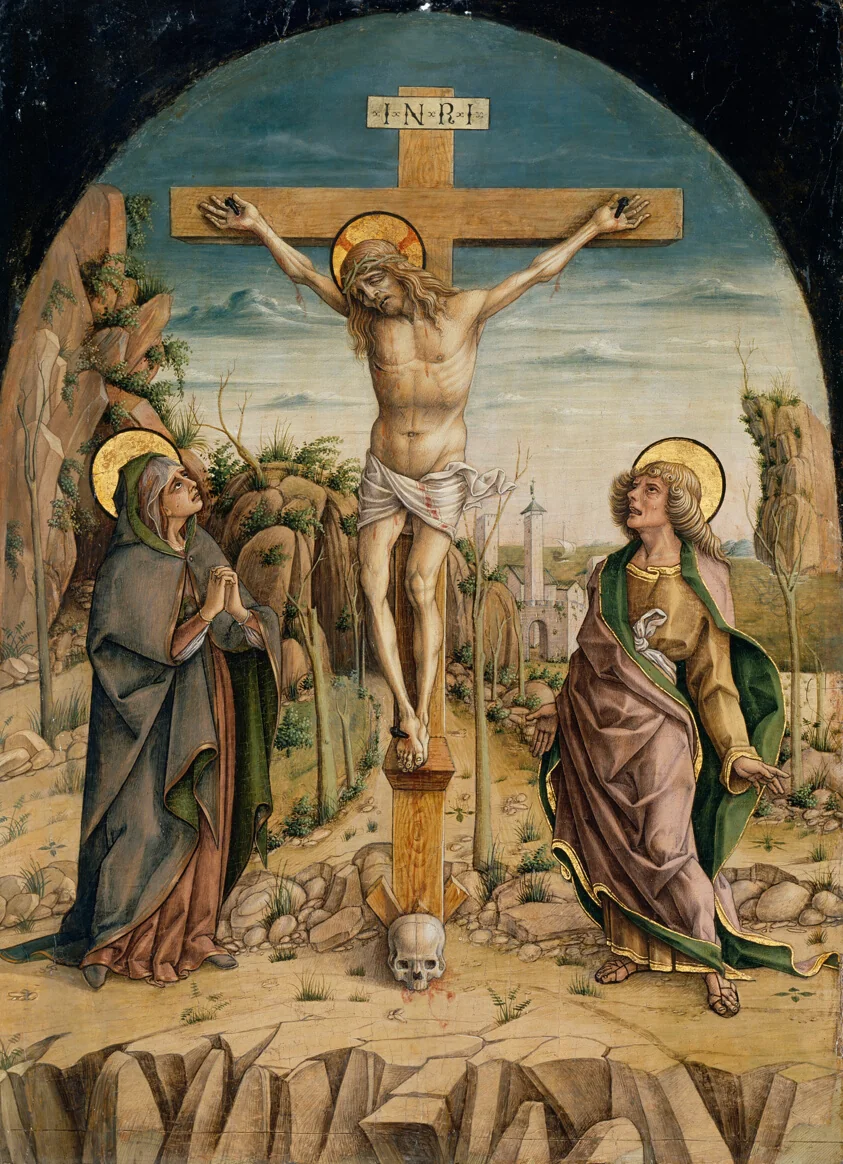
Carlo Crivelli’s vivid style married the beautiful with the grotesque. Here, the Virgin Mary and Saint John the Evangelist gaze in anguish at Jesus on the cross. Crivelli enhanced the scene’s morbidness by depicting Jesus emaciated and puffy-eyed, his mouth agape, with blood dripping from his wounds. As subtle hints toward his eventual victory over death, wind animates his loincloth and inflates the sail of a boat in the distance, while verdant plants shoot up from cracks in the rocky, arid terrain.
Provenance
Alexander Barker (died 1874) and his executors, London; sold Christie’s, London, June 21, 1879, no. 472, to Lesser for £100 16s [annotated catalogue at Frick Art Reference Library]. Baron E. de Beurnonville, Paris; offered for sale but bought in, Charles Pillet, Paris, May 9–16, 1881, no. 632; sold Hôtel Drouot, Paris, May 21–22, 1883, no.126, for Fr 2,800 [Mireur 1911]. Joseph Spiridon, Rome, probably by 1883 [the catalogue of the 1929 Spiridon sale erroneously states that it was acquired from Beurnonville in 1876]; sold Cassirer and Helbing, Berlin, May 31, 1929, no. 15, pl. 23, to Knoedler for 250,000 marks [annotated catalogue at Getty Center]; sold by Knoedler, London, to Art Institute, 1929.
Accession Number
111622
Medium
Tempera on panel
Dimensions
75 × 55.2 cm (29 9/16 × 21 3/4 in.); Framed: 91.4 × 72.1 × 10.2 cm (36 × 28 3/8 × 4 in.)
Classification
Painting
Credit Line
Wirt D. Walker Fund
Background & Context
Background Story
Carlo Crivellis The Crucifixion, painted around 1487, is a devotional panel of extraordinary intensity that showcases the artists signature combination of Northern Italian decorative brilliance and emotional directness. Crivelli, who spent most of his career in the Marches region of east-central Italy, developed a style that combined the linear precision and ornamental richness of Paduan painting with a commitment to naturalistic detail inherited from Northern Renaissance models. In this Crucifixion, Christs body hangs on the cross with a physical weight and specificity that makes the suffering tangible: the ribcage is emaciated, the hands twist against the nails, and blood flows in carefully described rivulets down the wood of the cross. The landscape behind is rendered in Crivellis characteristic manner, with every leaf, stone, and blade of grass individually delineated, creating an effect of hyper-reality that intensifies the devotional impact. Crivelli was unusual among Italian painters of his generation in his refusal to adopt the softening sfumato of Florentine painting, preferring instead to maintain the crisp outlines and jewel-like colors that give his works their distinctive intensity. The gold halos and ornamental borders that frame the scene are not surface decoration but integral to Crivellis vision of the sacred as something visibly precious and set apart from ordinary experience.
Cultural Impact
Crivellis distinctive style, combining Northern decorative precision with Italian compositional principles, represents an alternative to the Florentine tradition that dominated art historical narratives. Recent scholarship has rehabilitated Crivelli as a deliberately archaic artist who chose ornamental intensity over naturalistic softening, challenging the modern assumption that progress in art means the elimination of ornament.
Why It Matters
A devotional panel by Crivelli of startling physical intensity, combining Northern decorative precision with Italian compositional rigor and devotional directness, representing an alternative path in late 15th-century Italian painting that rejected Florentine sfumato in favor of ornamental brilliance.