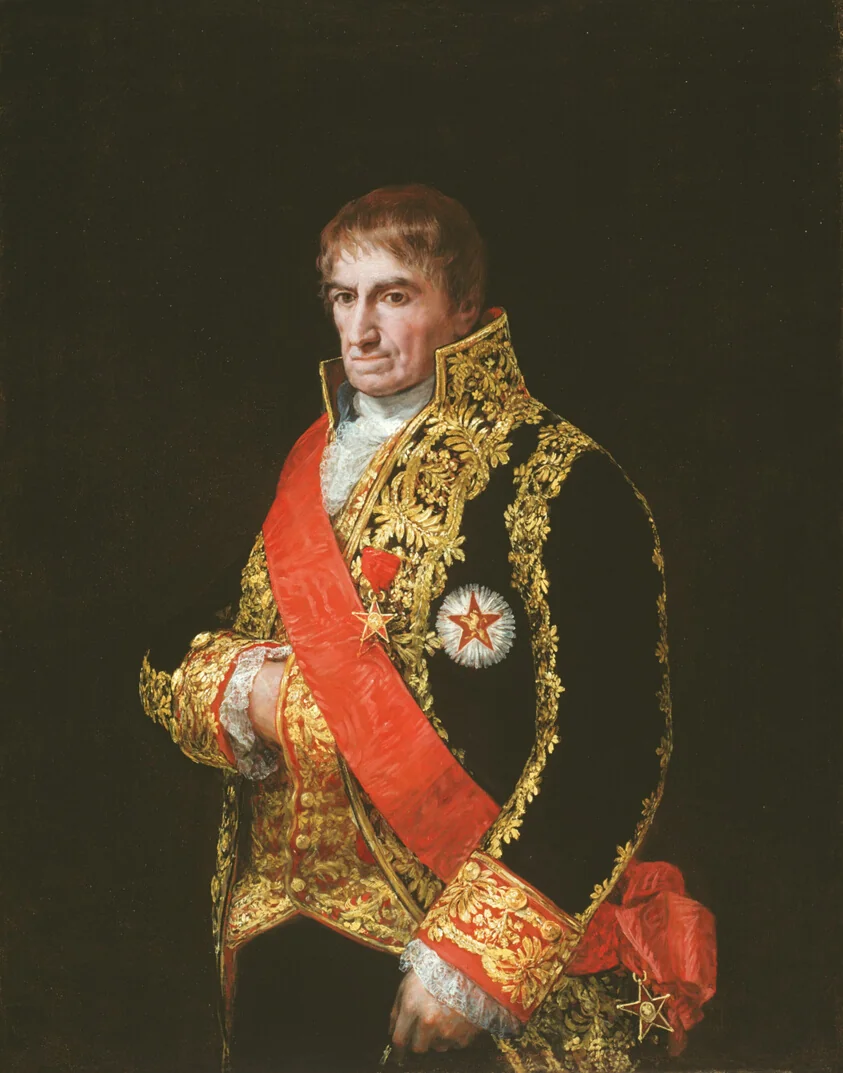
Portrait of General José Manuel Romero

Description

The early 19th century was a troubled time in Spain. After Napoleon placed his brother, Joseph Bonaparte, on the Spanish throne in 1808, the people rose up in rebellion, eventually driving the French out with the help of the British army. Although his own sentiments were patriotic and liberal, Francisco de Goya dutifully fulfilled his obligations as first painter to the king. This is a portrait of José Manuel Romero, a minister under Joseph Bonaparte, although the degree to which the man is overwhelmed by his splendid court uniform and decorations may suggest a certain lack of sympathy on the part of the artist.

Portrait of General José Manuel Romero

Francisco José de Goya y Lucientes

c. 1810

Accession Number

89043

Medium

Oil on canvas

Dimensions

105.5 × 87.7 cm (41 1/2 × 34 1/2 in.); Framed: 136.6 × 114.7 cm (53 3/4 × 45 1/8 in.)

Classification

Painting

Museum

The Art Institute of Chicago

Chicago, United States

Credit Line

Gift of Mr. and Mrs. Charles Deering McCormick

Background & Context

Background Story

Painted around 1810, this portrait depicts General José Manuel Romero, a Spanish military officer serving in the difficult years of the Peninsular War against Napoleonic France. The general is shown in full dress uniform, his chest crossed by sashes and decorations that testify to loyal service to a crown under siege. The composition is frontal and imposing, yet Goya avoids the flattery that characterized official war portraiture in other European courts. Romero's face bears the strain of command during a guerrilla war without front lines, his gaze steady but his skin pallid beneath the military glamour. The painting is executed with the rapid assurance of an artist who had spent decades recording the faces of power and could now inflect even celebratory images with doubt. The uniform is rendered with particular attention to textile textures—the gold braid, the red sash, the polished buttons—while the face is treated with a looser, more searching brushwork that suggests the person beneath the rank. This canvas belongs to the same wartime context as The Disasters of War, though it was painted for private rather than public circulation. It reveals Goya's complex relationship to Spanish military culture: respectful of individual courage while increasingly skeptical of the institutions that demanded it. The portrait's survival is itself historically significant, having escaped the destruction that claimed many of Goya's private commissions during the convulsions of the nineteenth century.

Cultural Impact

This wartime portrait captures the psychological cost of the Peninsular War, offering a human face amid the catastrophic violence that Goya would later expose in his print cycles.

Why It Matters

It matters as a face of resistance—a general painted honestly enough to show that even heroes were worried.