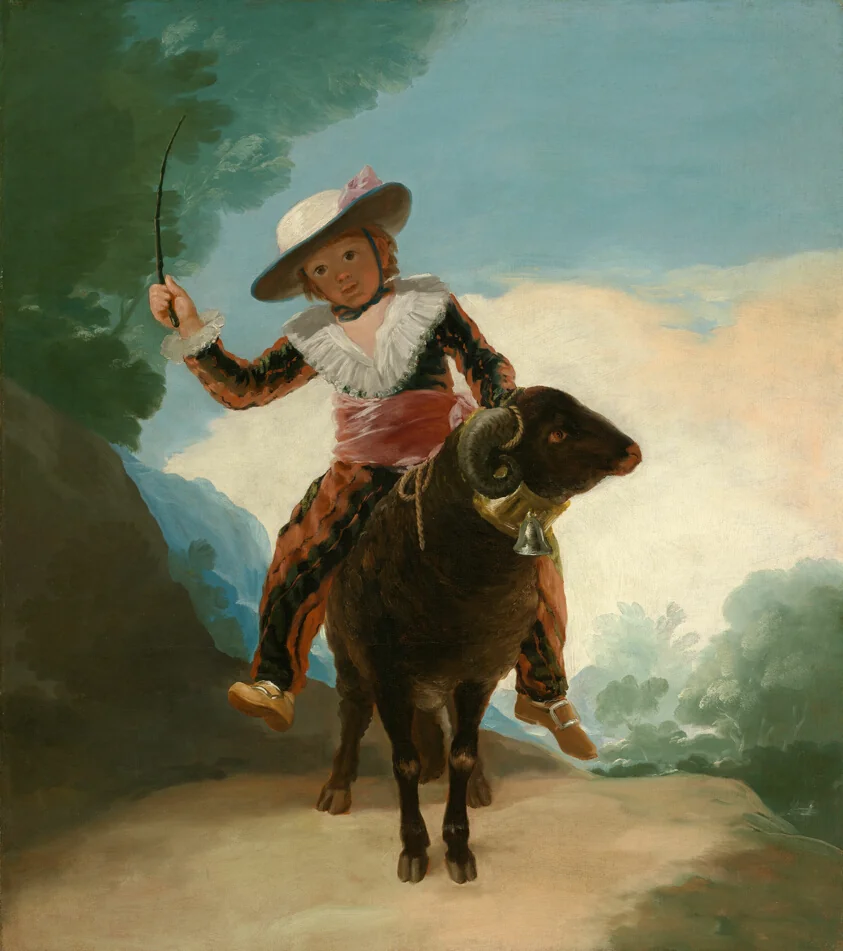
Boy on a Ram

Description

As painter to the king of Spain, Francisco de Goya also designed tapestries for the royal residences. The artist made small oil sketches to work out the designs, followed by full-scale painted cartoons that served as guides for the weavers at the king’s tapestry works. This cartoon was produced for a tapestry in a series decorating the dining room in the Palace of El Pardo outside Madrid. The room’s large panels illustrate a traditional decorative subject, the four seasons, but Goya exercised his imagination in the smaller panels above the doors, producing scenes of children and animals like this one.

Provenance

Real Fábrica de Tapices de Santa Bárbara, 1786/87 (painted as a cartoon for a series of tapestries executed there for Rey Carlos III for the palacio at El Pardo, outside Madrid); Livinio Stuyk y Vandergoten, by 1887 (director of the Real Fábrica de Tapices de Santa Bárbara); by descent to his son, Gabino Stuyk, Madrid, by 1900. Real Fábrica de Tapices, Madrid, by 1911 [this and the following according to a letter from March 19, 1991, from Melissa de Medeiros, Knoedler and Company, to Mary Kuzniar; copy in curatorial file]; sold to Knoedler and Company, London and New York, September 1911; sold to Charles Deering (died 1927), April 1912; by descent to his daughter, Mrs. Chauncey McCormick, Chicago; by descent to her son, Brooks McCormick, Chicago; given by Mr. and Mrs. Brooks McCormick to the Art Institute of Chicago, 1979.

Boy on a Ram

Francisco José de Goya y Lucientes

1786–87

Accession Number

111559

Medium

Oil on canvas

Dimensions

127.2 × 112.1 cm (50 1/16 × 44 1/8 in.); Framed: 153.7 × 138.4 × 12.7 cm (60 1/2 × 54 1/2 × 5 in.)

Classification

oil on canvas

Museum

The Art Institute of Chicago

Chicago, United States

Credit Line

Gift of Mr. and Mrs. Brooks McCormick

Background & Context

Background Story

Francisco Goya's "Boy on a Ram" (1786–87) is an oil on canvas from his tapestry cartoon series, depicting a young boy riding a ram in a playful, pastoral scene. The subject—children playing with animals—was a popular theme in Rococo art, reflecting the period's taste for scenes of innocent pleasure and rustic simplicity. The boy is shown astride the ram, perhaps holding its horns or a rope, the animal seeming to carry him forward. The painting is lively and full of movement, the figures rendered with Goya's characteristic freshness and vitality. The palette is warm and bright, with the white of the ram and the colors of the boy's clothing standing out against a landscape background. The tapestry cartoons were among Goya's most important early commissions, establishing his reputation at court and providing him with financial security. They also gave him the opportunity to paint scenes of Spanish popular life that would become a central theme of his art.

Cultural Impact

Goya's tapestry cartoons document the popular culture of 18th-century Spain, preserving the costumes, customs, and types of Spanish life that fascinated the artist throughout his career.

Why It Matters

This playful scene of a boy riding a ram captures the spirit of Goya's early tapestry cartoons: light, lively, and full of the energy of Spanish popular life, painted with a freshness that makes the decorative genre come alive.