Provenance
(Ambroise Vollard [1866-1939], Paris) by 1912;[1] sold to Marius de Zayas [1881-1961] by 1916.[2] Purchased by Edward Steichen [1879-1973] for Eugene [1875-1959] and Agnes Ernst Meyer [1887-1970], Mount Kisco, New York, by 1921;[3] gift 1958 to NGA.
[1]Lent by Vollard to the 1912 _Second Post-Impressionist Exhibition_ held at the Grafton Galleries, London.[2]Exhibited at de Zayas' Modern Gallery in New York in 1916. [3]Regarding Steichen's role, see letter dated 12 July 1977 from Katherine Graham in NGA curatorial files. Lent by the Meyers to the 1921 _Loan Exhibition of Impressionist and Post-Impressionist Paintings_ at the Metropolitan Museum of Art.
Accession Number
1958.10.2
Medium
oil on canvas
Dimensions
overall: 101 x 81.9 cm (39 3/4 x 32 1/4 in.) | framed: 125.1 x 106.4 x 5.1 cm (49 1/4 x 41 7/8 x 2 in.)
Classification
Painting
Credit Line
Gift of Eugene and Agnes E. Meyer
Tags
Painting Impressionist & Modern (1851–1900) Oil Painting Canvas French
Background & Context
Background Story
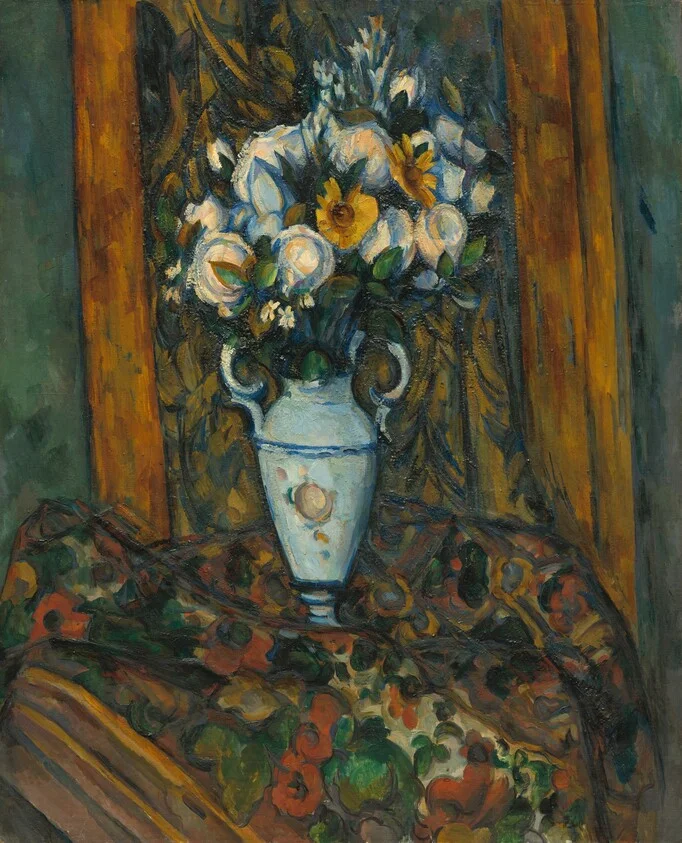
Vase of Flowers (1900/1903) represents Cézanne's engagement with the still-life tradition—one of the most important in his oeuvre and the genre that produced some of his most revolutionary paintings. By 1900-03, Cézanne was recognized by younger painters as the most significant living artist, and his still-life method—building form through patches of color that simultaneously described and constructed the depicted objects—was the foundation of the influence he exerted on Cubism and beyond. The vase of flowers, a traditional still-life subject, provided Cézanne with the opportunity to demonstrate his method in a genre that viewers could compare with the long tradition of floral still-life painting. Cézanne's treatment departs radically from this tradition: where conventional flower painting emphasized botanical accuracy and decorative arrangement, Cézanne constructed the flowers and vase from the same color patches that built his landscapes and figures—the same constructive method applied across genres. The vase's form is not described by outline but built by the intersection of color patches that define its volume; the flowers are not botanical specimens but chromatic events that suggest floral form without duplicating it. The late date connects this work to the period when Cézanne's influence was at its peak: the young painters who visited him at Aix—Émile Bernard, Denis, and others—were carrying his method back to Paris, where it would transform 20th-century painting.
Cultural Impact
Cézanne's floral still-lifes influenced how the flower-painting tradition was revised in modern art, replacing botanical description with chromatic construction. The paintings influenced later still-life painters who similarly treated traditional subjects as vehicles for formal exploration, from the Cubists to the painters of the École de Paris. The vase of flowers influenced how Cézanne's method was understood across genres, demonstrating its universality.
Why It Matters
This painting matters because it demonstrates that Cézanne's constructive method could serve traditional still-life subjects as effectively as it served his more famous landscapes and figure compositions—arguing that the method's significance lies in its approach to representation rather than in the subjects it represents.