Figure with Meat

Description

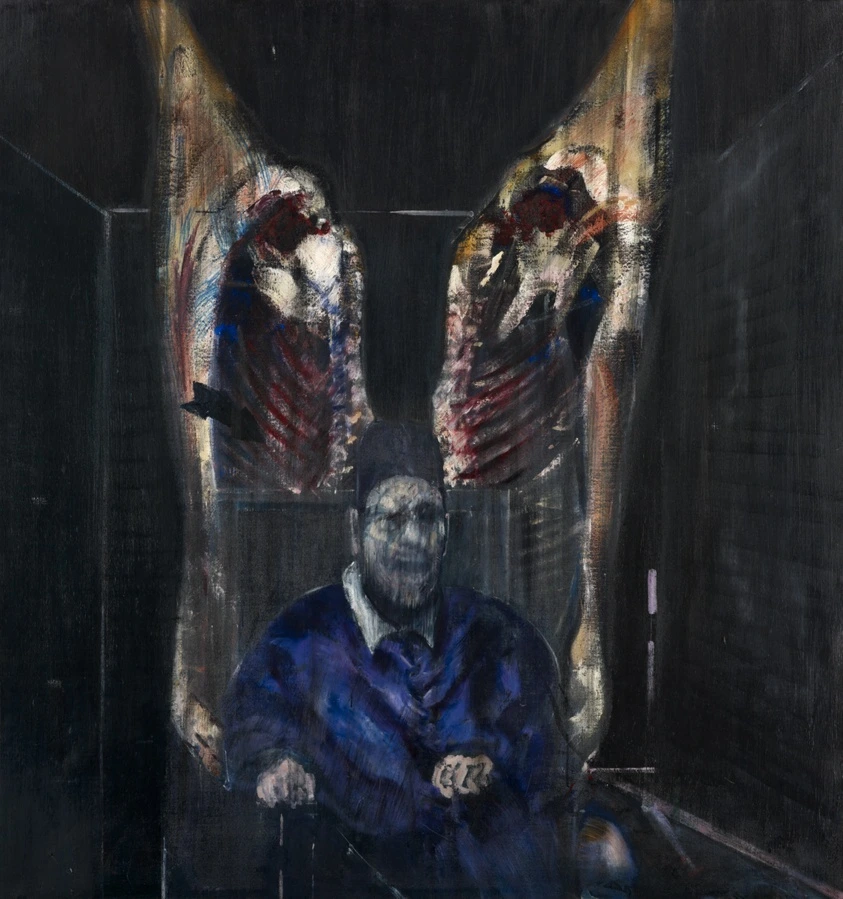
Permeated by anguished visions of humanity, Francis Bacon’s paintings embody the existential ethos of the postwar era. In his powerful, nihilistic works, tormented and deformed figures become players in dark, unresolved dramas. Bacon often referred in his paintings to the history of art, interpreting borrowed images through his own bleak mentality. Figure with Meat is part of a now-famous series he devoted to Diego Velázquez’s Portrait of Pope Innocent X (c. 1650; Galleria Doria-Pamphilj, Rome). Here he transformed the Spanish Baroque artist’s iconic portrayal of papal authority into a nightmarish image, in which the blurred figure of the pope, seen as if through a veil, seems trapped in a glass-box torture chamber, his mouth open in a silent scream. Instead of the noble drapery that frames Velázquez’s pope, Bacon is flanked by two sides of beef, quoting the work of seventeenth-century Dutch artist Rembrandt van Rijn and twentieth-century Russian artist Chaim Soutine, both of whom painted brutal and haunting images of raw meat. Framed by the carcass, Bacon’s pope can be seen alternately as a depraved butcher, or as much a victim as the slaughtered animal hanging behind him.

Provenance

Lucien Freud, London, by 1955; sold through Hanover Gallery, London, to the Art Institute, 1956.

Figure with Meat

Francis Bacon

1954

Accession Number

4884

Medium

Oil on canvas

Dimensions

Without frame: 129.9 × 121.9 cm (51 3/16 × 48 in.); 129.9 × 122 cm (51 1/8 × 48 in.)

Classification

Painting

Museum

The Art Institute of Chicago

Chicago, United States

Credit Line

Harriott A. Fox Fund

Background & Context

Background Story

Francis Bacon (1909-1992) painted Figure with Meat in 1954, depicting a seated figure flanked by two sides of beef in the grotesque, distorted manner that makes Bacon one of the most powerful painters of the 20th century. The composition directly references Rembrandt's Carcass of Beef (1657) and the Buddhist motif of a meditating figure flanked by two carcasses, which Bacon encountered in a book on Buddhist iconography. The 1954 date places this in Bacon's most productive period, when he was producing the distorted portraits and figure paintings that would make him the most important British painter of the postwar era.

Cultural Impact

Figure with Meat is important in Bacon's oeuvre because it demonstrates the combination of art-historical reference and visceral distortion that makes his paintings among the most powerful images of 20th-century art. The reference to Rembrandt's Carcass of Beef shows Bacon using art history as a source for his own visceral images, and the Buddhist motif of a meditating figure flanked by carcasses shows him using non-Western iconography as well—creating a type of painting that is simultaneously art-historical, cross-cultural, and viscerally powerful.

Why It Matters

Figure with Meat is Bacon's visceral art-historical grotesque: a seated figure flanked by two sides of beef, directly referencing Rembrandt's Carcass of Beef and the Buddhist motif of a meditating figure between carcasses. The 1954 painting combines art-historical reference with visceral distortion in the manner that makes Bacon the most powerful British painter of the postwar era.