Provenance
Galerie Kahnweiler, Paris, by 1917 [this and the following according to Cooper 1977]. Galerie Simon, Paris, after 1920. Pierre Faure, Paris [label on stretcher], after 1920. Galerie Simon, Paris, before 1941. Sir Kenneth Clark (1903–1983), London, by 1946 [Kahnweiler 1946]. Roland, Browse & Delbanco, London [label on stretcher], by 1949. Perls Galleries, New York, by 1949. Florene May Schoenborn (1903–1995) and Samuel A. Marx (1885–1964), Chicago and New York, 1949 [New York 1965, master checklist, copy in curatorial file]; bequeathed by Florene May Schoenborn to the Art Institute, Oct. 31, 1997.
Accession Number
148414
Medium
Oil, pasted papers, charcoal, pencil and ink on canvas
Dimensions
54 × 72.4 cm (21 1/4 × 28 1/2 in.)
Classification
collage
Credit Line
Bequest of Florene May Schoenborn
Background & Context
Background Story
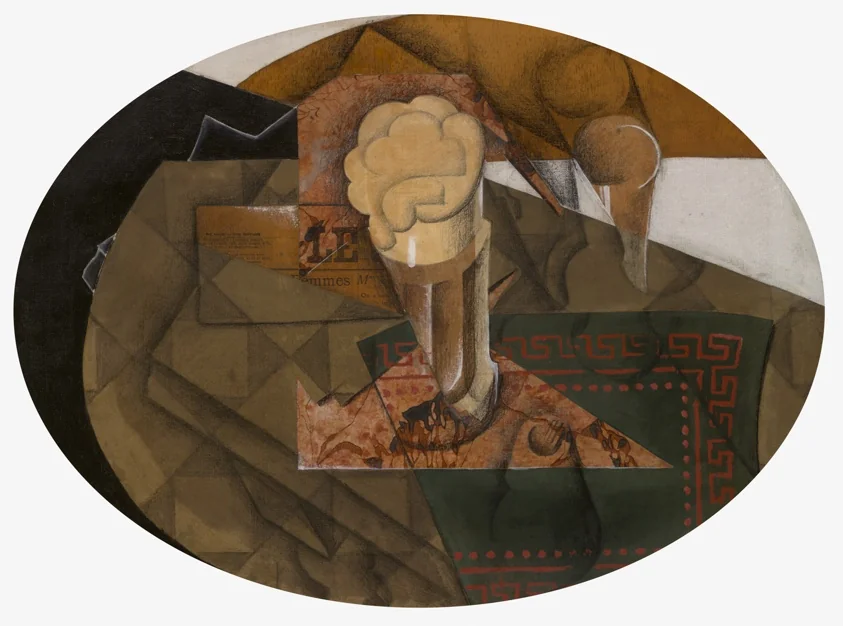
Juan Gris's The Glass of Beer (1914) is a collage in oil, pasted papers, charcoal, pencil, and ink on canvas. This work belongs to the Synthetic Cubist period, when Gris, Picasso, and Braque were incorporating real materials into their works. The subject is a simple one: a glass of beer on a table. But Gris's treatment transforms this ordinary subject through the revolutionary techniques of collage. The pasted papers (papiers collés) bring the materials of everyday life into the work of art. The charcoal and pencil provide linear definition, the oil paint adds passages of color, and the ink adds accents. The composition is flattened and fragmented, the objects analyzed and reconstructed according to Cubist principles. The Glass of Beer is a masterwork of Synthetic Cubist collage, demonstrating the movement's ability to transform the humble subjects of everyday life into works of art that challenge the very definition of painting.
Cultural Impact
Gris's collages of 1914 are among the most important works of Synthetic Cubism, expanding the possibilities of art through the incorporation of real materials.
Why It Matters
This collage of a glass of beer transforms an ordinary subject through the revolutionary technique of papier colle, the pasted papers and varied media creating a work that challenges the boundaries between art and everyday life.


