Description
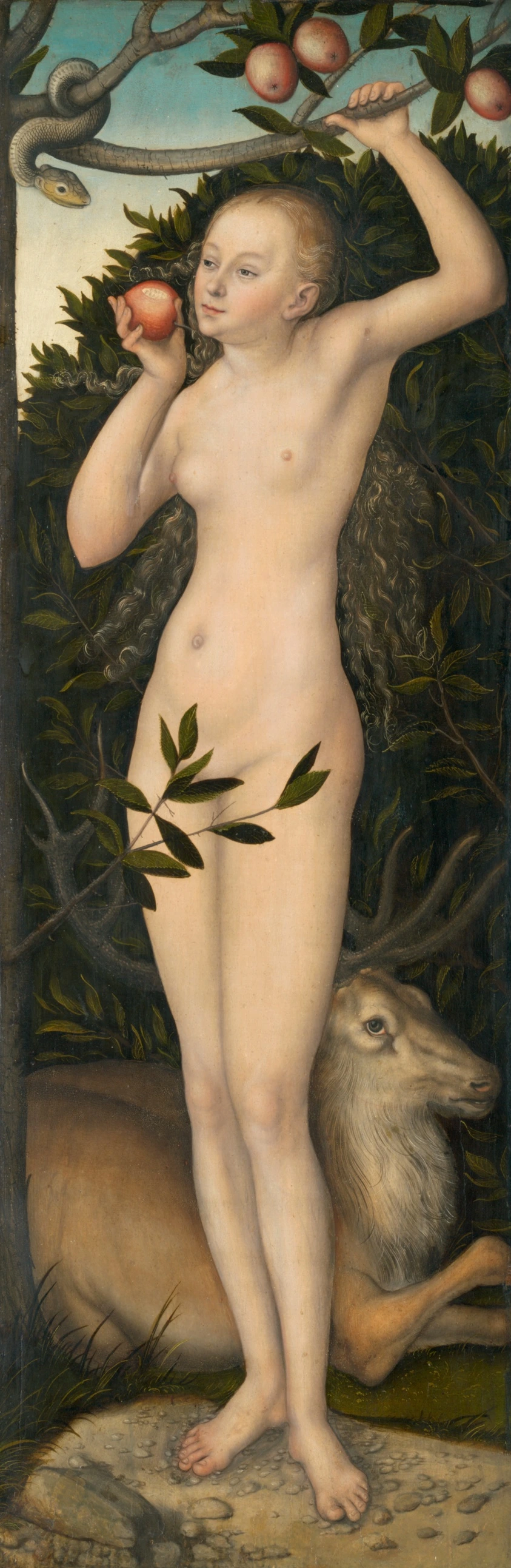
For most of his long career, Lucas Cranach the Elder was court painter to the Elector of Saxony. Although the general placement of Adam and Eve in these paintings reflects the influence of Albrecht Dürer's renowned classicizing treatment of the same subject in paintings and prints, Cranach's slender, undulating figures conform to the contemporary courtly ideals of beauty. This pair is one of the finest of the many versions of the subject made by Cranach and his workshop.
Provenance
Private collection, Stockholm [according to Rich 1936, p. 46]. J. Goudstikker, Amsterdam, by 1935 [record of payment to Goudstikker, September 10, 1935, Art Institute Archives]; sold to Charles H. Worcester, Chicago, September 1935; given to the Art Institute, 1935.
Accession Number
21668
Medium
Oil on panel
Dimensions
107.5 × 36.4 cm (42 5/16 × 14 5/16 in.); Framed: 121.6 × 51.6 cm (47 7/8 × 20 5/16 in.)
Classification
oil on panel
Credit Line
Charles H. and Mary F. S. Worcester Collection
Background & Context
Background Story
Lucas Cranach the Elder's Eve (1533-37) is the companion panel to Adam, depicting the first woman in the Garden of Eden. Eve is shown with the serpent and the forbidden fruit, her body rendered with the elegant proportions characteristic of Cranach. The palette is rich, the handling precise.
Cultural Impact
Cranach's Eve is one of the most famous images of the female nude in German Renaissance art.
Why It Matters
This panel of Eve captures Cranach's distinctive vision of feminine beauty, combining sensuousness with moral seriousness.