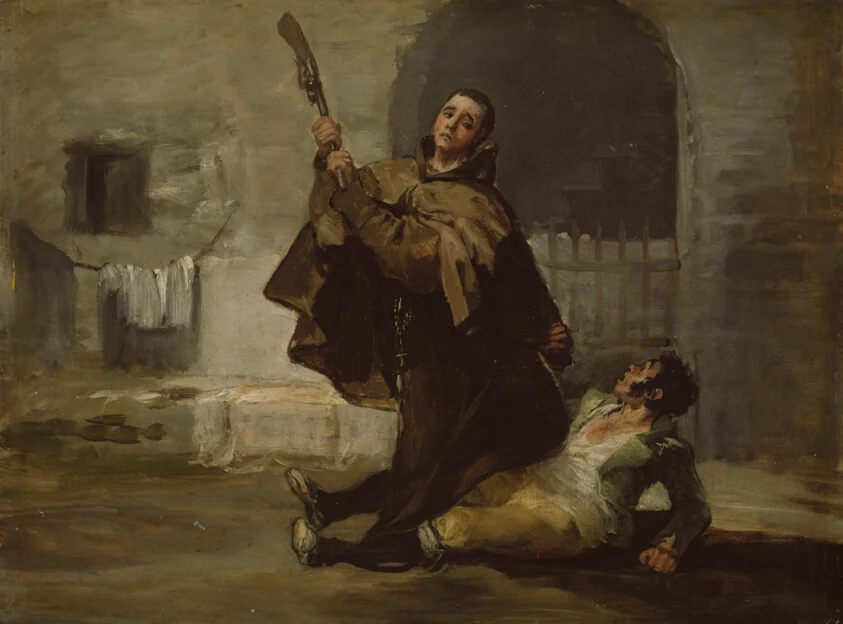
Friar Pedro Clubs El Maragato with the Butt of the Gun

Description

In small, lively paintings made for his own pleasure or for a few discerning patrons, Francisco de Goya explored satirical and popular aspects of Spanish life. This series was inspired by a contemporary event, the capture of notorious criminal El Maragato by Friar Pedro de Saldivia in 1806. After escaping from prison, El Maragato spent two months stealing food, guns, and money before trying to take Friar Pedro and other innocent people hostage. The friar outsmarted the bandit, however, seizing his gun, shooting him in the thigh as he tried to flee, and finally tying him up. This story was extremely popular in the early 19th century and Spanish artists memorialized it in images, poems, and songs.

Provenance

One of a series of six small paintings in an inventory of Goya’s collection, Madrid, taken in 1812 for the division of property between the artist and his son Javier following the death of the artist's wife; the group of small paintings marked X8 being allotted to the son: "Seis quadros del Maragato señalados con el número ocho, en 700 [reales]" (the inventory mark has been removed from the painting and is no longer visible) [see Gassier and Wilson 1971]; presumably Javier Goya after 1812. Lafitte collection, Madrid; sale, Paris, Hôtel Drouot, March 7, 1861, bought in together with other paintings from the series for 590 francs [see Hippolyte Mireur, Dictionnaire des ventes (Paris, 1914), vol. 3, p. 360 and Despartment Fitz-Gerald 1928-1950]. Julius Böhler, Munich by 1911; sold to Martin Ryerson (died 1932), Chicago in May 1911 [see purchase receipt dated May 13, 1911]; bequeathed to the Art Institute, 1933.

Friar Pedro Clubs El Maragato with the Butt of the Gun

Francisco José de Goya y Lucientes

c. 1806

Accession Number

16359

Medium

Oil on panel

Dimensions

29.2 × 38.5 cm (11 1/2 × 15 5/8 in.); Framed: 42 × 51.5 × 6.4 cm (16 1/2 × 20 1/4 × 2 1/2 in.)

Classification

Painting

Museum

The Art Institute of Chicago

Chicago, United States

Credit Line

Mr. and Mrs. Martin A. Ryerson Collection

Background & Context

Background Story

The second panel of Goya's Friar Pedro series shows the decisive moment when the unarmed monk turns the captured musket against its owner, using the butt of the gun to club the bandit into submission. Painted around 1806 on a small oak panel, the composition is a masterpiece of compressed violence: the friar's brown habit fills the left foreground, his arm raised in righteous anger, while El Maragato collapses backward in theatrical defeat. The spatial depth is minimal—the action presses against the picture plane like a relief sculpture—creating an immediacy that larger canvases rarely achieve. Goya's brushwork here is among the most vigorous of his pre-War period, with thick impasto in the clothing and quick slashes of pigment suggesting the chaotic energy of the struggle. The scene also carries a subtle political charge: painted during the final years of the Spanish ancien régime, the image of a humble monk defeating a lawless brute could be read as allegory for the Church's role in maintaining social order. Yet Goya was never a simple propagandist, and the violence he depicts is too raw, too physically convincing, to serve as comfortable moral instruction. The painting raises uncomfortable questions about the relationship between religious vocation and physical force, between justice and vengeance. These tensions would erupt with far greater ferocity in The Disasters of War, but they are already audible in this small, explosive panel.

Cultural Impact

This panel compresses physical violence into a miniature format with Expressionist intensity, revealing Goya's preoccupation with the moral ambiguity of righteous force before the Peninsular War.

Why It Matters

It matters because a monk hitting a bandit with a gun becomes something deeper—a question about whether goodness needs force to survive.