Provenance
The artist; sold through Galerie Maeght Lelong, New York, to Frances Dittmer/Refco Ltd., Chicago, by 1986 [Singerman, 1986]. Judith Neisser, Chicago, by 2011 [Rorimer, 2011]; given to the Art Institute of Chicago, Dec. 31, 2018.
Accession Number
184989
Medium
Oil on fiberglass with wood and aluminum
Dimensions
122 × 109.3 cm (48 × 43 in.)
Classification
N/A
Credit Line
Gift of Judith Neisser
Background & Context
Background Story
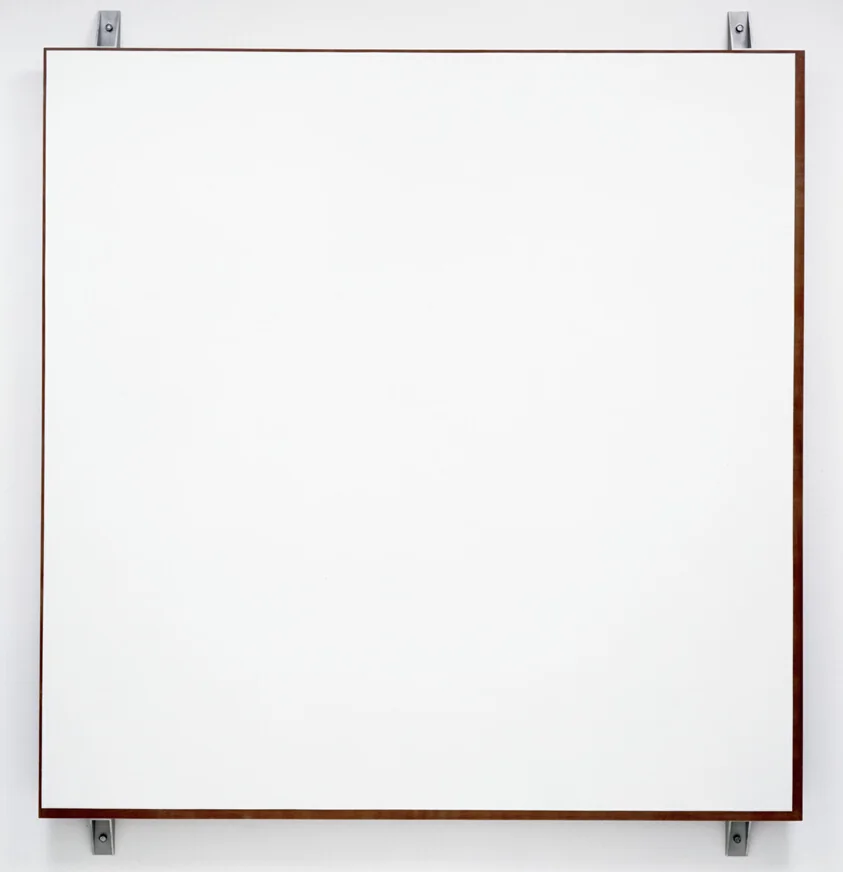
"Distributor" is a 1985 work by Robert Ryman that exemplifies the American Minimalist painter's lifelong exploration of the material properties of paint and support, the image consisting of white oil paint applied to a complex support of fiberglass, wood, and aluminum that challenges the conventional boundaries between painting and sculpture. The composition is a field of white, the paint applied with the thick, tactile brushwork that Ryman employed to create surfaces that catch light and cast tiny shadows, the variations in texture and thickness becoming the entire subject of the work. The title "Distributor" suggests both the dispersal of paint across the surface and the distribution of artistic meaning across the material components of the work, the word pointing to the act of painting itself rather than any external reference. The 1985 date places this work in the period of Ryman's most ambitious experiments with unconventional supports, when he was producing paintings on fiberglass, steel, and other industrial materials that questioned the traditional association of painting with canvas and wood. Art historians have connected this work to the broader tradition of monochrome painting, from the white canvases of Malevich to the textured whites of Cy Twombly, noting that Ryman's treatment is more materially complex, more focused on the physical properties of the support than the spiritual or symbolic content of these predecessors. The work also demonstrates Ryman's influence on the development of Minimalism and Conceptual Art: the reduction of painting to its essential components—paint, support, and light—provided a model for artists who sought to strip art of narrative and representation.
Cultural Impact
This 1985 white monochrome made material support complexity the entire subject, using fiberglass-wood-aluminum industrial dispersal to strip painting down to physical paint-light-shadow essentials.
Why It Matters
It matters because Ryman painted white on fiberglass and made the surface feel like it was having a conversation with the wall—proving that even nothing could be something if the material was honest.


