Description
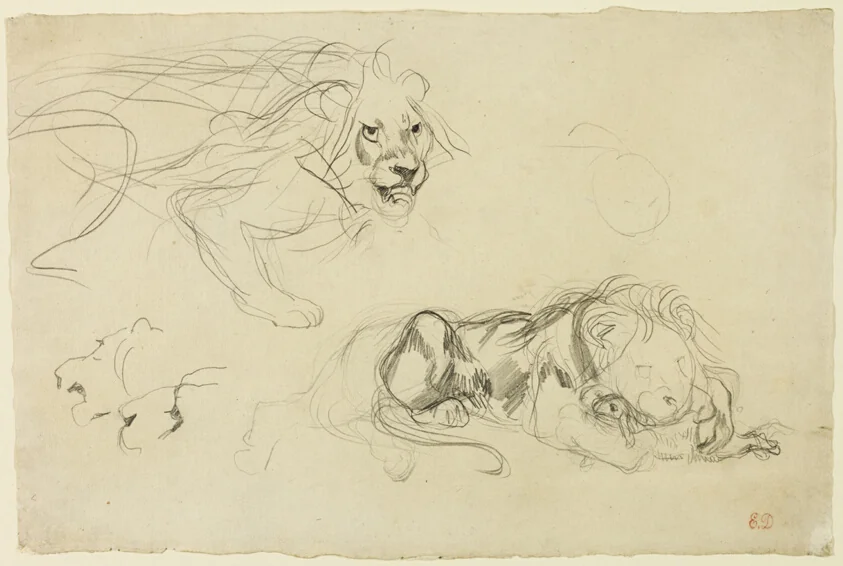
Delacroix created these preliminary images for the nearby Lion of the Atlas Mountains (1927.1646), which would appear in reverse as a result of the printmaking process. Experimenting with several positions for the lion’s prey, and two expressions for the feline itself, this abbreviated sheet suggests several close sessions at the Jardin des Plantes. Ever diligent in his research, Delacroix even sought permission to arrive before the zoo opened to the public, to watch the lions being fed.
Provenance
Estate of the artist [Lugt suppl. 838a]. Rene Paul Huet (died 1928), by 1908 [according to Delteil 1908]. Sold, Hôtel Drouot, Paris, June 28, 1946, lot 132. Sold by Marcel Guiot, Paris, to the Art Institute, 1950.
Accession Number
72534
Medium
Graphite on cream laid paper
Dimensions
22.7 × 34.2 cm (8 15/16 × 13 1/2 in.)
Classification
graphite
Credit Line
David Adler Collection
Background & Context
Background Story
Eugène Delacroix's "Studies of Lions" (c. 1829) is a graphite drawing on cream laid paper that shows the artist's fascination with the anatomy and movement of big cats. Delacroix made numerous studies of lions at the Jardin des Plantes zoo in Paris, and these drawings informed his paintings of lion hunts and exotic subjects. The lion was a symbol of power, nobility, and exoticism for the Romantics, and Delacroix's studies capture the animal's majesty with remarkable precision. This sheet shows multiple studies of lions—perhaps a head, a paw, the curve of the back—each one a concentrated investigation of a particular aspect of lion anatomy. The graphite technique is sensitive and precise, the lines building form through careful observation. The cream laid paper provides a warm, textured ground. These studies demonstrate the empirical foundation of Delacroix's art: even his most dramatic, imaginative compositions were built from careful observation of the natural world. His lion studies influenced later artists from Rodin to Picasso.
Cultural Impact
Delacroix's animal studies, particularly his lions, demonstrate the scientific observation that underlay Romantic passion, showing that the most expressive art is built on the most careful study of nature.
Why It Matters
These studies of lions capture the power and majesty of the great cat with remarkable precision, the graphite lines building form through patient observation that would inform Delacroix's most dramatic Romantic compositions.