Description
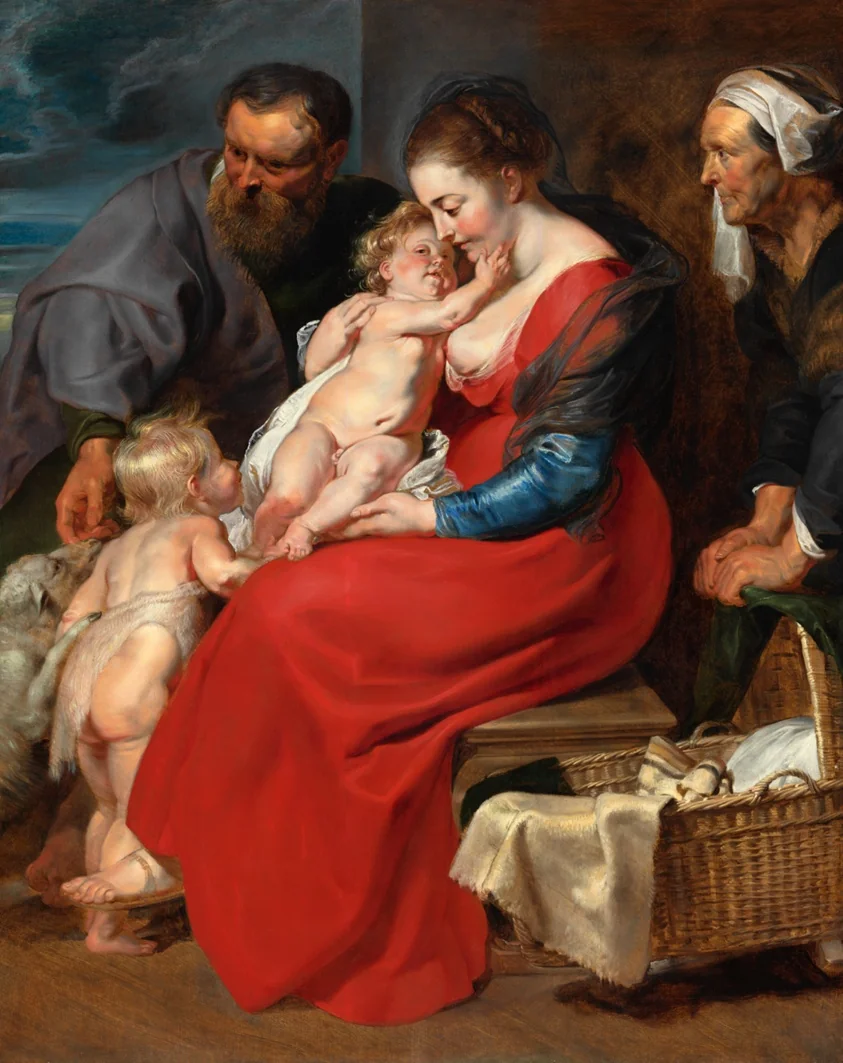
Several versions of this composition exist, suggesting that it was a popular image for private devotion. Peter Paul Rubens presented a distinctly human take on the figures of Jesus, his mother Mary, and his father Joseph. The Holy Family lack the halos that often identify them, and the adult characters wear contemporary Flemish attire. Mary’s exposed breast brings to mind Jesus’s need for physical nourishment as the human son of God. Her central placement underscores the growing veneration of this saint in the Catholic community of the Spanish Netherlands. The bold, diagonal movement of the two infants—John the Baptist eagerly leans toward Jesus, who twists away from him—counterbalances the Virgin Mary’s solid, anchored form. The pyramidal arrangement of the central figures shows Rubens’s attention to the principles of Renaissance art.
By the beginning of the seventeenth century, it was customary for young Flemish painters to complete their education in Italy. Rubens spent eight years there—much longer than many of his peers. He thoroughly absorbed the art of Renaissance painters in Rome and Venice as well as recent advances in early Baroque painting, which allowed him to dominate the artistic scene back in his native Antwerp. The paintings Rubens completed after his return, with their dramatic light and bold movement, show the influence of Caravaggio’s revolutionary work, but Rubens’s style soon became more classical, incorporating the kinds of balanced compositions, clearly defined forms, and crisply rendered surfaces seen here.
Provenance
Jacques Langlier, Paris, who acquired it in three pieces and had it conserved by the successors to Godefroid before selling it to Antoine Poullain for 24,000 fr [annotation in the copy of the Poullain sale in the Philadelphia Museum of Art; information on this and related annotations in other copies of this sale catalogue were kindly supplied by Burton Fredericksen, email of December 13, 2013 in curatorial file; it was presumably when the three vertical boards were reassembled that a narrow horizontal board was added across the top of the panel]; Antoine Poullain, Paris; sold J. B. P. Lebrun, Paris, March 15, 1780, lot 22 for 11,000 fr. to Orsay [according to annotated catalogue cited above and catalogue of the Orsay sale]; Comte d’Orsay, Paris, sold Basan, Paris, 14 April 1790, lot 65 [see also Rooses, 1886, p. 301]. The painting was taken to England but remained unsold and was returned to Paris [according to Smith 1830, p. 246, under no. 837]. Nicolas Lerouge; Paris, offered for sale January 16, 1816, lot 19, but bought in [according to annotated sale cat. at the Johnson Collection, Philadelphia Museum of Art (the name Castalan or Catalan is also mentioned as the consigner, see Rooses 1886, p. 301)]; Chevalier Sebastian Erard; his estate sale, Château de la Muette, August 7, 1832, lot no. 126, for 6,020 fr. to Hope [according to catalogue of Hope sale]; William Williams Hope, Rushton Hall, Northamptonshire; sold, Hôtel des Commissaries-Priseurs, Paris, May 11, 1858, lot no. 7 for 4200 fr. [annotated catalogue at the Frick Art Reference Library]. M. Thirion, Paris; sold Galerie Georges Petit, Paris, June 10, 1907, lot 17 for 59,000 fr. to de Jonghe [according to letter of May 2, 1967 from Julius Weitzner to Charles Cunningham in curatorial file, Paris; the painting has frequently been confused with the larger version on canvas formerly in the Marlborough and Butler collections, Rooses no. 227)]; S. de Jonghe, Paris (died c. 1943), who sent it to George Blumenthal in New York in 1938 [according to Weitzner letter cited above, noting that Blumenthal was de Jonghe’s partner at Lazard Frères]; transferred on de Jonghe’s death to Alavoine and Company for sale [letter of Julius Weitzner cited above]; sold to Julius H. Weitzner, London and New York by 1946 [he lent it to Los Angeles 1946]; given to his daughter Marjorie Weitzner Gambino, Rome, and sold on her behalf to the Art Institute, 1967.