Description
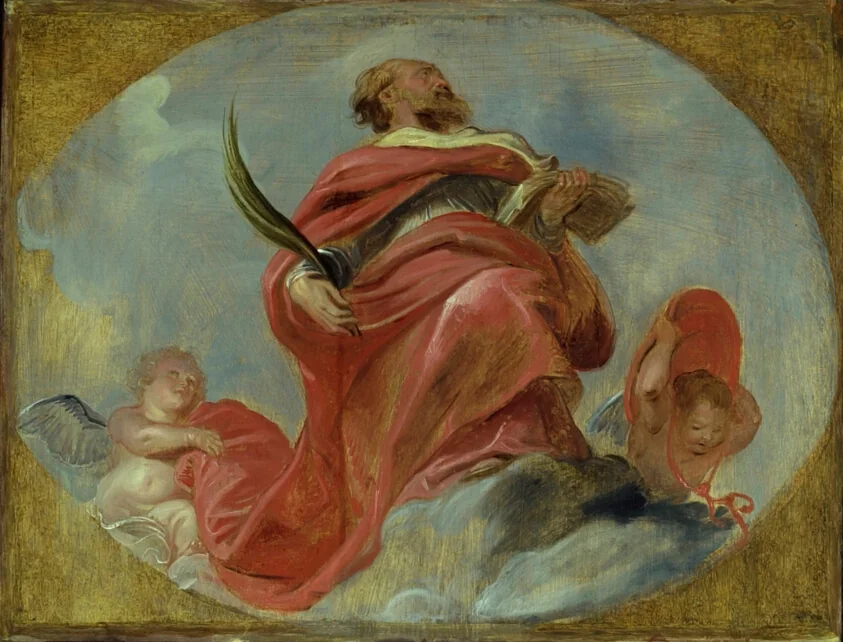
Peter Paul Rubens executed this study and 38 more as he prepared to decorate the ceiling of the Jesuit church in Antwerp. He presented such highly finished sketches to his patrons as proposals for major projects. This work shows a dramatically foreshortened saint gliding majestically on a cloud. The bold perspective would have furthered the illusion that the painting was a window in the ceiling of the church, offering a view to the open sky above. The man depicted here is the 12th-century martyr Albert of Louvain, patron saint of Archduke Albert, governor of the Spanish Netherlands.
Provenance
Matthäus Merian d. Ä., Basel, to 1650; by descent in Merian family to 1796; sold Basel, 1796, no. 27, for F10. Grazio Enea Lanfranconi, Bratislava, by 1895; sold Lempertz, Cologne, 21–23 October 1895, no. 174 as St. Jerome. Dr. Leo Cohn, Paris [according to Puyvelde 1940, no. 38]. Dr. Leo Charles Collins, New York [he lent the picture to Schaeffer and Brandt 1942; a Collins, an émigré, who was active both as a lawyer and art historian, was probably identical with Dr. Leo Cohn, originally of Vienna; see the introduction to Leo C. Collins, Hercules Seghers, Chicago, 1953]. E. and A. Silberman Galleries, New York. John J. Ireland (died 1968), Chicago, by 1955 [lent to New York 1955]; bequeathed to the Art Institute, 1968.
Accession Number
28874
Medium
Oil on panel
Dimensions
34.7 × 45.8 cm (13 5/8 × 18 in.); Framed: 58.5 × 69.3 × 6.4 cm (23 × 27 1/4 × 2 1/2 in.)
Classification
Painting
Credit Line
Bequest of Dr. John J. Ireland
Background & Context
Background Story
Painted in 1620, this portrait of Saint Albert of Louvain is one of the smaller devotional panels from Rubens's mature period, depicting the twelfth-century bishop and martyr with the dramatic chiaroscuro that had become his trademark. Albert was murdered in 1192 by imperial agents opposed to his ecclesiastical reforms, and Rubens portrays him at the moment of contemplation before martyrdom, his gaze lifted toward a divine light that enters from the upper left. The size of the panel—barely 35 × 46 centimeters—belies its emotional intensity; Rubens could compress the grandeur of his large altarpieces into intimate formats without losing their spiritual impact. The saint's red ecclesiastical robes are rendered with thick, tactile strokes of vermilion and carmine that seem to glow against the dark background, while his face is modeled with the soft transitions between light and shadow that Rubens had learned from Venetian painting. The work belongs to the same devotional context as Rubens's numerous private commissions for Catholic collectors in the Spanish Netherlands: small panels for personal altars that allowed the owner to participate in the Counter-Reformation's program of affective piety. Art historians have noted the influence of Caravaggio in the dramatic spotlighting, though Rubens's treatment is less theatrical and more emotionally accessible than the Italian master's. The panel also demonstrates Rubens's astonishing productivity: in 1620 he was simultaneously managing a large studio, executing diplomatic missions for the Habsburg court, and producing paintings at a rate that modern scholars can barely document.
Cultural Impact
This small panel compressed Baroque altarpiece grandeur into intimate devotional format, serving Counter-Reformation private piety with Caravaggesque drama tempered by Rubensian warmth.
Why It Matters
It matters because a murdered bishop fits in your hand—Rubens proving that sanctity doesn't need a cathedral wall to feel vast.