Description
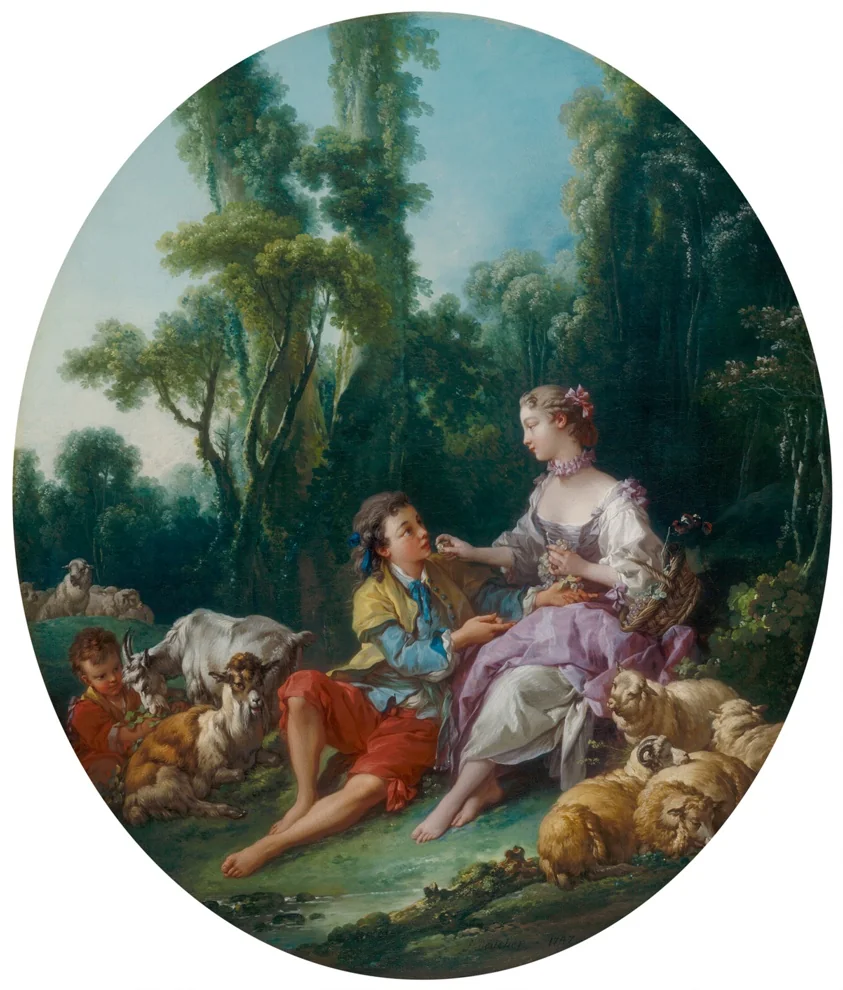
This painting is based on a 1745 pantomime about a young shepherd’s awakening love for a shepherdess. The couple feed each other grapes—a fruit associated with Bacchus, god of pleasure—suggesting that their encounter is not entirely chaste. François Boucher’s compositions on pastoral themes comprise his most influential contribution to 18th-century French art. These lush and playful fantasies of rustic life, designed primarily for the private enjoyment of wealthy financiers and aristocrats, had little to do with the social realities of rural labor during the period.
Provenance
With the pendant Flageolet Player, probably Jean Baptiste Machault d’Arnouville (died 1794), contrôleur général des finances; by descent to Melchior, marquis de Vogüe, one of whose descendants married comte René de Rohan Chabot [proposed by Alistair Laing in connection with the history of the pendant, in a letter to Susan Wise, August 13, 1986 in curatorial file]. Comte René de Rohan Chabot, Paris; sold to Wildenstein, 1959 [telephone conversation of Ay-Wang Hsia with Susan Wise, May 4, 1982]; sold to the Art Institute, 1973.
Accession Number
44742
Medium
Oil on canvas
Dimensions
Oval: 80.8 × 68.5 cm (31 3/4 × 27 in.); Framed: 96.6 × 84.5 × 11.5 cm (38 × 33 1/4 × 4 1/2 in.)
Classification
oil on canvas
Credit Line
Martha E. Leverone Endowment
Background & Context
Background Story
François Boucher's "Are They Thinking about the Grape?" (1747) is an oil on canvas that exemplifies the playful, erotic sensibility of the French Rococo. Boucher (1703–1770) was the most celebrated decorative artist of the 18th century, the favorite painter of Madame de Pompadour and the court of Louis XV. The title—a rhetorical question about the thoughts of the figures—adds a note of witty innuendo to the pastoral scene. The painting shows figures in a rustic landscape, perhaps shepherds or peasants, the grape reference suggesting thoughts of wine, pleasure, and the sensuous enjoyments of life. Boucher's technique is flawless: the colors are luminous, the brushwork is fluid, the composition is gracefully balanced. The figures are idealized and graceful, their poses elegant even in their supposed rusticity. This painting belongs to Boucher's mature period, when he was at the height of his fame and producing the works that defined the Rococo style for all of Europe. The combination of pastoral subject, erotic suggestion, and exquisite technique was precisely what Boucher's aristocratic patrons desired.
Cultural Impact
Boucher's pastoral scenes defined the visual culture of the French Rococo, creating a world of idealized pleasure and refined sensuality that expressed the spirit of the ancien régime.
Why It Matters
This playful pastoral scene captures the essence of Boucher's art: the elegant figures, the luminous colors, the witty title, and the sophisticated sensuality that made him the defining painter of the French Rococo.