Description
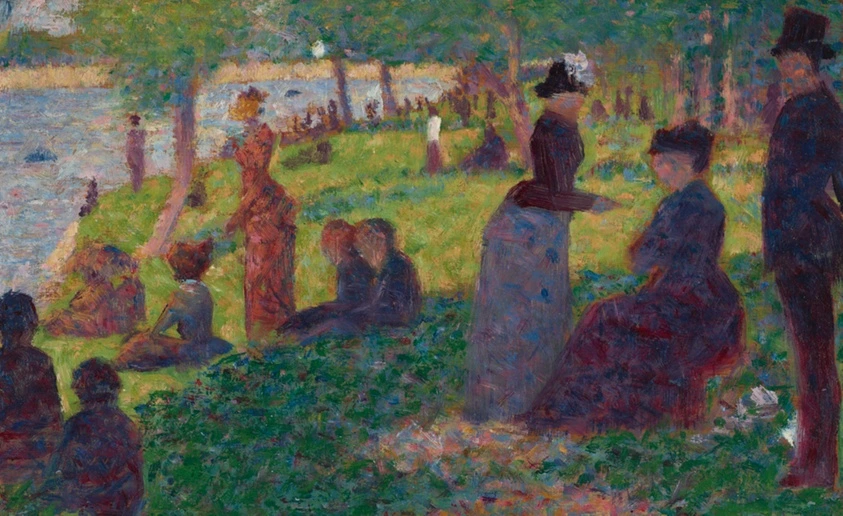
This small oil on thin wood panel is one of over 20 painted studies Georges Seurat made for A Sunday on La Grande Jatte—1884 . Although at first glance its composition seems similar to the finished canvas, its 20 or more figures have little to do with the final version. The trio at right with an elderly seated figure, for example, was completely rethought in the completed work, where they are replaced by a man in a top hat and a woman walking a monkey on a leash. This ironic combination of grand solemnity and wry humor is totally absent from the sketch’s awkwardly positioned figures.
Provenance
The artist (died 1891), Paris [panneau no. 87, posthumous inventory, dated May 3, 1891, reproduced in de Hauke 1961, v.1, 80]. Possibly by descent to the artist’s mother, Ernestine Faivre Seurat (died 1899). Maximilien Luce (died 1941), Paris [Herbert 1992, 129]; by descent to his son, Frédéric Luce, Paris, 1941 [this and the following according to correspondence from Claudine Godts, Wildenstein & Co. Inc., Oct. 14, 2021; copy in curatorial object file]; sold to Wildenstein and Co., Paris, May 1955 ; transferred to Wildenstein and Co., New York, Oct. 1955; sold to Leigh B. Block (died 1987) and Mary Lasker Block (died 1981), Chicago, Nov. 1955 [according to the above and correspondence from Susan Stein, Aug. 11, 2004; copy in curatorial object file]; bequeathed to the Art Institute of Chicago, 1981.
Accession Number
61616
Medium
Oil on panel
Dimensions
15.5 × 24.3 cm (6 1/8 × 9 9/16 in.); Framed: 25.4 × 35.6 cm (10 × 14 in.)
Classification
Painting
Credit Line
Gift of Mary and Leigh Block
Background & Context
Background Story
Georges Seurat (1859-1891) created this oil sketch in 1884 as a preparatory study for his monumental A Sunday on La Grande Jatte—1884, the painting that launched the Neo-Impressionist movement with its revolutionary Pointillist technique. The oil sketch shows Seurat working out the composition and color of the final painting in the small-scale, rapidly executed format that he used for his preparatory studies. The 1884 date places this at the moment when Seurat was developing the Pointillist technique—applying paint in small dots of complementary colors that blend optically in the viewer's eye—that would make A Sunday on La Grande Jatte the founding work of Neo-Impressionism.
Cultural Impact
The oil sketch for A Sunday on La Grande Jatte is important in the history of Neo-Impressionism because it shows Seurat developing the composition and color of the painting that would launch the Pointillist movement. The small-scale format and rapid execution of the oil sketch contrast with the monumental scale and deliberate technique of the final painting, and the comparison between the two shows how Seurat's revolutionary Pointillist technique was developed through preparatory studies before being applied to the final canvas.
Why It Matters
The oil sketch for A Sunday on La Grande Jatte is Seurat developing Pointillism: the composition and color of the founding work of Neo-Impressionism worked out in the small-scale, rapidly executed format of a preparatory study. The 1884 sketch shows Seurat developing the revolutionary technique of applying paint in small dots of complementary color that would launch the Pointillist movement.


