Provenance
Commissioned from the artist by Adam Natanson (died 1906) to decorate the library of his apartment at 85 rue Jouffroy, Paris, 1899 [see "Inventaire après le décès de M. Natanson," dated November 12, 1906, no. 68, copy in curatorial file]; transferred to Alfred Natanson's appartment at 92 boulevard Malesherbes, Paris in 1904; by descent to Adam's son, Thadée Natanson, Paris, 1906; his sale, Paris, Hôtel Drouot, June 13, 1908, lot 64; sold to Alexandre Natanson, Paris for 2, 600 francs; loaned to Léon Blum, Paris, from 1910 to 1929 [see Édouard Vuillard, Journal, April 18, 1910, II.4, fol. 21r, Institute de France]; Alexandre Natanson Sale, Paris, Hôtel Drouot, May 16, 1929, lot 127 (ill.); sold to Mme Bloch for Léon Blum (died 1950), Paris [see annotated catalogue at the Getty Research Institute and Salomon and Congeval 2003]; by descent to Robert Blum (died 1974), Paris, 1950. Knoedler and Co., New York [according to Salomon and Congeval 2003]. Reader’s Digest Association, Pleasantville, New York [according to Salomon and Congeval 2003]. Sale, Sotheby’s, New York, October 23, 1974, lot 216 (ill.); sold to John S. Samuels III, New York; Sale, Sotheby’s, New York, October 22, 1980, lot 60A (ill.); sold to Herman Shickman Gallery, New York [see New York Times 1981]; sold to the Art Institute, 1981.
Accession Number
109926
Medium
Oil on canvas
Dimensions
249.2 × 378.5 cm (96 1/8 × 149 in.); Framed: 259.4 × 392.5 cm (102 1/8 × 154 1/2 in.)
Classification
Painting
Credit Line
L.L. and A.S. Coburn Fund, Martha E. Leverone, Charles Norton Owen funds, and purchased with funds provided by an anonymous donor
Tags
Color: Gold
Background & Context
Background Story
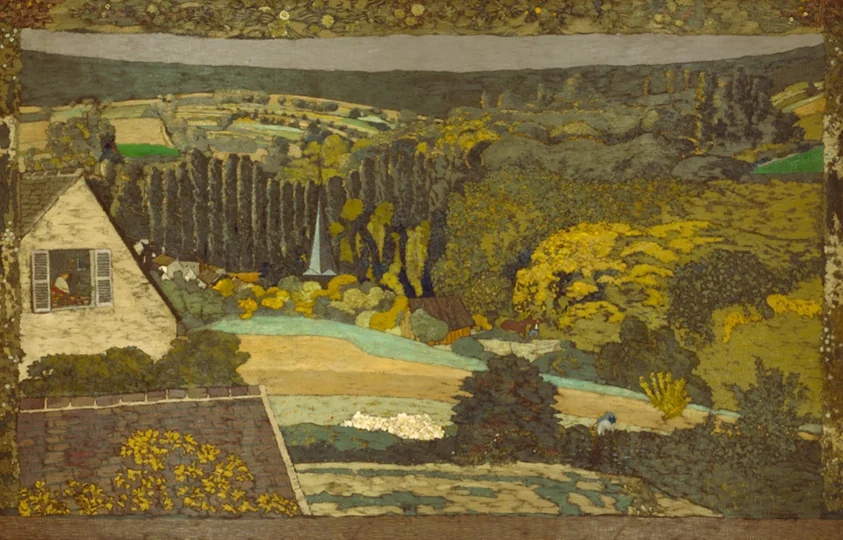
Edouard Vuillards Landscape: Window Overlooking the Woods from 1899 exemplifies the artists distinctive practice of painting interior scenes in which the window becomes both a framing device and a compositional axis connecting the domestic interior with the landscape beyond. Vuillard, the most intimate of the Nabi painters, spent his career depicting the rooms, fabrics, and daily rituals of middle-class Parisian domestic life, but in this work the interior is reduced to a narrow strip along the bottom of the canvas, while the landscape visible through the window fills the majority of the picture plane. The effect is characteristic of Vuillards visual philosophy: the landscape is not a separate, external reality but something that is always experienced from within a particular domestic context, framed by window mouldings and filtered through the patterns and colors of the room. The paint surface is built up in Vuillards signature manner, with layers of stippled and hatched color that create a dense, tapestry-like surface where every square inch contains equal attention, refusing the traditional hierarchy of figure over ground or center over edge. The year 1899 places this work at the height of Vuillards Nabi period, when his commitment to flat pattern and decorative unity was at its most radical, before the influence of Impressionism softened his technique in the following decade.
Cultural Impact
Vuillards window paintings represent a fundamental contribution to the history of depicting interior and exterior space simultaneously, influencing Bonnard, Matisse, and the entire tradition of paintings that refuse the boundary between domestic and landscape space. His insistence on the equal significance of every part of the canvas anticipated Abstract Expressionisms all-over composition.
Why It Matters
A quintessential Nabi painting by Vuillard in which a window overlooking the woods dissolves the boundary between interior and landscape, using stippled paint and flattened perspective to create a tapestry-like surface where pattern and observation are indistinguishable.


