Description
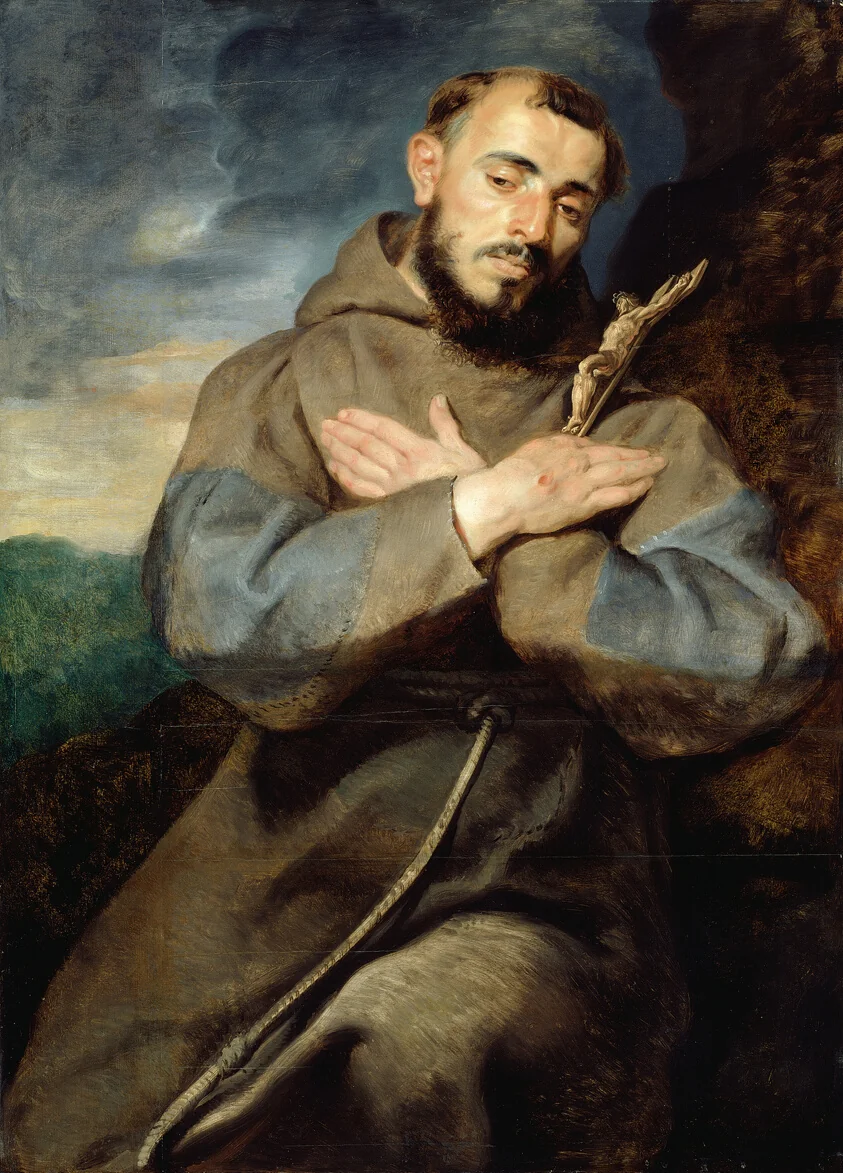
The Franciscans were among the reformed religious orders whose preaching and teaching activities helped revive the Roman Catholic Church in the Southern Netherlands following years of religious and political turmoil in the 1500s. Peter Paul Rubens here depicted the order’s founder, Saint Francis of Assisi, recognizable by the wound that imitates the pierced hands of the crucified Jesus. In this portrait-like image, which was likely made on commission, Rubens conveyed the saint’s spirituality through his meditative gaze and posture.
Accession Number
100342
Medium
Oil on panel
Dimensions
99 × 78.8 cm (43 1/4 × 31 in.); Framed: 148 × 118.8 × 7.6 cm (58 1/4 × 46 3/4 × 3 in.)
Classification
Painting
Credit Line
George F. Harding Collection
Background & Context
Background Story
This portrait of Saint Francis of Assisi, painted around 1615, captures the ecstatic devotion that made the Umbrian saint the most popular religious figure of the Counter-Reformation and the perfect subject for Rubens's sensual spirituality. The panel shows Francis in half-length, his face upturned toward a heavenly vision that remains invisible to the viewer, his hands emerging from the Franciscan habit to receive the stigmata or perhaps to bless. The expression is one of rapturous surrender, the eyes half-closed and the mouth slightly open, rendered with the anatomical precision that Rubens had learned from his study of antique sculpture and live model drawing. The palette is warm and earthy—browns and ochres for the habit, golden light on the face, a dark green landscape glimpsed in the background—that aligns the saint with the natural world he had famously embraced. The painting also reflects the broader Catholic rehabilitation of Francis in the seventeenth century: after the Protestant critique of monasticism, the Franciscans became central to the Catholic narrative of reform and renewal. Rubens's treatment avoids the grotesque asceticism of some medieval Franciscan images, presenting instead a robust, almost handsome saint whose physical vitality testifies to the health of the faith he represents. The panel's provenance is notable: it probably belonged to a private collector in Antwerp or Brussels, used for personal meditation rather than public worship. This intimacy is reflected in the scale and the directness of the saint's gaze, which seems to address the viewer individually rather than collectively.
Cultural Impact
This panel contributed to the Counter-Reformation rehabilitation of Saint Francis, replacing medieval ascetic grotesque with Rubensian physical vitality and sensual spiritual warmth.
Why It Matters
It matters because Rubens made Saint Francis beautiful—proving that ecstasy could look healthy, and holiness could have muscles.