Foliage—Oak Tree and Fruit Seller

Description

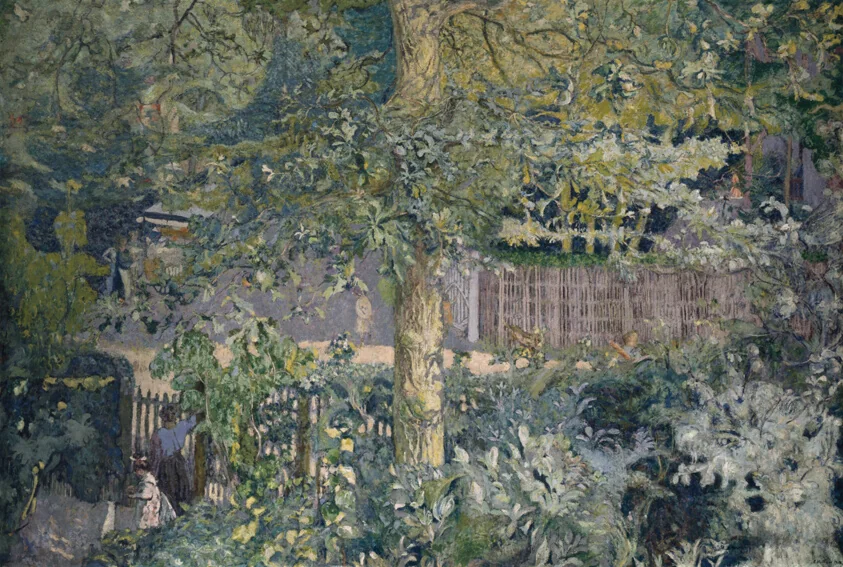
Lush vegetation dominates this view from a window of Edouard Vuillard’s summer residence outside Paris, with the sturdy trunk of an oak tree bisecting the scene. Instead of oil paint Vuillard used distemper, a mix of dry pigment and melted glue. With this medium he created a textured surface with myriad nuanced colors to evoke a tapestry-like wall decoration.

Vuillard belonged to the generation of artists after the Impressionists, known broadly as Post-Impressionists. Impressionism’s continued influence can be seen here in the loose brushstrokes, the use of color to evoke light and atmosphere, and the subject of women and children in a garden.

Provenance

Commissioned from the artist by Georges Bernheim, Paris, 1918; Roger Darnetal, Paris; Daniel Varenne, Geneva; Nathan Cummings, New York, on loan to the US Embassy in Paris from December 1969 to May 1970; on loan to the Federal Reserve Board, Washington D.C., from 11May 1972 to 12 August 1981; Sara Lee Corporation, Chicago, 1981; Millennium Gift of the Sara Lee Corporation to the Art Institute of Chicago, 1999.

Foliage—Oak Tree and Fruit Seller

Édouard Jean Vuillard

1918

Accession Number

153705

Medium

Distemper on canvas

Dimensions

193 × 283.2 cm (76 × 111 1/2 in.); Framed: 205.8 × 294.7 cm (81 × 116 in.)

Classification

Painting

Museum

The Art Institute of Chicago

Chicago, United States

Credit Line

A Millennium Gift of Sara Lee Corporation

Background & Context

Background Story

Édouard Vuillard's "Foliage—Oak Tree and Fruit Seller" (1918) is a distemper on canvas that combines Vuillard's lifelong interests in landscape, foliage, and the human figure. Distemper—a painting medium using pigment mixed with a water-soluble binder such as glue or egg—was a technique Vuillard favored for its matte finish and its ability to create the soft, muted effects he loved. This painting shows an oak tree with dense foliage, with a fruit seller and perhaps a customer beneath its spreading branches. The composition is organized around the massive trunk and canopy of the oak, which dominates the upper portion of the canvas while the human activity takes place below. By 1918, Vuillard had developed the fully mature style for which he is known: the forms are flattened, the patterns are emphasized, the colors are subdued and harmonious. The distemper medium creates a surface that seems to absorb rather than reflect light, giving the painting a distinctive, velvety quality. This work was created during the final year of World War I, and there is a sense of peaceful, everyday life continuing beneath the shelter of the ancient tree.

Cultural Impact

Vuillard's late landscapes demonstrate his ability to synthesize the lessons of Impressionism and Nabi symbolism into a personal style of extraordinary refinement and sensitivity.

Why It Matters

This painting of an oak tree and fruit seller captures the peace of everyday life beneath the shelter of a great tree, the distemper medium creating a soft, luminous surface that seems to glow with its own inner light.