The Girl by the Window

Description

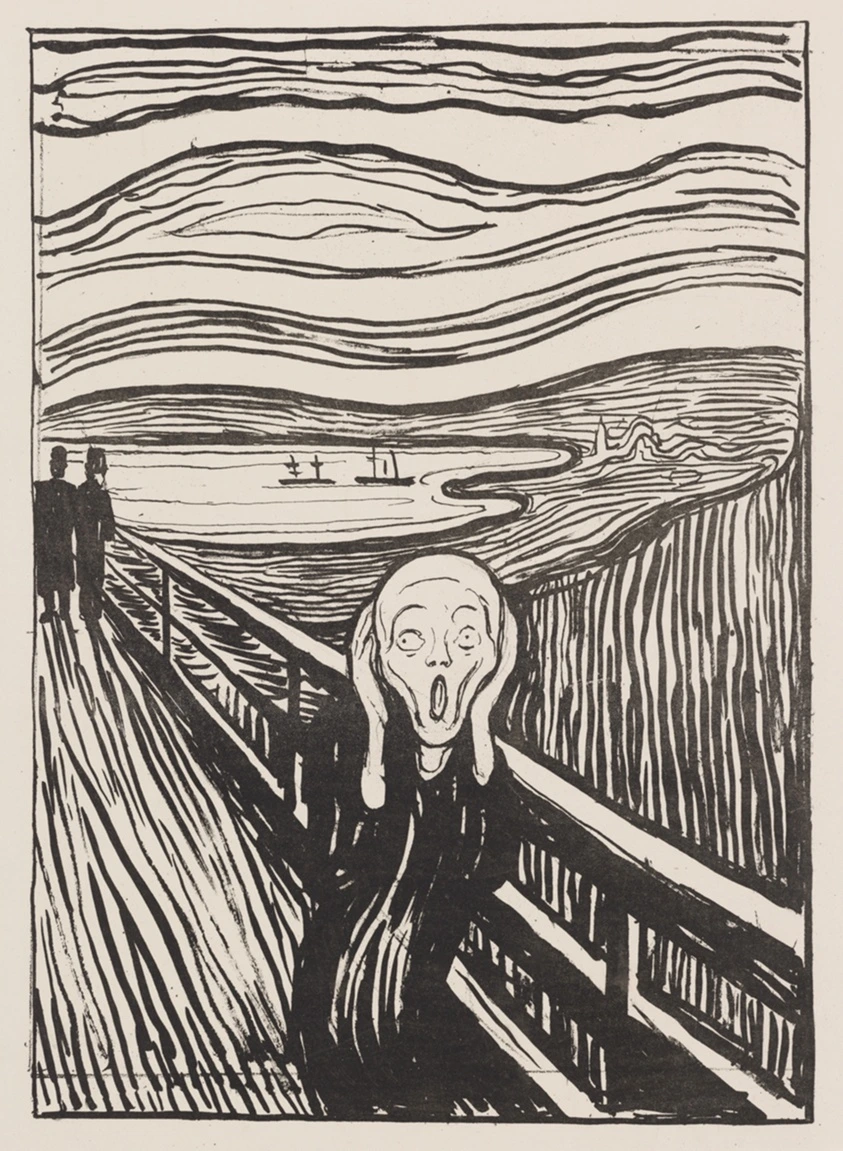
Edvard Munch’s life and art — particularly his iconic work The Scream (1893; National Museum, Oslo) — have come to epitomize modern notions of anxiety. Yet the same year he painted his radical image, Munch was experimenting with other styles and themes. Frequent visits to Paris and Berlin between 1889 and 1893 brought the Norwegian artist into direct contact with the Impressionists and Symbolists. These travels encouraged him to adopt their bold brushwork, daring compositions, and imagery. But he nonetheless continued to incorporate the Romantic subjects of the northern European artists long familiar to him, such as a lone figure at an open window. This combination is powerfully manifested in The Girl by the Window, made soon after his return home to Norway.

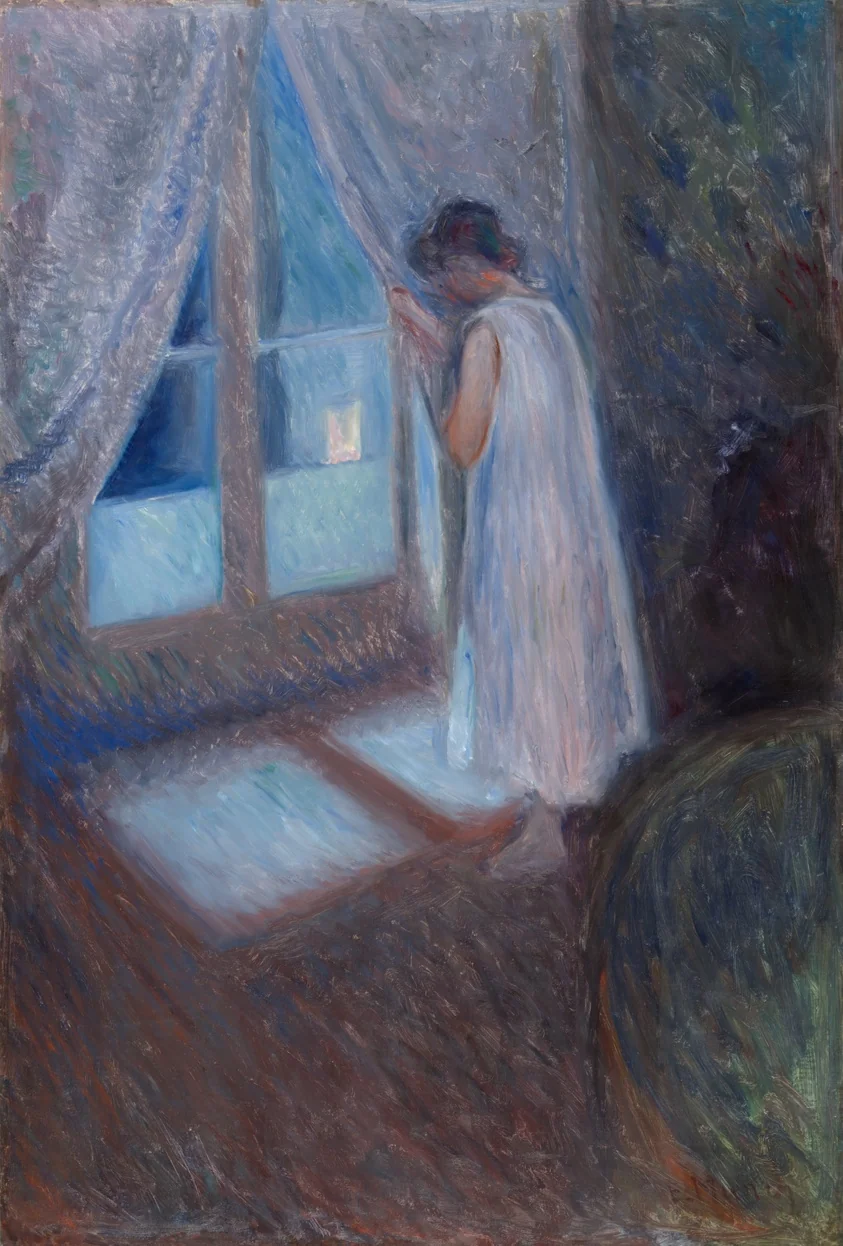
In the dead of night, a young girl in her nightgown stands in a darkened room gazing out at the city. The steep angle of the floor and the deep shadows that obliterate everything in the room, save a suggestion of a piece of furniture at the lower right, create an unsettling and enigmatic scene. Loosely applied, somber brown tones mingle with violets and blues, evoking a feeling of melancholy and anticipation. The window functions as a symbolic barrier, separating the interior from the outside world. The sense of mystery is deepened and complicated by the fact that we cannot see the expression on the girl’s face, nor do we know what she covertly observes. She in turn appears unaware that, as she gazes from behind the curtain at something unknown outside, the artist and implied viewer are watching her.

Provenance

Arthur von Franquet (died 1931), Braunschweig, from 1893 [acquired directly from the artist; see correspondence in Munch Museum archives, Oslo]; by descent to his nephew Herbert von Franquet, 1931. Sold to Neue Galerie, Vienna, 25 September 1935 [letter from Otto Kallir Nirenstein, Neue Galerie, to Edvard Munch, 26 September 1935, in Munch Museum archives, in which he states that he bought the picture the previous day and it "stammt aus der Sammlung Franquet," copy in curatorial file]. Harald Hort Halvorsen, Oslo, 1937 [bought in Paris in 1937 according to Halvorsen 1952]; sold by him to Pål Kavli, Oslo, c. 1937; by descent to Kavli’s second wife, Reidun Kavli (died 1996) [see correspondence and notes in curatorial file]; sold to Mr. Allan Andersen, Denmark; Luc Bellier, Paris as agent for Allan Andersen; sold to the Art Institute, 2000.

The Girl by the Window

Edvard Munch

1893

Accession Number

154235

Medium

Oil on canvas

Dimensions

96.5 × 65.4 cm (38 × 25 3/4 in.); Framed: 110.5 × 79.4 × 8.9 cm (43 1/2 × 31 1/4 × 3 1/2 in.)

Classification

oil on canvas

Museum

The Art Institute of Chicago

Chicago, United States

Credit Line

Searle Family Trust and Goldabelle McComb Finn endowments; Charles H. and Mary F.S. Worcester Collection
Background & Context

Background Story

Edvard Munch's "The Girl by the Window" (1893) is an oil on canvas that captures the quintessential Munch theme of young womanhood poised between innocence and knowledge, interior and exterior worlds. Munch (1863–1944) was the pioneer of Expressionism, and his paintings of the 1890s, including "The Scream," set the course for modern art. This painting shows a young girl standing by a window, her figure silhouetted against the light from outside. The window, a recurring motif in Munch's work, represents both the boundary between the domestic interior and the outside world and the threshold between different states of being. The girl's posture is tentative, her face turned toward the light, perhaps yearning for what lies beyond the window. The palette is muted, with the light from the window providing the main source of illumination. The brushwork is expressive, the paint applied in strokes that convey emotional intensity rather than naturalistic description. Painted in 1893, the same year as "The Scream," this work shows Munch exploring the psychological depths of everyday life with the same intensity he brought to his more famous compositions.

Cultural Impact

Munch's paintings of young women at windows are among the most psychologically powerful works of the Symbolist and Expressionist movements, capturing the transition from childhood to adulthood as a moment of existential significance.

Why It Matters

This painting of a girl by a window captures Munch's ability to invest an ordinary domestic scene with profound psychological resonance, the light from the window becoming a symbol of yearning and the threshold between worlds.