Accession Number
184354
Medium
Charcoal, with graphite and pastel, on yellow paper
Dimensions
48.2 × 48.2 cm (19 × 19 in.)
Classification
charcoal
Credit Line
Margaret Fisher Endowment
Background & Context
Background Story
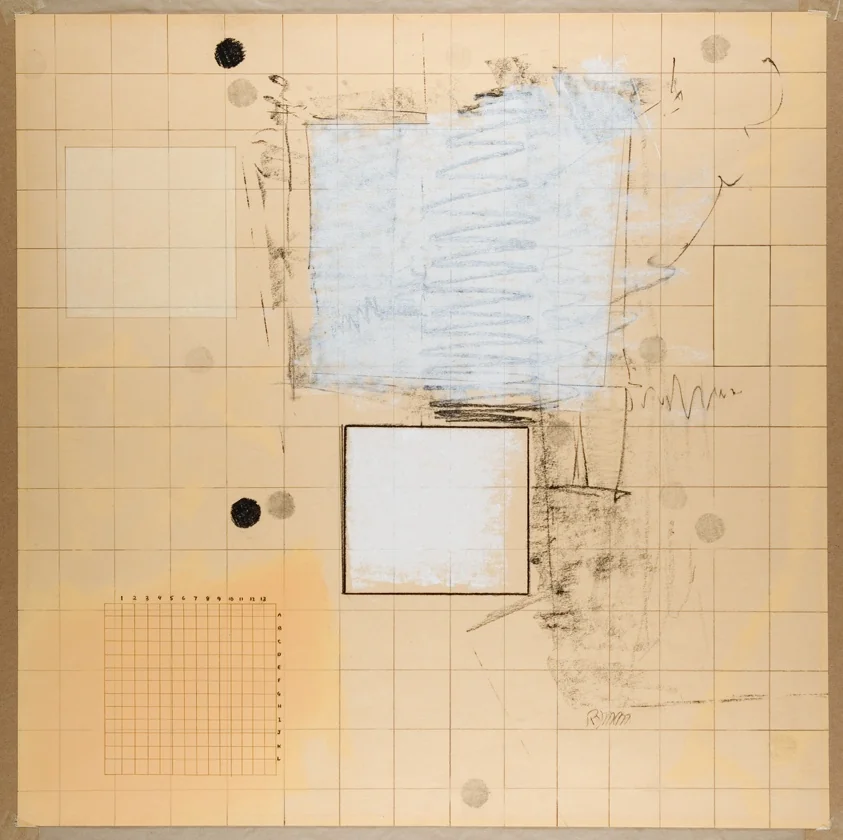
"Drawing with Numbers" is a c. 1963 charcoal drawing by Robert Ryman that represents an early stage in the American Minimalist's systematic exploration of mark-making, the title suggesting both the mathematical precision that Ryman brought to his work and the serial, repetitive quality of the strokes that cover the yellow paper support. The composition is a square field of charcoal marks, the strokes applied in a regular pattern that creates a subtle texture of tone and surface, the graphite and pastel additions providing slight variations that prevent the image from becoming merely mechanical. The yellow paper is significant: Ryman rarely used colored supports in his mature work, and this early drawing demonstrates his willingness to experiment with the ground as a variable in the painting process, the yellow creating a warmth that contrasts with the cool greys of the charcoal. The c. 1963 date places this work in the period of Ryman's first major exhibitions and his emergence as a significant figure in the New York art world, the drawing demonstrating both his technical precision and his conceptual ambition. Art historians have connected this drawing to the broader tradition of grid and serial art, from the modular compositions of Agnes Martin to the systematic drawings of Sol LeWitt, noting that Ryman's treatment is more focused on the material qualities of the mark than the geometric structure of these contemporaries. The work also anticipates Ryman's later white paintings: the same interest in surface texture, light reflection, and the reduction of painting to its essential components is already visible in this early charcoal study.
Cultural Impact
This c. 1963 charcoal grid explored mark-making seriality on yellow support warmth, using graphite-pastel variation to anticipate mature white-painting surface-texture obsession through early systematic experimentation.
Why It Matters
It matters because Ryman drew numbers in charcoal and made the yellow paper feel like it was keeping score—proving that even a grid could have warmth if the ground was willing.


