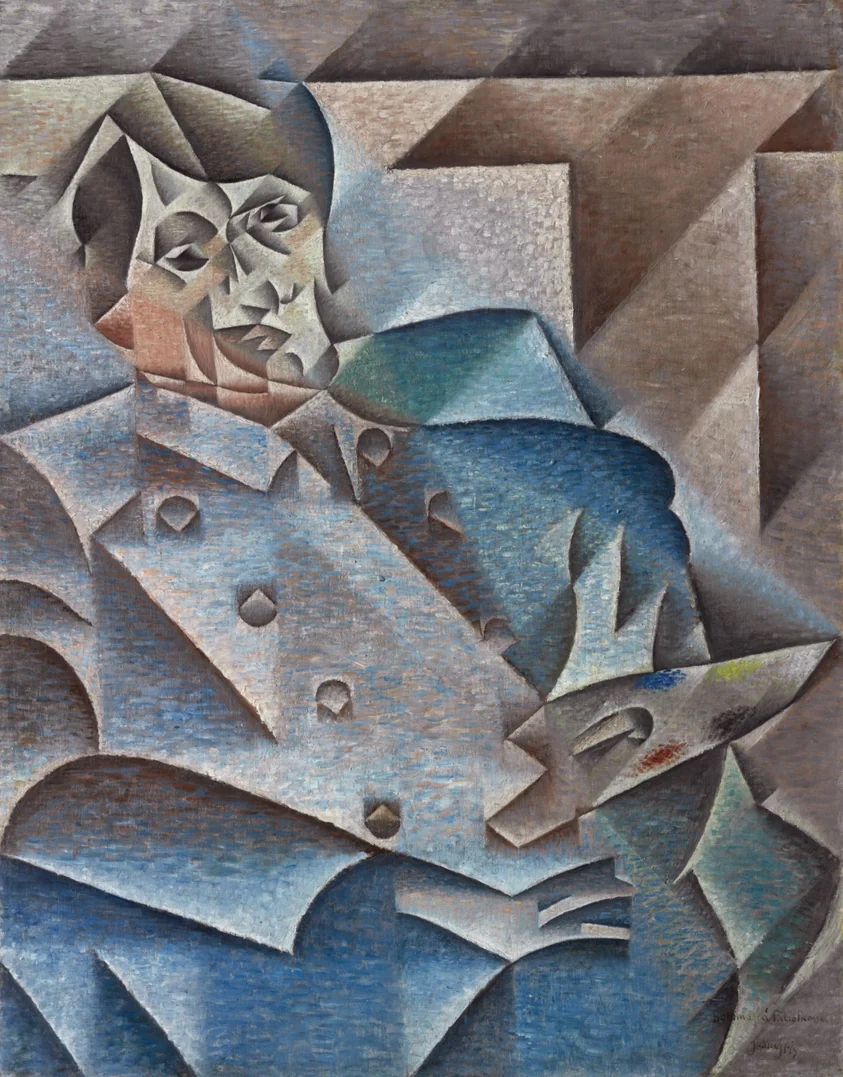
Portrait of Pablo Picasso

Description

In 1906 Juan Gris traveled to Paris, where he met Pablo Picasso and Georges Braque and participated in the development of Cubism. Just six years later, Gris too was known as a Cubist and identified by at least one critic as "Picasso’s disciple." Gris’s style draws upon Analytic Cubism—with its deconstruction and simultaneous viewpoint of objects—but is distinguished by a more systematic geometry and crystalline structure. Here he fractured his sitter’s head, neck, and torso into various planes and simple, geometric shapes but organized them within a regulated, compositional structure of diagonals. The artist further ordered the composition of this portrait by limiting his palette to cool blue, brown, and gray tones that, in juxtaposition, appear luminous and produce a gentle undulating rhythm across the surface of the painting.
Gris depicted Picasso as a painter, palette in hand. The inscription, "Hommage à Pablo Picasso," at the bottom right of the painting demonstrates Gris’s respect for Picasso as a leader of the artistic circles of Paris and as an innovator of Cubism. At the same time, the inscription helped Gris solidify his own place within the Paris art world when he exhibited the portrait at the Salon des Indépendants in the spring of 1912.

Provenance

Daniel-Henry Kahnweiler (1884–1979), Paris. Sold, Hôtel Drouot, Paris, June 13–14, 1921, Kahnweiler sequestration sale, lot 49, to “Grassat” for Galerie Simon [letters from Kahnweiler, October 21, 1975, and December 2, 1975; copy in curatorial object file]. With Etienne Bignou (1891–1950), Paris, and Bignou Gallery, New York, by April 1933 (possibly as early as June 1930) to at least April 1946 [Zurich 1933 and Paris 1930; letters to Bignou from Alex Reid and Lefevre, March 22 and April 18, 1946]. Galerie Louise Leiris, Paris, by February 1948 [Basel 1948]; sold to Buchholz Gallery, New York, by 1949 [New York 1949; letter from Kahnweiler, December 2, 1975; copy in curatorial object file]; sold to Jacques Seligmann and Co., New York, by 1949 [letter from Jacques Seligmann to Curt Valentin, Mar. 18, 1949, and letter from Jane Wade to Seligmann, Apr. 5, 1949, Seligmann Papers, Archives of American Art, Smithsonian Institution, Washington, D.C.]; sold to Leigh Block, Chicago, June 1949 [Block Collection Card in curatorial object file]; given to the Art Institute of Chicago, 1958.

Portrait of Pablo Picasso

Juan Gris

January–February 1912

Accession Number

8624

Medium

Oil on canvas

Dimensions

93.3 × 74.4 cm (36 3/4 × 29 5/16 in.)

Classification

oil on canvas

Museum

The Art Institute of Chicago

Chicago, United States

Credit Line

Gift of Leigh B. Block

Background & Context

Background Story

Juan Gris's Portrait of Pablo Picasso (January-February 1912) is an oil on canvas that depicts the artist who, with Braque, founded Cubism. Gris's portrait of Picasso is one of the most famous works of early Cubism, a tribute from one Spanish artist to another. The painting shows Picasso in the characteristic style of Analytic Cubism: the features are broken down and reassembled, the face is fragmented into planes, the space is flattened and ambiguous. The palette is limited to the muted browns, grays, and blues typical of the Analytic Cubist period. Despite the fragmentation, Picasso's features are recognizable, and the portrait captures something of his character and presence. This painting was executed in the early months of 1912, at the height of the Cubist revolution, and it represents Gris's participation in the most advanced artistic movement of the time. The portrait of Picasso is both a personal tribute and a manifesto of Cubist principles, demonstrating the movement's ability to transform even the most traditional genre of portraiture into something radically new.

Cultural Impact

Gris's portrait of Picasso is one of the most famous Cubist portraits, capturing the founder of the movement in the style he had helped to create.

Why It Matters

This Cubist portrait of Picasso transforms the traditional genre of portraiture through the revolutionary techniques of Analytic Cubism, the fragmented planes and muted palette creating a complex image that captures both the appearance and the essence of the subject.